
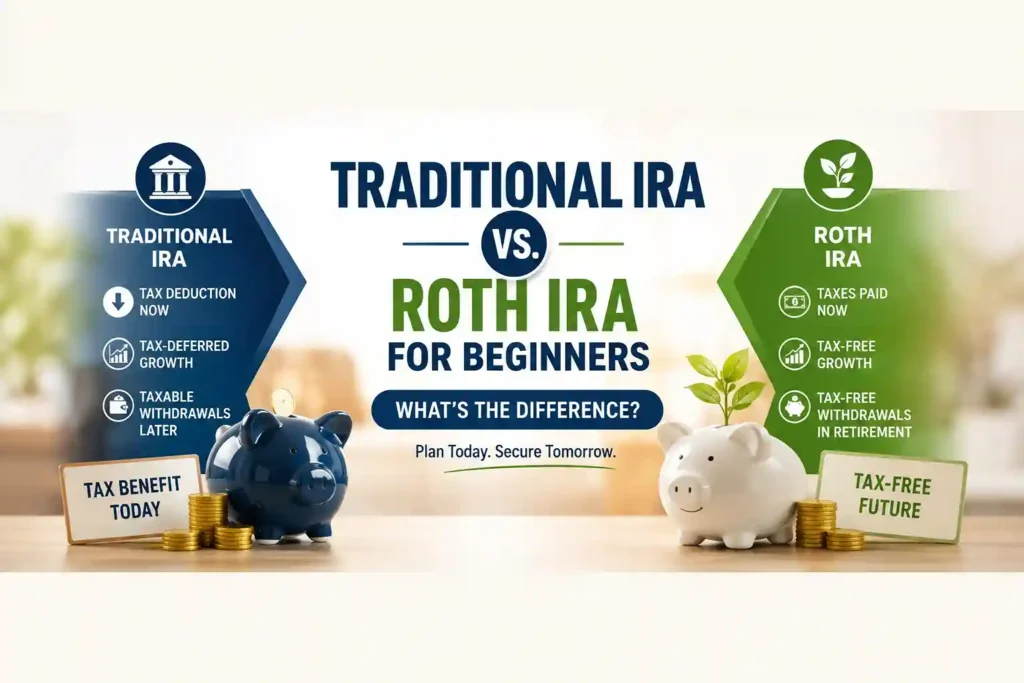
Traditional IRA vs. Roth IRA for Beginners: What’s the Difference?
Traditional IRA vs. Roth IRA for Beginners: What’s the Difference?
Planning for retirement can seem complicated when you first encounter terms like Traditional IRA, Roth IRA, tax deductions, tax-deferred growth, and qualified withdrawals. But the basic idea is easier than it sounds.
A Traditional IRA and a Roth IRA are both individual retirement accounts designed to help you save and invest for the future. The biggest difference is how and when the money is taxed.
With a Traditional IRA, you may be able to receive a tax deduction for eligible contributions today, while withdrawals are generally taxable later. With a Roth IRA, you contribute money that has already been taxed, but qualified withdrawals can generally be tax-free.
So, which one should you choose?
There isn’t a single answer that works for everyone. Your income, current tax bracket, expected retirement income, eligibility, and long-term goals all matter.
Let’s look at the differences in simple terms.
What Is a Traditional IRA?
A Traditional IRA is an individual retirement account that allows eligible individuals to save and invest for retirement while receiving certain tax advantages.
One of its most important features is the possibility of a tax deduction for contributions.
Whether your contribution is deductible depends on factors such as your income, tax-filing status, and whether you or your spouse participates in a workplace retirement plan.
Money inside a Traditional IRA can generally grow tax-deferred. In other words, you generally don’t pay federal income tax each year on investment earnings inside the account simply because those investments increased in value.
Taxes generally become due when you take taxable distributions.
For example, suppose you contribute money to a Traditional IRA and invest it for many years. If the investments grow, you generally aren’t paying annual federal income tax on those unrealized gains inside the IRA. When you eventually take taxable distributions, the withdrawals are generally included in taxable income.
In simple terms:
Traditional IRA = Potential tax benefit today + generally taxable withdrawals later
That tax structure can be attractive to people who want to reduce their current taxable income when eligible and are comfortable paying taxes during retirement.
What Is a Roth IRA?
A Roth IRA is another type of individual retirement account, but its tax treatment is almost the reverse of a Traditional IRA.
You contribute money that has already been taxed. Generally, you don’t receive a federal income-tax deduction for making a Roth IRA contribution.
The potential benefit comes later.
If you meet the applicable requirements for a qualified distribution, you can generally withdraw money from a Roth IRA without owing federal income tax on the qualified withdrawal.
That can make a Roth IRA especially appealing to people who believe they may face higher income or higher tax rates in the future.
For example, a young worker may currently be in a relatively modest tax bracket but expect income to increase over the course of a career. Paying taxes on contributions today and potentially taking qualified withdrawals tax-free later may be attractive.
In simple terms:
Roth IRA = Taxes paid before contribution + potentially tax-free qualified withdrawals later
However, Roth IRA contributions are subject to annual limits and income-based eligibility rules. Those rules can change, so always verify current requirements before contributing.
Traditional IRA vs. Roth IRA: Key Differences
The easiest way to understand these accounts is to compare their major features.
| Feature | Traditional IRA | Roth IRA |
| Contributions | Generally after-tax money; eligible contributions may be deductible | After-tax money |
| Current federal tax deduction | May be available depending on circumstances | Generally not available |
| Investment growth | Generally tax-deferred | Potentially tax-free |
| Qualified retirement withdrawals | Generally taxable | Generally tax-free |
| Income restrictions | Income can affect deductibility in some situations | Income can affect eligibility for direct contributions |
| Early withdrawals | Taxes and potential additional tax may apply unless an exception applies | Rules differ for contributions and earnings |
| Lifetime RMDs for original owner | Generally subject to applicable RMD rules | Generally no lifetime RMDs for the original owner under current federal law |
| Employer required? | No | No |
| Employer match | No | No |
The table gives you the basic picture, but retirement tax rules can be more complicated in practice.
Contribution limits, income thresholds, deduction rules, withdrawal requirements, and other regulations can change. Check current IRS guidance for the tax year in which you’re contributing.
The Biggest Difference: When Do You Pay Taxes?
If you remember only one thing from this article, remember this:
Traditional IRA: You may receive a tax benefit now, and generally pay taxes when you take taxable withdrawals later.
Roth IRA: You generally receive no current federal income-tax deduction, but qualified withdrawals can generally be tax-free later.
Consider a simple hypothetical example.
Suppose you have $6,000 available for retirement savings.
If you make an eligible Traditional IRA contribution, you may be able to deduct some or all of that contribution from taxable income, depending on your circumstances.
If you contribute $6,000 to a Roth IRA, you generally don’t receive a current federal income-tax deduction.
The tradeoff is that qualified Roth IRA withdrawals can generally be tax-free.
So the fundamental question becomes:
Would you rather potentially receive a tax benefit today or potentially receive tax-free qualified withdrawals in retirement?
Of course, your actual tax situation is more complicated than this simple example. But understanding the timing of taxation makes the rest of the comparison much easier.
Traditional IRA vs. Roth IRA: Which Is Better for Taxes?
There’s no universal winner.
The better tax structure can depend on your current tax bracket and what you reasonably expect your financial situation to look like later in life.
A Traditional IRA may be attractive if you:
- Want a potential tax deduction today.
- Are currently in a relatively high tax bracket.
- Expect your taxable income to be lower during retirement.
- Want to defer taxation on retirement savings.
- Are eligible for a deductible contribution.
Imagine you’re currently earning a relatively high income and are in a higher marginal tax bracket. If you’re eligible for a Traditional IRA deduction, reducing taxable income today may be valuable.
A Roth IRA may be attractive if you:
- Are currently in a relatively low tax bracket.
- Expect your income to increase over time.
- Expect to be in a higher tax bracket in retirement.
- Want the potential for tax-free qualified withdrawals.
- Value the fact that the original owner generally doesn’t have lifetime RMDs under current federal rules.
No one knows exactly what tax laws, tax rates, or personal income will look like decades from now.
That’s one reason some retirement savers value having different types of tax-advantaged accounts.
Roth IRA vs. Traditional IRA for Young Workers
If you’re early in your career, the Roth IRA can be particularly interesting.
Why?
Your current income may be lower than what you expect to earn later.
Suppose you’re 25 and beginning your career. You expect your salary to rise as you gain experience, change jobs, or take on more responsibility.
You may be paying taxes at a relatively modest rate today compared with what you might face later.
With a Roth IRA, you pay the applicable taxes before contributing. If the account remains invested for decades and you meet the requirements for qualified distributions, your retirement withdrawals can generally be tax-free.
Time can also be an important factor.
A retirement contribution made early in your career may have decades to potentially compound before you need the money.
That doesn’t mean a Roth IRA is automatically the right choice for every young worker. A Traditional IRA may still make sense depending on income, deductibility, tax rates, and other financial priorities.
The bigger lesson is this:
Don’t let uncertainty about the perfect retirement account stop you from starting to save.
When a Traditional IRA May Make More Sense
A Traditional IRA can be useful in several situations.
- You want a potential tax deduction
Eligible contributions may reduce your taxable income.
However, don’t assume every Traditional IRA contribution is automatically deductible. Your income, filing status, and workplace retirement-plan coverage can affect deductibility.
- You’re currently in a higher tax bracket
If you’re paying a relatively high marginal tax rate today, a current deduction may be valuable.
The value of a tax deduction depends on your circumstances, but the basic idea is straightforward: you may prefer receiving a tax benefit when your current tax rate is relatively high.
- You expect a lower tax rate in retirement
If your taxable income is expected to be lower after you stop working, you may prefer the Traditional IRA’s tax-deferred structure.
You generally receive the tax benefit earlier and pay taxes later when taking taxable distributions.
- You want tax-deferred retirement savings
A Traditional IRA allows investments to potentially compound without you generally paying annual federal income tax on investment gains inside the account.
Taxes generally come into the picture when taxable distributions are taken.
When a Roth IRA May Make More Sense
A Roth IRA can also be appealing for several reasons.
- You expect your income to rise
If you’re currently in a lower tax bracket but expect your earnings to increase significantly, paying taxes on contributions now may be attractive.
- You want potentially tax-free qualified withdrawals
This is one of the most important advantages of a Roth IRA.
When applicable requirements are met, qualified withdrawals can generally be made without federal income tax.
- You want more retirement tax flexibility
Having Roth money available can give you another source of funds that may be tax-free when withdrawn under the applicable rules.
That can be useful when managing taxable income during retirement.
- You value the absence of lifetime RMDs for the original owner
Under current federal rules, the original owner of a Roth IRA generally isn’t required to take lifetime RMDs.
Traditional IRAs generally have RMD requirements beginning at the applicable age.
This difference can matter for people who want greater control over when they withdraw money from retirement accounts.
Traditional IRA vs. Roth IRA Contribution Limits
Both Traditional and Roth IRAs have annual contribution limits.
One important point beginners sometimes miss is that you don’t generally get a completely separate full contribution limit for each account.
If you contribute to both a Traditional IRA and a Roth IRA during the same year, your contributions generally count toward the applicable combined IRA contribution limit.
For example, you can’t simply assume that you can contribute the full annual IRA limit to a Traditional IRA and then another full annual limit to a Roth IRA.
Roth IRA contributions also have income-based eligibility rules.
Traditional IRA contributions don’t have the same direct-contribution income restriction, but the ability to deduct those contributions can be affected by income and workplace retirement-plan coverage.
Because IRS limits and thresholds can change, check the current rules for the relevant tax year before contributing.
Can You Have Both a Traditional IRA and Roth IRA?
Yes, you can generally have both.
In fact, having both may be useful for some retirement savers.
Why?
Because the two accounts can provide different types of tax treatment.
For example, you might have:
- Traditional IRA money that received a tax deduction when eligible and is generally taxable when withdrawn.
- Roth IRA money contributed after taxes that may be withdrawn tax-free when the applicable qualified-distribution requirements are met.
This can create tax diversification.
Instead of having all your retirement savings subject to the same tax treatment, you may have different sources of retirement income available.
However, having both accounts doesn’t mean you can contribute the maximum amount separately to each one. The annual IRA contribution limit generally applies collectively to contributions across your Traditional and Roth IRAs.
Your eligibility and circumstances should be considered before deciding how to divide contributions.
Traditional IRA vs. Roth IRA: What About Withdrawals?
Withdrawals are another important difference.
Traditional IRA withdrawals
Money withdrawn from a Traditional IRA is generally included in taxable income.
If you withdraw money before the applicable retirement age, an additional tax may apply unless you qualify for an exception.
This means a Traditional IRA generally shouldn’t be viewed as a short-term savings account.
It’s designed primarily for retirement.
Roth IRA withdrawals
Roth IRA withdrawal rules work differently.
One reason the Roth IRA can be attractive is that contributions and investment earnings aren’t treated exactly the same way for withdrawal purposes.
Under the applicable rules, qualified distributions can generally be tax-free.
But don’t make the mistake of assuming that every withdrawal from a Roth IRA is automatically tax-free.
The tax treatment can depend on factors such as whether you’re withdrawing contributions or earnings and whether the distribution meets the requirements for being qualified.
If you’re considering an early withdrawal, understand the applicable rules before taking the money out.
Required Minimum Distributions: Traditional vs. Roth
Required minimum distributions, often called RMDs, are another important distinction.
Traditional IRAs are generally subject to RMD rules under current federal law. Once you reach the applicable age, you generally must begin taking required distributions according to the rules.
Those distributions can affect taxable income.
The original owner of a Roth IRA generally doesn’t have lifetime RMDs under current federal law.
This can provide additional flexibility.
For example, a retiree may prefer not to withdraw money from a Roth IRA in a particular year because they don’t need it. Under current rules, the original owner generally isn’t forced to take lifetime RMDs from that Roth IRA.
However, inherited IRAs can be subject to different rules.
If you’re inheriting a retirement account, don’t assume the rules are identical to those that apply to the original account owner.
Common Mistakes Beginners Should Avoid
Choosing between a Traditional IRA and Roth IRA becomes easier when you know what mistakes to avoid.
Mistake #1: Assuming Roth is always better
Roth accounts have attractive benefits, but that doesn’t make them automatically superior.
Your current tax bracket and expected future tax situation matter.
Mistake #2: Assuming Traditional IRA contributions are always deductible
They aren’t necessarily.
Deductibility can depend on your income, filing status, and whether you or your spouse is covered by a workplace retirement plan.
Mistake #3: Ignoring Roth IRA income rules
High-income taxpayers may face restrictions on making direct Roth IRA contributions.
Always check the current income thresholds.
Mistake #4: Confusing contribution limits
Traditional and Roth IRA contributions generally share the same annual IRA contribution limit.
You can’t simply treat them as two completely separate contribution buckets.
Mistake #5: Ignoring investment costs
An IRA is an account—not an investment.
The investments you choose, their fees, diversification, and risk level can significantly affect your long-term results.
Mistake #6: Waiting too long to begin
Some people spend years researching retirement accounts without actually starting.
You don’t need a perfect strategy on day one.
Start with a sensible plan, continue learning, and adjust your strategy as your financial situation changes.
A Simple Decision Framework for Beginners
If you’re still unsure which IRA makes sense, walk through these questions.
Step 1: What is your current tax situation?
Consider your income and marginal tax bracket.
Step 2: What might your future look like?
Do you expect your income to increase significantly?
Step 3: Would a Traditional IRA contribution be deductible?
Check the current rules based on your income, filing status, and workplace retirement-plan coverage.
Step 4: Are you eligible for a direct Roth IRA contribution?
Check the current income thresholds.
Step 5: When would you rather receive the tax benefit?
If you value a potential deduction today, a Traditional IRA may be worth considering.
If you prefer paying taxes now in exchange for potentially tax-free qualified withdrawals later, a Roth IRA may be attractive.
Step 6: Would tax diversification help?
You don’t necessarily have to choose only one.
Using different retirement accounts can potentially provide more flexibility later.
Traditional IRA vs. Roth IRA: Which Should You Choose?
So, which IRA is right for you?
A Traditional IRA may be worth considering if you value a potential tax deduction today, are currently in a relatively high tax bracket, or expect your taxable income to be lower during retirement.
A Roth IRA may be worth considering if you’re currently in a relatively low tax bracket, expect your income to rise, or value the possibility of tax-free qualified withdrawals.
And for some people, both accounts may have a role.
The goal isn’t to pick the account with the most attractive-sounding tax feature. The goal is to build a retirement strategy that works with your income, taxes, investment approach, and long-term goals.
Your retirement plan should also consider other accounts, such as an employer-sponsored 401(k), emergency savings, debt, and taxable investments.
Frequently Asked Questions
Is a Roth IRA better than a Traditional IRA?
Not automatically. A Roth IRA may be attractive when you want potentially tax-free qualified withdrawals, while a Traditional IRA may be valuable when you’re eligible for a current tax deduction. Your tax situation and retirement goals should determine which structure fits better.
Can I have both a Traditional IRA and Roth IRA?
Yes. You can generally have both types of accounts. However, the annual IRA contribution limit generally applies collectively to contributions made to your Traditional and Roth IRAs.
Can I contribute to a Roth IRA if I have a 401(k)?
Having a 401(k) doesn’t automatically prevent you from contributing to a Roth IRA. However, Roth IRA income eligibility rules still apply, and the tax rules can be different depending on your circumstances.
Are Traditional IRA contributions tax-deductible?
They may be. Whether you can deduct your contribution depends on factors including income, filing status, and whether you or your spouse participates in a workplace retirement plan.
Are Roth IRA withdrawals tax-free?
Qualified Roth IRA distributions can generally be tax-free. However, specific requirements apply, and not every Roth IRA withdrawal should automatically be assumed to be tax-free.
Can I lose money in an IRA?
Yes. An IRA is simply a tax-advantaged account that holds investments. Stocks, bonds, mutual funds, ETFs, and other investments can rise or fall in value.
Which IRA is best for beginners?
There is no universal winner. Beginners should consider their current tax situation, expected future income, eligibility, investment choices, fees, retirement timeline, and long-term goals.
Final Thoughts
The difference between a Traditional IRA and Roth IRA ultimately comes down to tax timing.
With a Traditional IRA, eligible contributions may provide a tax deduction today, while taxable withdrawals generally create a tax bill later.
With a Roth IRA, you generally contribute after-tax money today, but qualified withdrawals can generally be tax-free in retirement.
Neither approach is automatically right for everyone.
Your current income, tax bracket, expected future income, retirement goals, and eligibility should all be part of the decision.
And remember, you don’t necessarily have to choose one account forever. Having both Traditional and Roth retirement savings can potentially give you greater tax flexibility later.
Most importantly, don’t let the decision keep you from getting started.
For complete knowledge on wealth building read 10 Proven Ways to Build Wealth From Scratch in America
A consistent retirement-saving habit, combined with a diversified investment strategy and regular reviews of your financial plan, can help put you on a stronger path toward your long-term goals.
This article is for general educational purposes only and does not constitute financial, investment, tax, or legal advice. IRA rules, contribution limits, income thresholds, and tax laws can change. Verify current IRS guidance before making decisions. Consider consulting a qualified financial or tax professional for advice based on your individual circumstances.
