
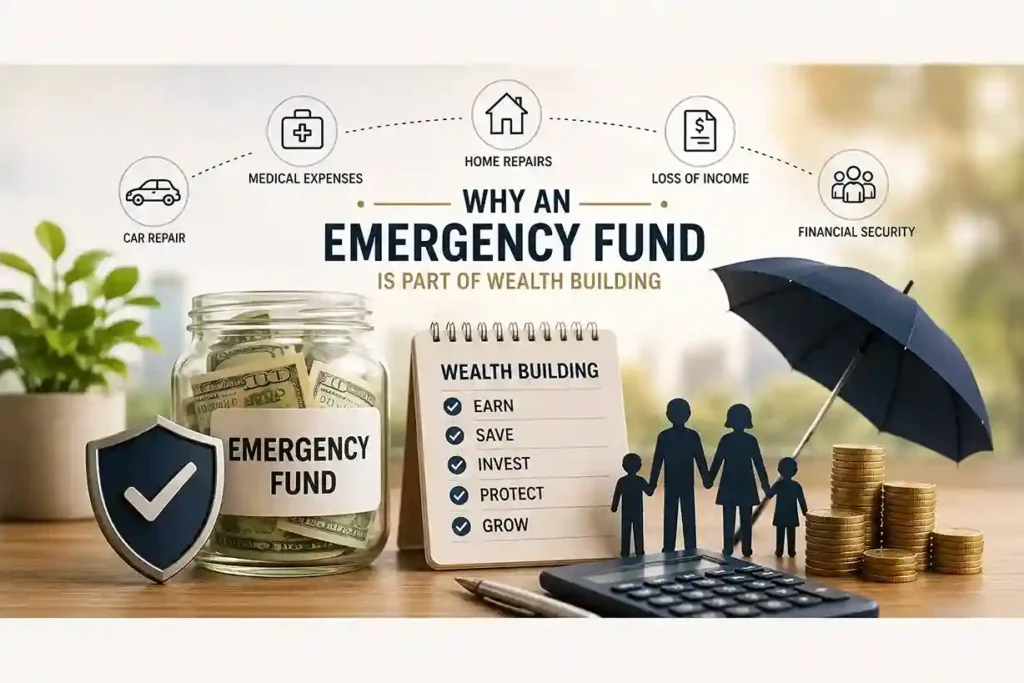
How Emergency Fund Is Part of Wealth Building
How Emergency Fund Is Part of Wealth Building
Imagine that you have finally developed a solid financial routine.
You earn a steady income. You pay your bills on time. You contribute to retirement accounts. You invest regularly. Your savings and investments are gradually growing.
Then something unexpected happens.
Your car needs a major repair. You face an unexpected medical expense. Your home requires an urgent repair. Or your income suddenly drops because of a job loss.
If you don’t have accessible savings, you may have to put the expense on a credit card, borrow money, or sell investments to cover the bill.
That single event can interrupt months or years of financial progress.
This is why wealth building is about more than making investments grow. It is also about protecting the progress you have already made.
An emergency fund provides that protection.
The Consumer Financial Protection Bureau describes an emergency fund as a cash reserve specifically set aside for unplanned expenses or financial emergencies, such as car repairs, home repairs, medical bills, or loss of income. The CFPB also notes that even relatively small amounts of emergency savings can provide financial security and help people recover from unexpected expenses.
An emergency fund may not produce the long-term returns associated with stocks or other growth-oriented investments. Its purpose is different.
Investments are designed primarily to help your wealth grow. An emergency fund is designed to help keep an unexpected event from forcing you to destroy that progress.
For deeper information on How Emergency Fund Is Part of Wealth Building see How to Build Wealth in America: The Complete Guide to Growing, Protecting, and Preserving Your Money.
What Is an Emergency Fund?
An emergency fund is money deliberately set aside for unexpected and necessary financial needs.
It should generally be separate from the money you use for everyday spending.
Examples of legitimate emergencies can include:
- An unexpected car repair
- A major home or appliance repair
- An unexpected medical expense
- A temporary loss of income
- An urgent family-related expense
- An essential bill that you could not reasonably anticipate
The Federal Reserve’s 2025 survey of U.S. households found that 59% of adults experienced at least one major unexpected expense during the previous 12 months. Major vehicle repairs or replacements were reported by 30% of adults, while major house or appliance repairs and unexpected major medical expenses were each reported by more than one-fifth of adults.
That illustrates why financial surprises are not unusual events. They are a normal part of life.
An emergency fund exists to absorb some of those surprises.
What Isn’t an Emergency?
An emergency fund generally shouldn’t become a general-purpose spending account.
Examples of planned expenses include:
- Vacations
- Holiday shopping
- New electronics
- Planned vehicle purchases
- Regular insurance premiums
- Routine home maintenance
- Planned entertainment
- Other predictable purchases
These expenses may be important, but they are not necessarily emergencies.
That’s where sinking funds can be useful. A sinking fund is money saved in advance for a known or expected future expense, while an emergency fund is intended for unexpected financial shocks.
Keeping those purposes separate can make it easier to preserve your emergency savings.
Why an Emergency Fund Belongs in a Wealth-Building Strategy
A common definition of wealth building focuses on accumulation.
Earn money.
Save money.
Invest money.
Allow assets to compound.
All of those activities matter.
But there is another side to wealth building:
protecting your financial foundation.
Think of wealth building as having two broad components.
1. Growth
Growth-oriented activities can include:
- Saving and investing
- Retirement contributions
- Diversified investments
- Business ownership
- Real estate
- Other productive assets
2. Protection
Protection can include:
- Emergency savings
- Insurance
- Diversification
- Debt management
- Tax planning
- Appropriate risk management
An emergency fund belongs primarily to the protection side.
It is not intended to replace investments. Instead, it can help prevent short-term financial problems from interfering with long-term investment plans.
That distinction is extremely important.
A person could have a substantial investment portfolio and still be financially vulnerable if they have almost no accessible cash.
Likewise, someone could have a healthy emergency reserve but still need to invest for long-term goals.
Financial strength requires both liquidity and long-term growth.
How Emergencies Can Derail Wealth Building
Consider a hypothetical investor with $20,000 invested in a diversified portfolio and $1,000 in readily available savings.
A $5,000 emergency arrives.
The investor has several choices, none of them ideal:
- Borrow the money
- Put the expense on a credit card
- Sell investments
- Ask family for assistance
- Use another financial resource
If the person sells investments, the problem isn’t simply the amount withdrawn.
The person also gives up the opportunity for that money to remain invested and potentially compound over many years.
If the investments happen to be down when the emergency occurs, the investor may also be forced to sell at an unfavorable time.
On the other hand, if the person borrows money at a high interest rate, future income that could have gone toward saving and investing may instead go toward interest and debt repayment.
The financial chain can look like this:
Unexpected expense → insufficient cash → borrowing or selling investments → higher costs or lost investment opportunity → reduced future savings → slower wealth accumulation
An emergency fund can interrupt that chain.
Emergency Funds Can Help Prevent High-Interest Debt
One of the strongest connections between emergency savings and wealth building is debt prevention.
Suppose a household faces a hypothetical $4,000 emergency and has no cash available.
The household might put the expense on a credit card and carry the balance.
Now the original $4,000 expense has potentially become a much larger financial burden because interest continues to accumulate.
The household may have to redirect part of every future paycheck toward debt repayment.
That creates an opportunity cost.
Money that could have gone toward:
- Retirement contributions
- Investments
- Education savings
- Other financial goals
may instead go toward servicing old debt.
This is why avoiding unnecessary high-interest debt can contribute to wealth building.
The Federal Reserve’s 2025 household survey found that 63% of adults said they could cover a hypothetical $400 emergency using cash, savings, or a credit card that they would pay off at the next statement. That means a substantial share of adults would not have that level of readily available financial flexibility.
The CFPB similarly warns that without savings, even a minor financial shock can set someone back and potentially turn into debt that is difficult to repay.
An emergency fund therefore isn’t merely about having cash.
It can be about avoiding a future financial obligation that works against wealth accumulation.
Emergency Savings Can Protect Your Investments
One of the biggest advantages of an emergency fund is that it can provide liquidity without requiring you to liquidate long-term investments.
Imagine that the stock market has fallen significantly and you suddenly need $8,000.
If your emergency fund contains enough money to cover the expense, your long-term investment portfolio may not need to be touched.
That allows your investments to remain aligned with their intended long-term purpose.
This does not mean selling investments during an emergency is always wrong.
Sometimes it may be necessary.
The problem arises when an investor has no other reasonable source of liquidity and therefore becomes forced to sell long-term assets because of a short-term financial problem.
Emergency savings can reduce the likelihood of that situation.
Emergency Funds Can Help You Stay Invested
Wealth building requires discipline.
Markets rise and fall. Expenses change. Income changes. Unexpected events happen.
Having an emergency reserve can create a financial buffer between those events and your investment portfolio.
Suppose an investor knows that several months of essential expenses are available in a liquid savings account.
A temporary market decline may feel less threatening because the investor doesn’t need to sell investments immediately to pay an unexpected bill.
That psychological separation can be valuable.
An emergency fund doesn’t eliminate market risk.
It doesn’t guarantee investment success.
But it can make it easier to maintain a long-term investment strategy without using the investment portfolio as an everyday emergency account.
In that sense, emergency savings can support behavioral discipline, which is an important but often overlooked part of long-term wealth building.
How Much Should an Emergency Fund Be?
There is no single emergency-fund number that is appropriate for every household.
You will often hear the guideline of three to six months of essential expenses.
That can be a useful starting framework, but it should not be treated as a universal rule.
The appropriate amount depends on your circumstances.
Consider:
- Monthly essential expenses
- Job stability
- Income predictability
- Number of household earners
- Number of dependents
- Insurance coverage
- Debt obligations
- Access to other financial resources
- Whether you are self-employed
- How quickly you could replace lost income
The Federal Reserve’s 2024 household survey found that 55% of adults reported having emergency or rainy-day savings sufficient to cover three months of expenses.
The CFPB also emphasizes that the appropriate amount depends on an individual’s circumstances and that even a small amount can provide some financial security.
A Simple Framework
Instead of asking:
“How much money should everyone have?”
ask:
“How much money would my household reasonably need to withstand a significant financial disruption?”
That produces a more useful answer.
Build an Emergency Fund in Stages
You don’t necessarily have to jump from zero savings to six months of expenses.
A staged approach can make the process more manageable.
Stage 1: Build a Starter Reserve
Start by creating a modest cash buffer for smaller unexpected expenses.
The exact amount depends on your circumstances.
The objective is simply to move from having no emergency savings toward having some financial flexibility.
Stage 2: Strengthen the Reserve
Once the initial buffer is established, continue contributing toward several months of essential expenses if that level makes sense for your household.
Stage 3: Personalize the Target
Consider your income stability and household obligations.
Someone with highly predictable employment and two household incomes may have different needs from a freelancer whose monthly income varies considerably.
Stage 4: Replenish After Use
Using your emergency fund for a genuine emergency is not a failure.
That is what the fund exists for.
Afterward, rebuild the balance.
Where Should You Keep an Emergency Fund?
The priorities for emergency savings are generally:
- Safety
- Liquidity
- Accessibility
- Reasonable interest
An emergency fund should be accessible enough that you can use it when a genuine emergency occurs.
For many U.S. households, an FDIC-insured savings account can be a practical option.
The FDIC states that qualifying deposits at FDIC-insured banks—including savings accounts, checking accounts, money market deposit accounts, and certain certificates of deposit—are insured up to the applicable limits. The standard coverage limit is $250,000 per depositor, per insured bank, per ownership category.
Importantly, FDIC insurance does not cover investments such as stocks, bonds, or mutual funds.
That distinction reinforces the different purposes of cash reserves and investments.
A savings account may not offer the highest possible long-term return, but an emergency fund isn’t primarily designed to maximize investment returns.
It is designed to be available when you need it.
Emergency Fund vs. Investing: Which Comes First?
This question doesn’t have one universal answer.
A person’s financial priorities can depend on several factors.
For example, someone with no emergency savings and significant high-interest debt may have different priorities from someone who already has several months of expenses saved and receives an employer retirement match.
A reasonable framework can involve several goals working together:
- Establish an initial emergency reserve
- Address expensive debt
- Take advantage of valuable employer retirement benefits where appropriate
- Strengthen emergency savings
- Continue long-term investing
- Increase savings and investment contributions as income grows
The important point is that saving and investing do not have to be enemies.
You can gradually build financial resilience while also making progress toward long-term goals.
The right balance depends on your circumstances.
Emergency Fund vs. Sinking Fund
These two types of savings are easy to confuse.
Emergency Fund
Designed for unexpected financial shocks.
Examples:
- Unexpected medical expense
- Major car repair
- Sudden income interruption
- Emergency home repair
Sinking Fund
Designed for known or reasonably predictable future expenses.
Examples:
- Annual insurance payment
- Holiday spending
- Planned car maintenance
- Property taxes
- Expected home maintenance
- School expenses
- Planned travel
Suppose you know that your car insurance premium is due every six months.
That isn’t an emergency.
You could save a small amount each month in a sinking fund so the eventual payment doesn’t unexpectedly disrupt your budget.
Using sinking funds for predictable expenses can help preserve the emergency fund for genuinely unexpected events.
Emergency Fund vs. Insurance
Emergency savings and insurance also serve different purposes.
Insurance is designed to transfer or reduce certain financial risks according to the terms of a policy.
Emergency savings provides accessible cash for unexpected financial needs.
For example, insurance might cover an eligible loss after a deductible, while an emergency fund could provide money for the deductible or another expense that isn’t covered.
Neither one completely replaces the other.
A strong financial plan often uses multiple layers of protection rather than relying on a single tool.
Emergency Funds for Different Households
Different households can reasonably have different emergency-fund strategies.
Single Employee
A single-income household may need to consider how long it could take to replace lost income.
If there is no second household income, maintaining a larger reserve may provide additional flexibility.
Dual-Income Household
Two relatively stable incomes can provide some diversification of household income.
That doesn’t eliminate the need for emergency savings, but it may influence the appropriate target.
Family With Children
Families may face more essential expenses and more financial responsibilities.
Dependents can therefore influence how much liquidity a household wants available.
Self-Employed Worker
Self-employed individuals may experience more variable income.
A larger reserve can sometimes provide additional flexibility during periods of lower revenue.
Freelancer
Someone whose income fluctuates substantially from month to month may want to consider both emergency savings and a separate system for managing normal income volatility.
The key principle is simple:
Your emergency-fund target should reflect your financial risk, not someone else’s number.
Common Emergency Fund Mistakes
1. Having No Emergency Savings
Without a cash reserve, even a relatively modest financial shock can create significant stress.
2. Keeping Too Little
A very small reserve may be useful as a starting point, but it may not be sufficient for a household with substantial financial obligations.
3. Keeping Excessive Cash Without a Purpose
The opposite problem is also possible.
Cash that significantly exceeds reasonable liquidity needs may have a lower long-term growth potential than appropriately invested assets.
The goal is not to accumulate unlimited cash.
The goal is to maintain an appropriate reserve.
4. Investing Emergency Money in Volatile Assets
Emergency savings should generally prioritize stability and liquidity.
The money should be available when needed rather than exposed unnecessarily to market fluctuations.
5. Using the Fund for Non-Emergencies
If every vacation or shopping purchase comes out of emergency savings, the fund cannot perform its intended role.
6. Forgetting to Replenish It
After using emergency savings, rebuilding the reserve should become a financial priority.
7. Counting Credit Cards as an Emergency Fund
A credit card provides access to borrowing, not necessarily financial security.
Debt can be expensive, especially when balances are carried over time.
8. Ignoring Insurance
Emergency savings shouldn’t be the only form of financial protection.
9. Copying Someone Else’s Target
A three-month target might make sense for one household and be insufficient for another.
How to Build an Emergency Fund on a Tight Budget
Building an emergency fund can be difficult when most of your income already goes toward essential expenses.
That doesn’t mean the effort is pointless.
Start with what is realistically possible.
Automate Small Contributions
Even small recurring transfers can establish a savings habit.
Use Windfalls Strategically
A tax refund, bonus, gift, or other unexpected income may provide an opportunity to increase savings.
Review Discretionary Spending
Look for expenses that can be reduced without creating an unrealistic or unsustainable budget.
Increase Income When Possible
Additional income can accelerate emergency savings without requiring every existing expense to be eliminated.
Increase Savings Gradually
As income increases, consider directing part of the increase toward financial goals rather than automatically increasing spending.
The objective isn’t perfection.
It is progress.
How an Emergency Fund Fits Into the Bigger Wealth-Building Picture
An emergency fund should be viewed as one component of a much larger financial system.
A simplified framework might look like this:
Earn income → establish financial stability → build emergency savings → manage expensive debt → invest for long-term goals → diversify → protect assets → preserve wealth
The exact order can differ from person to person.
For example, employer retirement matching, high-interest debt, insurance needs, and emergency savings can all interact.
But the larger principle remains:
You need both growth and protection to build durable wealth.
Investments can help your assets grow.
Emergency savings can help protect those investments from being used prematurely.
Insurance can protect against certain large risks.
Debt management can prevent interest costs from consuming future income.
Tax planning can help preserve more of your money.
Together, these pieces create a stronger financial foundation.
The Opportunity Cost of Holding Cash
There is an important trade-off.
Cash generally has less long-term growth potential than productive investments such as diversified stocks.
Suppose you keep a large amount of money in cash for many years.
That money may earn interest, but it may not have the same long-term growth potential as money invested for retirement or other distant goals.
Inflation can also reduce purchasing power over time.
So why hold cash at all?
Because liquidity has value.
The purpose of an emergency fund isn’t to maximize your investment return.
It is to provide a financial buffer when you need money quickly.
Think of it as paying for financial resilience.
You accept the potential opportunity cost of holding some money in cash because that money has a different job.
A useful distinction is:
Long-term investment money should generally be evaluated for growth. Emergency money should generally be evaluated for resilience, accessibility, and safety.
Emergency Funds and Financial Independence
Financial independence is often associated with having enough assets or income to support your desired lifestyle without depending entirely on employment.
But financial independence isn’t only about accumulation.
It is also about resilience.
An emergency fund can contribute to that resilience by helping you:
- Avoid unnecessary debt
- Handle temporary disruptions
- Protect investment assets
- Maintain financial flexibility
- Reduce dependence on short-term borrowing
- Continue pursuing long-term goals
An emergency fund alone cannot create financial independence.
But financial independence becomes harder to achieve if every unexpected expense forces you to take on debt or liquidate long-term assets.
That is why financial resilience deserves a place in any serious wealth-building strategy.
A Practical Emergency-Fund Action Plan
If you’re starting from scratch, consider this framework.
Step 1: Calculate Essential Expenses
Focus on expenses that you would need to continue paying during a financial disruption.
These might include:
- Housing
- Utilities
- Food
- Transportation
- Insurance
- Essential healthcare
- Minimum debt obligations
- Necessary household expenses
Step 2: Evaluate Income Stability
Ask how predictable your income is and how difficult it might be to replace.
Step 3: Set an Initial Target
Choose a realistic starting amount.
Don’t let an ambitious long-term target prevent you from starting.
Step 4: Keep the Money Separate
Use a dedicated savings account or another appropriate liquid vehicle so the money isn’t easily confused with everyday spending.
Step 5: Automate Contributions
A recurring transfer can make saving more consistent.
Step 6: Gradually Increase the Reserve
Work toward a level appropriate for your household’s risk and obligations.
Step 7: Reassess Periodically
Your emergency-fund needs can change when you:
- Change jobs
- Have children
- Buy a home
- Take on new debt
- Become self-employed
- Experience a major income change
Step 8: Replenish After an Emergency
If you use the fund, rebuild it.
Step 9: Continue Long-Term Investing
Once your broader financial foundation is appropriate for your circumstances, continue directing money toward long-term wealth-building goals.
Frequently Asked Questions (How Emergency Fund Is Part of Wealth Building)
Is an emergency fund part of wealth building?
Yes. An emergency fund is generally better understood as a wealth-protection tool rather than a wealth-growth asset. It can help prevent unexpected expenses from forcing you into expensive debt or premature investment sales.
How much should an emergency fund contain?
There is no universal amount. Three to six months of essential expenses is a commonly used framework, but the appropriate amount depends on income stability, household size, dependents, expenses, debt, insurance, and other circumstances.
Should I invest my emergency fund?
Emergency savings generally needs to prioritize safety and liquidity rather than long-term investment growth. Money that you may need during a financial emergency is different from money intended for a distant financial goal.
Should I build an emergency fund before investing?
Not necessarily in an absolute sense. Financial priorities can overlap. Your situation may involve building an initial cash reserve while addressing expensive debt and taking advantage of certain employer retirement benefits. The appropriate balance depends on your circumstances.
Can an emergency fund prevent debt?
It can reduce the need to borrow when unexpected expenses occur. The CFPB notes that without savings, financial shocks can potentially turn into debt that may be difficult to repay.
Where should I keep my emergency fund?
Many people use an accessible savings account. If you use a bank deposit account, check whether the institution is FDIC-insured and understand the applicable coverage limits. FDIC insurance generally covers qualifying deposits up to $250,000 per depositor, per insured bank, per ownership category.
Is three months of expenses enough?
It can be an appropriate target for some households, but not necessarily for everyone. Consider income stability, dependents, monthly obligations, insurance, and how quickly you could replace lost income.
What counts as an emergency?
An emergency is generally an unexpected and necessary expense or financial disruption. Examples include major unexpected repairs, medical expenses, or loss of income.
Should I replenish my emergency fund after using it?
Generally, yes. If you use emergency savings for a legitimate emergency, rebuilding the reserve can restore your financial safety net.
Can I have too much money in an emergency fund?
Yes. Holding substantially more cash than your reasonable liquidity needs can create an opportunity cost because cash may have less long-term growth potential than appropriately invested assets. The goal is an appropriate reserve—not an unlimited cash balance.
Is an emergency fund better than investing?
They serve different purposes. An emergency fund provides liquidity and financial protection, while long-term investments are designed to pursue growth. A complete financial strategy may need both.
The Bottom Line
Wealth building is often described as the process of making your money grow.
But durable wealth requires something more.
It requires the ability to keep moving forward when life doesn’t go according to plan.
An unexpected car repair, medical bill, home repair, or period of unemployment can put pressure on even a well-designed financial plan. Without accessible savings, that pressure can lead to expensive debt or the forced sale of long-term investments.
An emergency fund can act as a financial shock absorber.
It may not produce the highest possible return. That’s not its job.
Its job is to provide liquidity when you need it, reduce financial vulnerability, and protect the long-term financial progress you’re working to create.
The most useful way to think about an emergency fund is therefore not:
“Money sitting on the sidelines.”
Instead, think of it as:
“Money protecting the wealth-building plan.”
When emergency savings, debt management, investing, insurance, and long-term planning work together, you aren’t simply trying to grow wealth.
You’re building a financial system designed to grow, protect, and preserve it.
Financial Disclaimer
This article is provided for general educational and informational purposes only. It does not constitute individualized financial, investment, tax, legal, insurance, retirement, or estate-planning advice. Investments involve risk, including possible loss of principal. Tax laws, contribution limits, regulations, and financial conditions can change. Current IRS rules should be checked for tax-year-specific decisions, and individuals with complex circumstances should consider consulting appropriately qualified professionals.
