
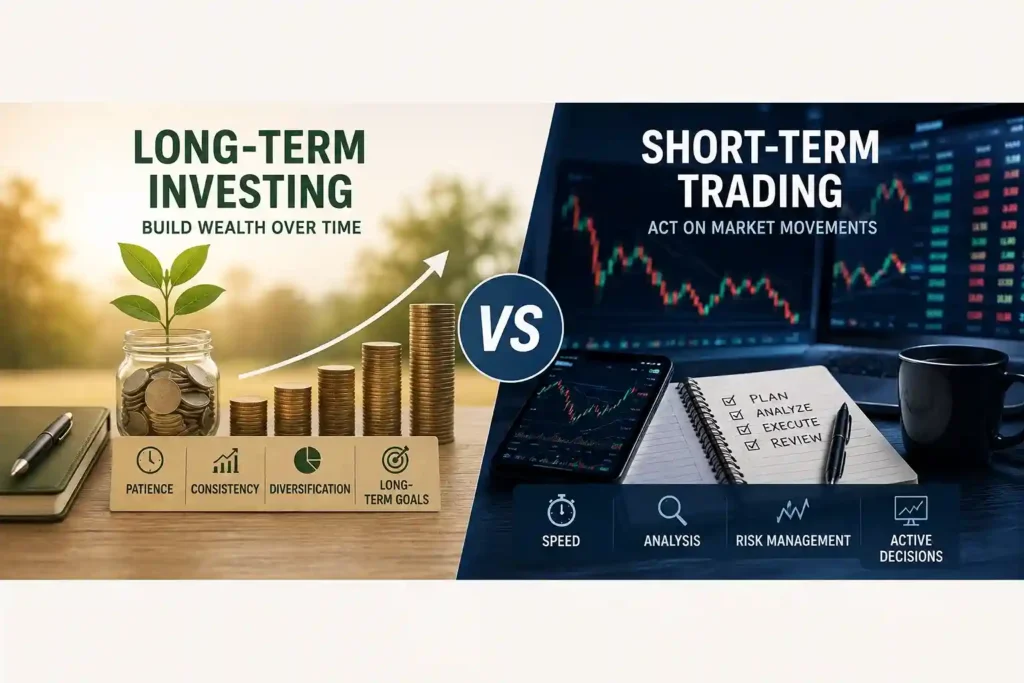
Long-Term Investing vs. Short-Term Trading: Which Strategy Is Right for You?
Long-Term Investing vs. Short-Term Trading: Which Strategy Is Right for You?
Building wealth through financial markets can take many forms. Some people invest with a long-term perspective, holding diversified investments for years or even decades. Others focus on short-term trading, attempting to benefit from price movements over much shorter periods.
Although both approaches involve buying and selling financial assets, they are not the same strategy.
Long-term investing generally centers on patience, consistent contributions, diversification, and financial goals such as retirement or long-term wealth accumulation. Short-term trading is more active and focuses on shorter-term market movements, often requiring substantially more time, research, and risk management. The SEC’s Investor.gov specifically distinguishes long-term investing from short-term trading and warns that short-term trading can involve significant risks.
So, which approach is right for you?
The answer depends on your financial goals, time horizon, risk tolerance, available time, and ability to stay disciplined. Understanding the differences can help you avoid choosing a strategy simply because it appears exciting or promises faster results.
What Is Long-Term Investing?
Long-term investing generally means purchasing investments with the intention of holding them for an extended period—often years or decades.
Instead of trying to predict what a stock will do tomorrow, a long-term investor is typically more concerned with whether the overall investment strategy can help support a financial goal over time.
Common long-term goals include:
- Retirement
- Building wealth
- Financial independence
- Long-term family goals
- Future education expenses
- Creating a financial cushion for later life
A long-term investor may use stocks, bonds, mutual funds, ETFs, or other investments depending on their goals and circumstances.
The strategy often emphasizes time, consistency, diversification, and disciplined behavior.
Importantly, long-term investing doesn’t mean ignoring your portfolio forever. Investors may periodically review their investments, consider whether their asset allocation still fits their goals, and rebalance when appropriate.
The key difference is that the investor isn’t necessarily making decisions based on every daily market movement.
What Is Short-Term Trading?
Short-term trading involves attempting to benefit from relatively short-term price movements.
Depending on the strategy, positions may be held for days, weeks, or even shorter periods. Day trading represents an especially active form of short-term trading in which securities are bought and sold within the same day.
Short-term traders may analyze:
- Market prices
- Company information
- Economic developments
- Market trends
- Trading volume
- Other market data
Trading generally involves much more frequent decision-making than traditional long-term investing.
That increased activity also brings additional challenges. Investor.gov notes that day trading is fast-moving, speculative, and can expose participants to substantial losses, particularly when leverage is involved.
This is why short-term trading shouldn’t be viewed simply as “investing faster.”
It is a fundamentally different approach with different demands and risks.
Long-Term Investing vs. Short-Term Trading: Key Differences
| Factor | Long-Term Investing | Short-Term Trading |
| Time horizon | Years or decades | Days, weeks, or shorter |
| Primary objective | Long-term wealth building | Capturing shorter-term price movements |
| Trading frequency | Usually lower | Usually higher |
| Market monitoring | Generally lower | Often much higher |
| Diversification | Commonly emphasized | Depends on strategy |
| Decision-making | Long-term goals and investment fundamentals | Short-term market conditions and strategy |
| Time commitment | Usually lower | Often substantially higher |
| Emotional pressure | Can be lower | Can be considerably higher |
| Costs | Often lower due to fewer transactions | Can increase with frequent activity |
| Tax considerations | Holding period can matter | Frequent transactions may create additional tax considerations |
The distinction is important because a strategy that fits one person may be completely unsuitable for another.
How Long-Term Investing Can Build Wealth
One of the biggest advantages of long-term investing is the opportunity to allow time and compounding to work together.
Suppose you regularly invest money and your investments generate returns. If those returns remain invested, future growth can potentially occur on both your original contributions and previous investment gains.
That’s the basic idea behind compound growth.
You can learn more about this concept in your related article, How Compound Interest Helps You Build Wealth Over Time.
Consistency Matters
Long-term wealth building isn’t necessarily about making one spectacular investment decision.
For many investors, it is more about developing a repeatable process:
Earn → Save → Invest → Stay invested → Review → Adjust when necessary
Regular contributions can make investing a habit rather than something dependent on predicting the perfect time to enter the market.
Investor.gov similarly emphasizes regular investing and long-term financial goals as part of building wealth over time.
Time Doesn’t Eliminate Risk
It’s important not to misunderstand the benefits of a long time horizon.
Long-term investing does not guarantee profits.
Stocks and other investments can lose value, sometimes substantially. FINRA notes that all investments carry some degree of risk, and even long-term stock investing remains subject to market risk.
Time can help an investor remain invested through different market cycles, but it doesn’t make an investment risk-free.
How Short-Term Trading Works
Short-term trading focuses on relatively short-term changes in the price of financial assets.
A trader may have a specific idea about where an investment’s price could move and attempt to benefit from that movement.
The process can involve:
- Researching a potential opportunity
- Evaluating relevant market information
- Establishing a trading thesis
- Deciding whether the potential reward justifies the risk
- Monitoring the position
- Evaluating the outcome afterward
However, there is a critical distinction between having a strategy and having a guaranteed outcome.
No trading strategy can guarantee that a market prediction will be correct.
Prices can move unexpectedly because of economic news, company developments, investor sentiment, geopolitical events, or other factors.
And the shorter the time horizon, the less room there may be for a long-term investment thesis to develop.
Risk: The Biggest Difference Beginners Should Understand
Risk is one of the most important concepts to understand before comparing investing and trading.
Risk isn’t simply “the possibility that the price will fall.”
It can include:
- Market risk
- Business risk
- Concentration risk
- Liquidity risk
- Inflation risk
- Behavioral risk
- Timing risk
- Leverage-related risk
Market investments can lose value and that diversification and asset allocation are among the tools investors can use to manage certain risks.
Long-Term Investing
A long-term investor may have a longer period to remain invested through market fluctuations.
For example, someone saving for a retirement goal decades away may have more time to tolerate market volatility than someone who needs the money next year.
But that doesn’t mean the investor can ignore risk.
Investor.gov explains that appropriate asset allocation depends partly on an investor’s time horizon and risk tolerance.
Short-Term Trading
Short-term traders have a much shorter window in which their expectations may play out.
A sudden price movement can quickly turn a trade in the opposite direction.
The risks can become even greater when borrowed money or leverage is involved. Investor.gov warns that leverage can magnify losses.
Costs and Taxes Matter More Than Beginners Think
Investment performance isn’t determined only by whether an asset’s price rises.
You also need to consider costs and taxes.
Potential costs can include:
- Fund expenses
- Account fees
- Bid-ask spreads
- Trading-related costs
- Other transaction expenses
Frequent trading can potentially increase the impact of transaction-related costs.
Taxes can also differ depending on factors such as:
- Investment type
- Holding period
- Account type
- Income
- Individual circumstances
For U.S. investors, the tax treatment of investment gains can be complicated, and rules can change. Investor.gov notes that investments held for shorter periods can generally receive different tax treatment from investments held longer than a year.
Don’t choose an investment strategy based solely on headline returns.
Consider what remains after investment costs and applicable taxes.
For individual tax questions, current IRS guidance or a qualified tax professional is more appropriate than relying on a general article.
Time and Skill Requirements
Another major difference is the amount of time each strategy may require.
Long-Term Investing
A long-term investor may primarily need to:
- Establish financial goals
- Choose an appropriate strategy
- Make regular contributions
- Maintain diversification
- Review the portfolio periodically
- Rebalance when appropriate
That doesn’t mean long-term investing is effortless. Investors still need to understand what they own and why they own it.
But daily market monitoring generally isn’t necessary for a long-term strategy.
Short-Term Trading
Short-term trading can demand considerably more involvement.
Depending on the strategy, traders may spend significant time:
- Researching markets
- Monitoring prices
- Following financial news
- Evaluating positions
- Managing risk
- Reviewing previous decisions
Investor.gov describes day trading as particularly time-consuming and fast-moving.
A strategy that requires more attention than you can realistically provide may not be a good fit.
Emotional Discipline: The Hidden Challenge
Money decisions aren’t purely mathematical.
Investors can experience:
- Fear
- Greed
- Impatience
- Overconfidence
- Fear of missing out
- Panic during market declines
These emotions can influence decision-making.
For example, someone may buy an investment after seeing a large recent gain because they fear missing out. Another investor may sell during a market decline because they become uncomfortable with losses.
Short-term trading can create even more frequent decision points.
Investor.gov has warned about emotional and impulsive decisions associated with short-term market activity and social-media-driven investment trends.
This leads to a useful principle:
A financial strategy is only useful if you can follow it consistently.
A theoretically attractive strategy that causes you to make emotional decisions may be worse for you than a simpler strategy you can maintain with discipline.
Which Strategy Is Better for Building Long-Term Wealth?
If the primary objective is building long-term wealth, long-term investing may fit that objective more naturally than attempting to make frequent short-term market predictions.
Why?
Because long-term investing can focus on:
- Regular contributions
- Long-term goals
- Diversification
- Compounding
- Asset allocation
- Patience
- Limiting unnecessary activity
Investor.gov describes long-term investing as buying, holding, and growing a diversified portfolio over an extended period, while distinguishing it from the more active nature of short-term trading.
That doesn’t mean long-term investing is guaranteed to outperform every trader or every short-term strategy.
It means the two approaches have different objectives and demands.
The desire to build wealth quickly can sometimes encourage people to take risks they don’t fully understand.
A better question than:
“How quickly can I make money?”
is:
“What strategy gives me a reasonable opportunity to work toward my financial goals without taking risks I can’t afford?”
That question fits naturally into your broader guide on 10 Proven Ways to Build Wealth From Scratch in America.
Can You Invest Long Term and Trade at the Same Time?
Some people may choose to maintain a long-term investment portfolio while also pursuing more active strategies.
If someone does this, it can be useful conceptually to distinguish between:
Core long-term investments and Higher-risk or speculative activities
The important point is that money intended for essential goals should not automatically be exposed to substantial short-term market risk.
For example, retirement savings and money needed for near-term expenses may have very different purposes from money someone is willing to expose to a highly uncertain strategy.
Your investment choices should always reflect the purpose of the money.
That’s also why understanding retirement planning is an important part of a broader wealth-building strategy.
Common Mistakes Beginners Make
- Confusing Investing With Trading
Buying a stock doesn’t automatically make someone a “trader.”
The time horizon and strategy matter.
- Chasing Quick Profits
The possibility of making money quickly can be appealing, but it can also encourage excessive risk-taking.
Be especially skeptical of anyone suggesting that substantial profits are easy or guaranteed.
- Trading Without a Defined Strategy
Randomly buying and selling because of headlines, social-media posts, or market excitement isn’t a reliable substitute for a coherent investment plan.
- Ignoring Diversification
Putting too much money into one company, sector, or investment can create unnecessary concentration.
Your related guide, Asset Allocation for Beginners: How to Build a Diversified Portfolio, explores this topic in greater depth.
Investor.gov explains that diversification involves spreading investments across different assets and securities to help manage risk.
- Ignoring Fees and Taxes
Even profitable decisions can have costs.
Look beyond the headline return.
- Letting Emotions Control Decisions
Fear and excitement can both cause poor decisions.
- Using Money Needed for Essential Goals
Money needed for rent, emergencies, education, healthcare, or other near-term needs should be considered separately from money intended for long-term investing.
How to Decide Which Approach Fits You
Instead of asking which strategy is universally better, ask whether the strategy fits your situation.
Question 1: What Is Your Goal?
Are you building retirement wealth or trying to pursue short-term market opportunities?
Your goal should influence your approach.
Question 2: What’s Your Time Horizon?
Money needed soon generally has different investment considerations from money you won’t need for decades.
Investor.gov notes that time horizon is a major factor in determining an appropriate asset allocation.
Question 3: How Much Time Can You Commit?
Long-term investing can generally be managed with less frequent attention.
Active trading can require much more time.
Question 4: How Do You Handle Losses?
Ask yourself honestly how you react when an investment declines.
If a temporary decline would cause you to abandon your entire plan, your strategy may not match your risk tolerance.
Question 5: Can You Follow a Plan?
Discipline matters more than excitement.
A simple strategy that you understand may be more sustainable than a complicated approach you can’t consistently follow.
Question 6: Are You Diversified?
Avoid allowing one investment or one market idea to determine the outcome of your entire financial future.
Question 7: Are You Using Money You Can Afford to Invest?
Your investment horizon should match the purpose of the money.
Don’t confuse money for immediate needs with money intended for long-term wealth building.
A Simple Long-Term Investing Framework for Beginners
If your primary objective is long-term wealth building, start with the financial foundation rather than immediately focusing on individual investments.
Step 1: Define Your Financial Goals
Identify what you’re trying to accomplish.
Examples include:
- Retirement
- Financial independence
- Long-term wealth
- Education
- Other major future goals
Step 2: Build Your Financial Foundation
Consider your:
Budget → Emergency savings → Debt management → Investing
Your emergency fund can provide a financial buffer for unexpected expenses.
Step 3: Determine Your Asset Allocation
Consider your time horizon, risk tolerance, and financial objectives.
Asset allocation involves dividing investments among categories such as stocks, bonds, and cash.
Step 4: Choose Diversified Investments
Understand what you actually own.
A broadly diversified investment can provide exposure to many securities, but don’t assume that every fund or ETF is automatically diversified. Investor.gov specifically notes that narrowly focused funds may not provide adequate diversification.
Step 5: Invest Consistently
A consistent process can be more sustainable than constantly trying to predict market highs and lows.
Step 6: Review Periodically
Review your investments when your financial circumstances or goals change.
Step 7: Stay Focused on the Long Term
Market headlines can change every day.
Your financial goals generally don’t need to change every day.
Frequently Asked Questions (Long-Term Investing vs. Short-Term Trading)
Is long-term investing safer than short-term trading?
Neither is risk-free. Long-term investing and short-term trading have different risk profiles and objectives. A longer time horizon can give investors more opportunity to remain invested through market cycles, but it doesn’t eliminate the possibility of losses.
Is trading better than investing?
There isn’t a universal answer. Trading is more active and can require significantly more time and risk management. For someone focused on long-term financial goals, a long-term investment approach may be more aligned with those goals.
Can beginners start long-term investing?
Beginners can learn about long-term investing by first understanding financial goals, risk, diversification, asset allocation, and the investments they are considering. Starting with education and a clear plan is generally more useful than chasing the latest market trend.
Can I invest and trade at the same time?
Some people may use different strategies for different portions of their finances. However, money allocated to higher-risk activities should be considered separately from money needed for essential expenses or important long-term goals.
How long is considered long-term investing?
There isn’t one universally applicable cutoff. In general, long-term investing means holding investments for an extended period, typically years rather than days or weeks. The appropriate time horizon depends on the financial goal.
Can long-term investing lose money?
Yes. Long-term investing does not guarantee positive returns. Stocks and other investments can lose value, including during periods of significant market declines.
Conclusion: Choose a Strategy That Matches Your Goal
Long-term investing and short-term trading are two very different approaches to participating in financial markets.
Long-term investing generally emphasizes:
Time + consistency + diversification + patience
Short-term trading emphasizes:
Active decisions + shorter time horizons + market movements + risk management
The most important question isn’t which approach sounds more exciting or promises faster results.
It’s which approach aligns with your financial goals, time horizon, risk tolerance, available time, and ability to remain disciplined.
For someone focused primarily on long-term wealth creation, a consistent and diversified investment strategy can fit naturally into a broader financial plan. It can also work alongside other important building blocks such as emergency savings, debt management, retirement planning, and appropriate asset allocation.
And remember: there is no shortcut that eliminates investment risk.
Building wealth is usually less about finding one perfect investment and more about developing a sound financial process that you can follow over many years.
If you’re building your financial future from the ground up, continue with 10 Proven Ways to Build Wealth From Scratch in America to explore the broader principles behind long-term wealth creation.
Financial Disclaimer
This article is for general educational and informational purposes only. It does not constitute personalized investment, financial, tax, legal, or other professional advice. All investments involve risk, including the potential loss of principal. Past performance does not guarantee future results. Short-term trading, particularly strategies involving leverage, can involve substantial losses. Investment decisions should be based on your individual goals, financial circumstances, time horizon, and risk tolerance. Tax rules and financial regulations can change, and individual tax treatment varies. Consider reviewing current information from appropriate U.S. government sources and consulting a qualified financial or tax professional before making significant financial decisions.
