
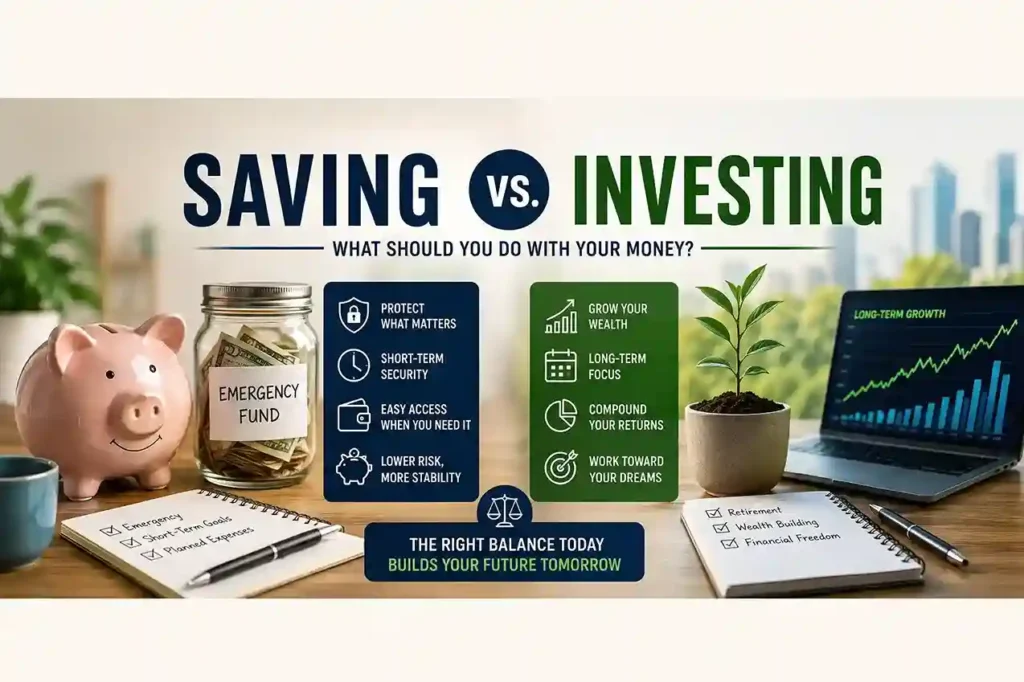
Saving vs. Investing: What Should You Do With Your Money?
Saving vs. Investing: What Should You Do With Your Money?
If you have extra money after paying your bills, should you put it into a savings account or invest it?
For many people, the answer is not as simple as choosing one over the other. Saving and investing serve different financial purposes. Saving generally focuses on keeping money accessible and relatively stable, while investing focuses on growing money over the long term while accepting market risk.
The right choice depends on when you will need the money, how much risk you can handle, and what financial goal the money is intended to accomplish.
Someone saving for an emergency expense may need easy access to their money. Someone saving for retirement decades from now may have a very different strategy.
The good news is that you usually do not have to choose between saving and investing forever. A strong financial plan can use both.Together, saving and investing can form an important foundation for long-term financial progress. If you want to understand how these strategies connect with income, debt, investing, taxes, and other aspects of building long-term financial security, explore our complete guide to building wealth in America.
Saving vs. Investing: What’s the Difference?
The simplest way to understand the difference is this:
Saving is generally for money you need to protect and access. Investing is generally for money you can leave alone for longer periods and are willing to expose to market risk in pursuit of potential growth.
What Does Saving Mean?
Saving means setting money aside rather than spending it.
Common places to keep savings include:
- Savings accounts
- High-yield savings accounts
- Money market deposit accounts
- Certificates of deposit (CDs)
- Other relatively low-risk cash or cash-equivalent options
Savings are commonly used for:
- Emergency expenses
- Upcoming purchases
- Short-term financial goals
- Bills and expenses
- Money that needs to remain accessible
The major advantage of saving is liquidity. You generally know where the money is and can access it without exposing it to the daily fluctuations of the stock market.
However, saving also has a potential drawback: inflation can reduce the purchasing power of cash over time.
What Does Investing Mean?
Investing means putting money into assets that have the potential to increase in value or generate income over time.
Examples include:
- Stocks
- Bonds
- Mutual funds
- Exchange-traded funds (ETFs)
- Diversified investment portfolios
Investing is commonly used for long-term goals such as:
- Retirement
- Long-term wealth building
- Financial independence
- Other goals that may be many years away
Unlike money held in a savings account, investments can rise and fall in value. You can lose money, especially over shorter periods.
The reason people accept that risk is the potential for higher long-term growth.
Saving vs. Investing at a Glance
| Factor | Saving | Investing |
|---|---|---|
| Main purpose | Stability and accessibility | Long-term growth |
| Typical time horizon | Short term | Generally longer term |
| Market risk | Generally low | Can be substantial |
| Accessibility | Usually high | Depends on the investment/account |
| Growth potential | Generally lower | Generally higher over long periods, but not guaranteed |
| Common options | Savings accounts, CDs | Stocks, bonds, ETFs, mutual funds |
| Common goals | Emergencies and near-term purchases | Retirement and long-term wealth |
Neither option is automatically “better.”
The better choice depends on what the money is supposed to do for you.
When Should You Save Money?
Saving is generally appropriate when protecting your money and keeping it accessible are important.
1. When You Need an Emergency Fund
An emergency fund is one of the most important uses for savings.
Unexpected expenses can happen at any time. A vehicle may need repairs. A household appliance may fail. You may face an unexpected bill or a period of reduced income.
If your emergency money is invested in stocks, its value could be lower precisely when you need it.
Keeping emergency savings in an appropriate liquid account can reduce the need to sell investments during an unfavorable market period.
The appropriate emergency-fund amount depends on your income, expenses, job stability, household situation, insurance coverage, and other circumstances.
There is no single number that works for everyone.
2. When You Have a Short-Term Goal
Suppose you know you will need $8,000 for a major purchase within a year or two.
That money has a very different job from money intended for retirement decades from now.
Because the time available to recover from a market decline is limited, preserving the money may be more important than pursuing higher potential returns.
Savings may therefore be more appropriate for many short-term goals.
3. When You Cannot Afford to Lose the Money
Consider money needed for an upcoming essential expense.
If losing 15% or 20% of that money would force you to delay the expense or borrow money, exposing it to substantial market risk may not be appropriate.
Your financial goal should influence your risk decision.
4. When You Need High Liquidity
Some financial goals require quick access to cash.
Examples include:
- Emergency expenses
- Monthly financial obligations
- Near-term medical or household expenses
- Upcoming moving costs
- Major purchases
For these purposes, liquidity can be more important than maximizing investment returns.
When Should You Invest Money?
Investing generally becomes more relevant when your financial goal is long term and you can tolerate market fluctuations.
Retirement
Retirement is one of the clearest examples.
If you are decades away from retirement, keeping every retirement dollar in cash may expose your long-term purchasing power to inflation.
A diversified investment strategy can provide exposure to assets with long-term growth potential.
Workplace retirement plans such as 401(k)s and individual retirement accounts such as Traditional and Roth IRAs can also provide tax advantages, depending on eligibility and circumstances.
Long-Term Wealth Building
Investing can also play an important role in building wealth over long periods.
Compounding can become increasingly powerful when money remains invested for many years.
For example, imagine two people each invest $10,000.
One leaves the money invested for decades, while the other repeatedly moves money in and out of investments based on short-term market movements.
Even without knowing future returns, the first person generally gives compounding more time to work.
Of course, investment returns are never guaranteed.
Money You Do Not Need Immediately
If you have money that you will not need for many years, you may have more flexibility to tolerate short-term market volatility.
That does not mean you should take unlimited risk.
Instead, your investment choices should reflect:
- Your time horizon
- Financial goals
- Risk tolerance
- Overall financial situation
- Diversification needs
Why Your Time Horizon Matters
One of the most useful ways to decide between saving and investing is to ask:
When will I need this money?
The answer can dramatically change the appropriate strategy.
Short Term: Around 0–3 Years
For money likely to be needed within a few years, protecting the money and maintaining access to it can be important.
Examples include:
- Emergency reserves
- Upcoming tuition
- A planned vehicle purchase
- A near-term home expense
- A vacation
The shorter the time horizon, the less time you may have to recover from a market decline.
Medium Term: Around 3–7 Years
Medium-term goals require more careful consideration.
For example, someone planning to buy a home several years from now may have a different strategy from someone saving for retirement.
The appropriate mix depends on:
- How flexible the goal is
- How much risk you can tolerate
- Whether the date is fixed
- How much money is required
- Whether a temporary loss would create a problem
There is no universal investment allocation for every medium-term goal.
Long Term: 7+ Years
Long-term goals generally provide more time to deal with market volatility.
Retirement is the classic example.
When money can potentially remain invested for many years, diversified investments may have a greater role because the goal is not simply to preserve today’s dollars but potentially grow their purchasing power over time.
Even long-term investing carries risk, however.
Should You Build an Emergency Fund Before Investing?
For many households, establishing an appropriate emergency reserve should be an important early financial priority.
An emergency fund can help prevent an unexpected expense from forcing you to:
- Use expensive credit
- Borrow from family
- Sell investments unexpectedly
- Stop contributing to long-term goals
Imagine that the stock market falls sharply just as your car requires a major repair.
If your emergency money is invested, you might have to sell an investment after its value has declined.
An accessible emergency reserve can give you another option.
That does not mean you must completely finish every savings goal before investing. Some people may simultaneously build emergency savings and contribute to retirement accounts, particularly when an employer retirement plan offers a valuable matching contribution.
The important point is to give different dollars different jobs.
What If You Have High-Interest Debt?
Saving and investing decisions should also be considered alongside debt.
High-interest credit card debt can be particularly expensive because interest can accumulate rapidly.
If you are carrying expensive debt, paying it down may provide a more predictable financial benefit than taking additional investment risk.
However, this does not necessarily mean you should stop all investing.
For example, an employer retirement plan may provide a matching contribution. Giving up a valuable employer match without considering the implications may not be desirable.
A better approach is to look at the entire financial picture:
- Emergency savings
- Interest rates on debt
- Employer retirement benefits
- Income
- Essential expenses
- Investment horizon
- Financial goals
How Much Should You Save vs. Invest?
There is no universal rule that says every person should save exactly a particular percentage and invest another percentage.
Your financial situation is unique.
Instead of starting with a percentage, start with priorities.
Step 1: Understand Your Essential Expenses
Know approximately how much money your household needs for basic expenses.
Step 2: Build Appropriate Emergency Savings
Create a reserve that matches your circumstances and provides reasonable financial protection.
Step 3: Address Expensive Debt
Evaluate high-interest debt and determine how aggressively it should be addressed.
Step 4: Consider Employer Retirement Benefits
If your employer offers a retirement plan with matching contributions, understand how the match works.
Step 5: Save for Near-Term Goals
Keep money for upcoming expenses in an appropriate savings vehicle.
Step 6: Invest for Long-Term Goals
Money intended for goals many years away may have a greater role for diversified investments.
This approach is more useful than blindly following a fixed savings-to-investing ratio.
Saving and Investing Can Work Together
A common mistake is thinking that every dollar must either be saved or invested.
In reality, you can build different financial buckets.
Imagine a household has $20,000 available.
It might conceptually divide the money into:
- Emergency reserve: accessible savings
- Near-term goal: savings or another appropriate lower-risk option
- Long-term retirement money: diversified investments
The exact amounts depend on the household’s circumstances.
The important principle is that each dollar should have a purpose.
Your emergency fund does not need to behave like your retirement portfolio.
Your retirement money does not need to behave like your vacation fund.
Different goals require different strategies.
Where Should You Keep Your Savings?
Several options may be useful for different types of savings.
High-Yield Savings Accounts
A high-yield savings account can offer relatively easy access to money while potentially paying more interest than a traditional savings account.
These accounts can be useful for emergency funds and other cash savings.
When comparing accounts, consider:
- Interest rate
- Fees
- Minimum balance requirements
- Withdrawal policies
- Bank reputation
- Deposit insurance eligibility
Money Market Deposit Accounts
Money market deposit accounts are bank deposit accounts that may offer interest and access to funds through features such as checks or debit cards, depending on the account.
Do not confuse a money market deposit account with a money market mutual fund, which is an investment product and does not have the same structure as an insured bank deposit.
Certificates of Deposit
Certificates of deposit, or CDs, generally require you to leave money deposited for a specified period.
In exchange, they may provide a fixed interest rate for the term.
The trade-off is reduced flexibility.
Early withdrawal may result in a penalty, depending on the CD and financial institution.
Treasury Securities
U.S. Treasury securities are another option some investors and savers consider for certain financial goals.
They have different maturities, structures, and risks than bank savings accounts.
They should not automatically be treated as interchangeable with an ordinary savings account.
Where Can You Invest for Long-Term Goals?
Long-term investors have several account and investment choices.
401(k)
A 401(k) is an employer-sponsored retirement plan.
Depending on the plan, employees may be able to contribute pre-tax or Roth contributions.
Some employers also provide matching contributions.
Traditional IRA
A Traditional IRA can provide tax advantages for eligible contributions and investments, subject to applicable rules.
Taxes are generally deferred until qualifying withdrawals are made.
Roth IRA
A Roth IRA uses after-tax contributions and can provide tax-free qualified withdrawals under applicable rules.
Eligibility and contribution rules apply.
Taxable Brokerage Account
A taxable brokerage account can provide flexibility for investing outside retirement accounts.
Unlike retirement accounts, it generally does not have the same tax-advantaged structure.
ETFs and Mutual Funds
Exchange-traded funds and mutual funds allow investors to own collections of investments through a single fund.
Some funds provide broad diversification across many companies or bonds.
However, not every fund is automatically diversified or low cost, so investors should understand what a fund owns and what fees it charges.
The Role of Risk in Saving vs. Investing
Understanding risk is essential.
Saving and investing expose you to different types of risk.
Market Risk
Investments such as stocks can decline in value.
A portfolio worth $50,000 today could be worth considerably less during a market downturn.
Inflation Risk
Cash can lose purchasing power if inflation rises faster than the rate your savings earn.
For example, if your savings account earns 2% while prices rise 3%, your balance may increase in dollars while its purchasing power declines.
Liquidity Risk
Some financial products make it harder or more expensive to access money quickly.
This is one reason emergency funds are generally kept in highly accessible accounts.
Interest-Rate Risk
Certain bonds and other fixed-income investments can fluctuate in value as interest rates change.
The broader lesson is simple:
Every financial choice involves trade-offs.
Saving can reduce market risk but expose you to inflation and opportunity costs.
Investing can provide greater long-term growth potential but exposes you to market volatility and the possibility of losses.
Inflation Changes the Saving vs. Investing Decision
Inflation is an important reason why simply accumulating cash may not be enough for long-term wealth building.
Imagine you have $10,000.
If that money earns interest, the account balance may grow.
But if the cost of goods and services rises faster than your savings rate, your purchasing power may still decline.
This is why long-term financial planning often involves more than simply asking:
“Will my account balance increase?”
A better question is:
“Will my money maintain or increase its purchasing power over time?”
Investing may provide greater long-term growth potential, but that potential comes with uncertainty and risk.
Common Saving and Investing Mistakes
1. Investing Your Emergency Fund
Emergency money generally needs to be available when you need it.
Exposing it to substantial market volatility can create problems during a financial emergency.
2. Keeping All Long-Term Money in Cash
Cash provides stability, but keeping all long-term money in low-growth assets may reduce your potential for long-term growth and leave you vulnerable to inflation.
3. Ignoring Inflation
A larger account balance does not automatically mean greater purchasing power.
4. Taking Too Much Investment Risk
The possibility of higher returns does not mean you should take unlimited risk.
Your portfolio should reflect your goals and ability to tolerate losses.
5. Investing Money You Need Soon
Short-term goals can be disrupted by market declines.
Money needed soon may require a different strategy.
6. Failing to Diversify
Putting too much money into one company, sector, or asset can increase concentration risk.
Diversification can help reduce the impact of a poor result from any single investment, although it cannot eliminate investment losses.
7. Chasing High Returns
An investment promising extraordinary returns may also carry extraordinary risk.
Never assume a high advertised return is guaranteed.
8. Ignoring High-Interest Debt
It can be difficult to build financial wealth while expensive debt continues to accumulate.
9. Ignoring Employer Retirement Benefits
If your employer offers a retirement plan and matching contributions, failing to understand the benefit could mean missing an important part of your compensation.
10. Treating Saving and Investing as Opposites
You can save for emergencies while investing for retirement.
There is no need to make your entire financial life a choice between the two.
Saving vs. Investing Examples
Example 1: Building an Emergency Fund
Suppose Sarah has no emergency savings and wants to start investing.
She may first want to establish an appropriate cash reserve.
Why?
Because an unexpected expense could otherwise force her to sell investments at an inconvenient time.
Her long-term investing goal still matters, but financial stability matters too.
Example 2: Saving for a Home in Two Years
John plans to use $40,000 as part of a home purchase in approximately two years.
Because the money has a relatively short time horizon, protecting the funds may be more important than seeking maximum investment growth.
A significant market decline shortly before the purchase could create a major problem.
Example 3: Investing for Retirement in 25 Years
Maria is 35 and expects to retire around age 60.
Her retirement money has a much longer time horizon.
She may therefore have more ability to tolerate short-term market fluctuations and use diversified long-term investments.
Her portfolio still needs to reflect her risk tolerance and circumstances.
Example 4: A Young Adult Starting to Build Wealth
A young adult might simultaneously:
- Build emergency savings
- Avoid unnecessary high-interest debt
- Contribute to a workplace retirement plan
- Learn about diversified investing
- Save for near-term goals
The key is not choosing between saving and investing forever.
It is deciding what each dollar is supposed to accomplish.
Example 5: Someone With Credit Card Debt
Suppose Alex has $5,000 in high-interest credit card debt and $2,000 in savings.
Alex may need to balance building financial stability with addressing expensive debt.
The best approach depends on interest rates, income stability, emergency needs, employer retirement benefits, and other circumstances.
A Simple Decision Tree: Should You Save or Invest?
When deciding what to do with extra money, ask these questions.
Do you need the money soon?
Yes: Consider keeping it in an appropriate savings or cash-oriented vehicle.
No: Continue to the next question.
Do you have an appropriate emergency reserve?
No: Consider prioritizing emergency savings.
Yes: Continue.
Do you have high-interest debt?
Yes: Evaluate paying down the debt alongside your other financial priorities.
No: Continue.
Is the money intended for a long-term goal?
Yes: Consider a diversified investment strategy appropriate for your time horizon and risk tolerance.
No: Determine the goal and choose the financial vehicle accordingly.
This simple framework can prevent many common mistakes.
Saving vs. Investing for Different Financial Goals
| Financial Goal | Saving | Investing | General Consideration |
|---|---|---|---|
| Emergency fund | Usually important | Usually less appropriate | Liquidity and stability matter |
| Monthly expenses | Appropriate | Usually unnecessary | Money needs to be accessible |
| Vacation next year | Often appropriate | Generally higher risk | Short time horizon |
| Car purchase in two years | Often appropriate | Depends on circumstances | Protecting the required amount may matter |
| Home down payment | Depends on timing | Depends on timing | Longer timelines provide more flexibility |
| Education several years away | Depends on timeline | May play a role | Goal timing matters |
| Retirement decades away | Some cash may be useful | Often important | Long-term growth may matter |
| Long-term wealth building | Some cash reserve is useful | Often important | Diversification and time horizon matter |
These are general educational guidelines, not individualized recommendations.
What Should You Do First?
If you are unsure where to start, consider organizing your finances in this general sequence:
1. Know Your Financial Numbers
Understand your income, essential expenses, debt payments, savings, and investments.
2. Establish Appropriate Emergency Savings
Build a financial cushion that matches your circumstances.
3. Address Expensive Debt
Pay attention to high-interest debt that can undermine your financial progress.
4. Understand Your Employer Retirement Plan
If available, learn about employer contributions, matching, vesting, and investment choices.
5. Save for Near-Term Goals
Keep money needed soon in an appropriate place where it can be accessed when required.
6. Invest for Long-Term Goals
Use a diversified strategy appropriate for your time horizon and risk tolerance.
7. Review Your Plan Periodically
Your financial strategy should evolve as your income, expenses, family circumstances, goals, and time horizons change.
Frequently Asked Questions
Is saving better than investing?
Neither is universally better. Saving is generally more appropriate for emergencies and near-term goals, while investing may be more appropriate for long-term goals where you can accept market risk.
Should I save money before investing?
For many people, establishing an appropriate emergency reserve before taking substantial investment risk can provide greater financial stability. However, some people may save and invest simultaneously, particularly when they have access to valuable employer retirement benefits.
How much money should I keep in savings?
There is no universal amount. The appropriate level depends on your essential expenses, income stability, household circumstances, debt, insurance, and financial goals.
Should I invest my emergency fund?
Emergency funds generally need to be accessible and stable. Putting emergency money into volatile investments can create the risk that the money will be worth less when you need it.
Is investing riskier than saving?
Investing in assets such as stocks generally involves more short-term market risk than keeping money in an insured bank deposit account. However, cash also has risks, including inflation and loss of purchasing power.
Should I invest money I need in three years?
A three-year time horizon is relatively short for many market investments. The appropriate strategy depends on the goal, flexibility, risk tolerance, and consequences of losing money before the goal date.
What is the difference between a savings account and an investment account?
A savings account is primarily designed to hold cash and provide access to your money, while an investment account allows you to buy investments such as stocks, bonds, ETFs, and mutual funds. The risks and potential returns are different.
Can I save and invest at the same time?
Yes. In fact, many people do. You can maintain an emergency fund and short-term savings while investing money intended for long-term goals.
Should I pay off debt before investing?
It depends on the debt’s interest rate, your emergency savings, employer retirement benefits, and other circumstances. High-interest debt deserves particular attention because its cost can be substantial.
What is better for long-term wealth: saving or investing?
Saving provides financial stability and liquidity, while investing provides greater potential for long-term growth but also carries market risk. A long-term wealth-building strategy can use both.
The Bottom Line
Saving and investing are not enemies.
They are tools designed for different jobs.
Save money you need to protect and access. Invest money you can leave invested for the long term and are willing to expose to market risk.
Your emergency fund should not necessarily behave like your retirement portfolio.
Your vacation savings should not necessarily be invested like a 30-year retirement account.
And your long-term wealth-building strategy should not depend entirely on cash.
The most useful question is therefore not:
“Should I save or invest?”
Instead, ask:
“What is this money for, and when will I need it?”
If you need the money soon, saving may make more sense.
If you need it much later, investing may have a greater role.
And if you have multiple financial goals—which most people do—the answer may be both.
The goal is to give every dollar an appropriate job: cash for financial stability, savings for near-term goals, and diversified investments for long-term growth potential.
Financial Disclaimer
This article is for educational and informational purposes only and is not individualized financial, investment, tax, legal, or insurance advice. Financial circumstances differ from person to person, and laws, regulations, tax rules, employer benefits, and financial products can change. Verify current information with appropriate official sources and consider consulting a qualified professional for complex personal circumstances.
