
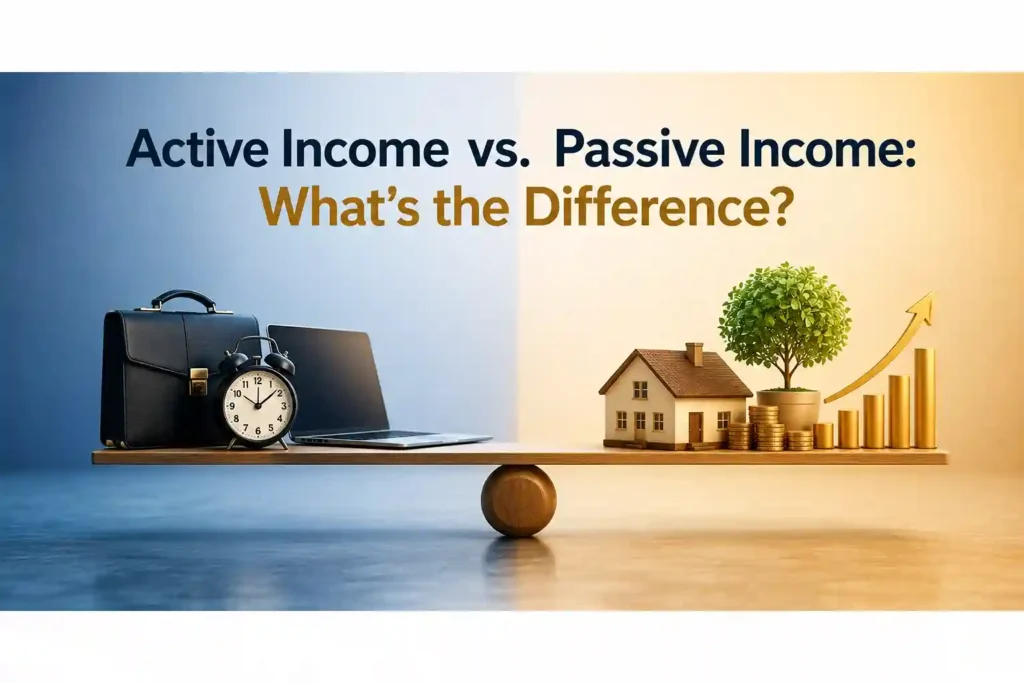
Active Income vs. Passive Income: What’s the Difference?
Active Income vs. Passive Income: What’s the Difference?
For most people, earning money starts with a simple exchange: you provide your time, skills, or expertise, and someone pays you for it. A salary, hourly wage, freelance payment, or commission can all provide the cash flow needed to pay bills, save money, and invest for the future.
But as people learn more about building wealth, they often encounter another concept: passive income.
Passive income is commonly described as money earned without actively working for every dollar. That description can be appealing, but it can also be misleading. Most passive income sources require some combination of upfront work, invested capital, management, maintenance, or risk.
So, what is the difference between active income and passive income? And which one matters more for building wealth?
The answer is that you do not necessarily have to choose one over the other. Active income can provide the earnings and capital needed to build assets, while income generated by those assets may eventually provide additional financial flexibility. If you want the broader picture, see How to Build Wealth in America: The Complete Guide to Growing, Protecting, and Preserving Your Money.
What Is Active Income?
Active income is money earned through direct participation in work or services. In simple terms, you generally have to spend time working or providing a service to receive the income.
For many households, active income is the primary source of cash flow.
Common examples include:
- Salary from a full-time or part-time job
- Hourly wages
- Bonuses
- Commissions
- Freelance payments
- Consulting fees
- Professional service income
- Gig-work earnings
- Self-employment income
For example, if you work as an accountant and receive a salary from your employer, that salary is active income. If you stop working, your regular employment income will generally stop as well.
This doesn’t mean active income is bad or inferior. In fact, active income can be the foundation of a successful wealth-building strategy.
A strong career or business can increase your earning power, allowing you to save more, invest more, pay down debt, and acquire income-producing assets.
Examples of Active Income
Salary
A salary is one of the most common forms of active income.
An employee performs work for an employer and receives compensation, usually on a regular schedule.
Salary can provide relatively predictable cash flow, although employment income is never completely guaranteed.
Hourly Wages
Workers who are paid based on the number of hours worked earn active income.
The more hours worked, within the terms of the job, the more income may be earned.
Freelance Income
Freelancers earn money by providing services to clients.
Examples include:
- Graphic design
- Writing
- Programming
- Photography
- Consulting
- Tutoring
- Video production
Freelancing can offer flexibility, but the income generally requires continued work.
Commissions
Sales professionals and other workers may earn commissions based on sales or other measurable results.
This is also active income because earning the money generally requires ongoing participation.
Self-Employment Income
A person running their own business may earn income from providing products or services.
However, business income can become more complicated. A business owner may actively work in the business, hire employees, use systems, or eventually reduce their direct involvement.
Therefore, not all business income should automatically be labeled passive.
What Is Passive Income?
Passive income generally refers to money generated from assets, investments, intellectual property, or business activities that may require less direct ongoing labor than traditional employment.
The important word is “may.”
Passive income does not necessarily mean:
- No work
- No investment
- No risk
- No management
- No taxes
- No maintenance
In many cases, substantial work is required before an income-producing asset begins generating money.
For example, someone who creates a book may spend months researching, writing, editing, publishing, and marketing it. Once the book is established, however, it may generate additional sales without requiring the author to personally perform the work for every individual sale.
That is more accurately described as income that can become relatively less labor-intensive, rather than money that requires absolutely no effort.
Examples of Passive Income
There are several potential sources of income that people commonly describe as passive.
Interest Income
Money held in certain interest-bearing accounts or investments can generate interest.
For example, if you place money in an interest-bearing account, the financial institution may pay interest based on the applicable terms.
The income doesn’t normally require you to work additional hours for each dollar of interest.
However, you still need capital in the first place, and the amount of income depends on the amount invested and the applicable interest rate.
Dividend Income
Some investments may distribute dividends to shareholders.
An investor doesn’t typically have to work for each dividend payment, but earning dividend income requires capital invested in the underlying assets.
Dividend payments are also not guaranteed. Companies can change, reduce, suspend, or eliminate dividends.
Rental Income
Rental property is another commonly discussed source of passive income.
A property owner may receive rent from tenants.
However, rental property is an excellent example of why the word passive can be misleading.
Property ownership may involve:
- Finding tenants
- Maintenance
- Repairs
- Insurance
- Property taxes
- Financing
- Vacancy periods
- Legal compliance
- Property management
A landlord who manages everything personally may have substantial ongoing responsibilities. Hiring a property manager can reduce the owner’s direct involvement, but it also creates an additional expense.
Royalties
Royalties can be generated from intellectual property such as:
- Books
- Music
- Patents
- Licensing arrangements
- Certain creative works
The creator usually has to produce or develop the intellectual property before royalties can be earned.
Once the asset is established, however, it may continue producing income without requiring the creator to repeat the original work every time.
Digital Products
Digital products such as educational resources, templates, software, or courses can potentially generate income after they have been created.
But digital products aren’t automatically passive.
They may require:
- Product development
- Marketing
- Customer support
- Updates
- Platform management
- Advertising
- Technical maintenance
The amount of ongoing work depends heavily on the business model.
Active Income vs. Passive Income: Key Differences
The easiest way to understand the distinction is to compare how each type of income is generated.
| Factor | Active Income | Passive Income |
|---|---|---|
| Main requirement | Direct work or services | Assets, capital, systems, or prior effort |
| Ongoing involvement | Usually higher | Often lower, but varies |
| Time relationship | Often closely connected to hours worked | May be less directly connected to time |
| Initial effort | Usually ongoing | Can require significant upfront effort |
| Capital requirement | Often low to moderate | Can be moderate or substantial |
| Scalability | Often limited by available time | Some sources can scale more easily |
| Predictability | Varies | Varies |
| Risk | Varies | Varies |
| Examples | Salary, wages, freelance work | Interest, dividends, royalties, rental income |
This table provides a general framework, not an absolute classification for every situation.
For example, a business owner may earn active income from working in the business while also receiving income from business assets.
Is Passive Income Really Passive?
This is one of the most important questions to understand.
The term passive income is frequently used in financial marketing to make an opportunity sound easier than it actually is.
In reality, many passive-income opportunities require significant effort.
Consider a few examples.
Rental Property
You might receive rent each month, but the property still needs to be maintained and managed.
Digital Products
You might sell a product repeatedly, but you may still need to update it, market it, and support customers.
Investments
Investments may generate dividends or interest, but they require capital and involve financial risk.
Content Businesses
A website, YouTube channel, newsletter, or other content business may eventually generate income from advertising, products, or affiliates. However, creating an audience can require substantial ongoing effort.
A better way to think about passive income is:
Income that can become less directly tied to your ongoing labor, rather than income that requires absolutely no effort.
That distinction helps protect you from unrealistic financial promises.
Active Income Can Be a Powerful Wealth-Building Tool
People sometimes talk about active income as though it is something you should escape as quickly as possible.
That isn’t necessarily a good way to think about personal finance.
A strong active income can be extremely valuable.
It can provide the cash flow needed to:
- Pay everyday expenses
- Build an emergency fund
- Eliminate expensive debt
- Contribute to retirement accounts
- Invest in diversified assets
- Build a business
- Acquire real estate
- Develop new skills
For example, suppose someone increases their annual income by improving their professional skills. If they keep their lifestyle under control and invest part of the additional income, the higher active income can help accelerate long-term wealth building.
In this way, active income can become the fuel used to acquire productive assets.
Potential Advantages of Active Income
Active income has several important advantages.
Regular Cash Flow
Employment can provide relatively predictable income, which makes budgeting easier.
Skill Development
Working can help you develop valuable skills that may increase your future earning potential.
Career Growth
Experience and specialization can lead to promotions, higher salaries, or new opportunities.
Access to Benefits
Some employment arrangements may provide benefits such as health insurance, retirement-plan access, paid leave, or other forms of compensation.
Capital for Investing
Perhaps most importantly for wealth building, active income gives you money that can potentially be saved and invested.
Potential Limitations of Active Income
Active income also has limitations.
Time-for-Money Relationship
In many jobs, your income is closely connected to the amount of time you spend working.
There are only so many hours available each day.
Employment Risk
A job can be lost because of layoffs, company restructuring, economic conditions, or changes in the industry.
Income Ceiling
Some careers have relatively limited earning potential unless you gain additional skills, move into management, start a business, or change professions.
Burnout
Depending on the occupation, relying entirely on active work for income can become physically or mentally demanding.
These limitations don’t make active income undesirable. They simply highlight why building financial assets can be useful over the long term.
Potential Advantages of Passive Income
Income generated from assets or systems can offer several potential benefits.
Diversification of Income
Having more than one source of income can reduce dependence on a single paycheck.
Potential Long-Term Cash Flow
Certain assets may generate income over extended periods, although no income stream is guaranteed.
Greater Flexibility
If a larger portion of your financial needs can eventually be supported by assets, you may have more flexibility in how you spend your time.
Scalability
Some income-producing assets can potentially generate additional income without requiring a proportional increase in working hours.
For example, selling one digital product to 100 customers does not necessarily require 100 times the work of selling it to one customer.
However, marketing, customer service, platform fees, and other responsibilities can increase as a business grows.
Limitations and Risks of Passive Income
Passive income is not automatically safer or better than active income.
It comes with its own risks.
Investment Risk
Stocks, bonds, real estate, and other investments can lose value.
Income Variability
Dividends, interest rates, rental income, and business earnings can change.
Capital Requirements
Many investment-based income sources require money upfront.
Maintenance
Rental properties, websites, digital products, and businesses may require ongoing attention.
Business Risk
A business or digital product can fail to attract enough customers.
Tax Considerations
Income from different sources can receive different tax treatment.
Scams and Unrealistic Claims
Some online opportunities promise large amounts of passive income with little work or risk.
These claims should be treated with skepticism.
A useful rule is:
The combination of high returns, low risk, and little effort deserves particularly careful scrutiny.
Active Income vs. Passive Income and Taxes
Taxes are an important part of the active-versus-passive-income discussion, but the terminology can become confusing.
In everyday personal-finance conversations, people often use passive income to describe money that doesn’t require much ongoing work.
The U.S. tax system has a more specific concept called passive activity.
These concepts should not be treated as identical.
For example, income from investments, interest, dividends, rental activities, businesses, and capital gains can each have different tax rules.
Active income such as wages can involve federal income tax withholding and potentially payroll taxes.
Self-employment income may have additional tax considerations.
Investment income may involve different rules depending on whether it is interest, dividends, or capital gains.
Rental activities have their own tax considerations as well.
Therefore, you should not assume:
“Passive income is always taxed one way.”
The actual tax treatment depends on the specific source of income and the applicable tax rules.
Because tax laws can change and individual circumstances matter, people with significant or complicated income sources should consider consulting a qualified tax professional.
How Active Income Can Help Create Passive Income
One of the most useful ways to think about the relationship is as a progression.
Earn → Save → Invest → Build Assets → Generate Additional Income → Reinvest → Build Wealth
Active income often comes first.
Imagine someone earns money from employment.
Instead of spending all of it, they may:
- Establish appropriate emergency savings.
- Pay down expensive debt.
- Invest consistently.
- Build retirement assets.
- Develop additional skills.
- Start a carefully planned side business.
- Acquire productive assets.
- Reinvest some of the resulting income.
Over many years, this process can potentially reduce dependence on employment income.
This is one of the fundamental ideas behind long-term wealth building.
How to Build Additional Income Streams
Building multiple income sources doesn’t mean you need five businesses, three rental properties, and a complicated investment portfolio.
In many cases, simplicity is better.
1. Increase Your Active Income First
For someone starting with limited capital, improving active income can be one of the most practical first steps.
Consider:
- Learning valuable skills
- Pursuing professional certifications
- Negotiating compensation when appropriate
- Taking on higher-value responsibilities
- Changing careers when appropriate
- Building a service-based side business
Increasing income can create more money available for saving and investing.
2. Build Financial Stability
Before aggressively pursuing additional income streams, establish a solid financial foundation.
This may include:
- Maintaining appropriate emergency savings
- Managing high-interest debt
- Having suitable insurance
- Creating a realistic budget
- Establishing clear financial goals
A strong foundation can reduce the likelihood that you will be forced to sell investments or abandon long-term plans because of a short-term financial emergency.
3. Invest Consistently
Long-term investing can potentially allow your money to work alongside your labor.
Depending on your circumstances, investments may generate returns through:
- Interest
- Dividends
- Capital appreciation
Investment returns are never guaranteed, and investments carry different levels of risk.
Diversification and an appropriate asset allocation can help align an investment portfolio with your goals and risk tolerance.
4. Build a Side Business
A side business can begin as active income.
For example, a person may initially spend several hours each week providing a service.
Over time, they might develop:
- Repeatable processes
- Digital products
- Employees or contractors
- Automated systems
- Recurring revenue
At that point, some aspects of the business may become less dependent on the owner’s direct labor.
But the business can still involve substantial risk and management.
5. Create Intellectual Property
Writing a book, developing educational materials, creating software, or producing other intellectual property can require significant upfront work.
Once created, however, the asset may potentially generate income multiple times.
This is one reason intellectual property is often discussed in the context of passive or semi-passive income.
6. Consider Real Estate Carefully
Rental property can generate income, but it should not be treated as free money.
Before purchasing a property, investors need to consider:
- Purchase price
- Financing costs
- Property taxes
- Insurance
- Repairs
- Maintenance
- Vacancy
- Property management
- Local market conditions
- Potential changes in property value
The goal should be to understand the economics and risks rather than simply assuming that rent equals profit.
Which Is Better: Active Income or Passive Income?
There is no universal answer.
The better question is:
How can active and passive income work together to support your financial goals?
For someone early in their career, active income may be the most important financial resource.
For someone with substantial accumulated assets, investment income may represent a larger portion of their overall cash flow.
A person building wealth might therefore move through different stages.
Stage 1: Build Earning Power
Focus on education, skills, career development, or business capabilities.
Stage 2: Build Financial Stability
Create savings, manage debt, and protect against major financial setbacks.
Stage 3: Accumulate Assets
Invest and acquire productive assets appropriate for your goals.
Stage 4: Develop Additional Income
Allow investments, businesses, or intellectual property to become additional sources of cash flow.
Stage 5: Increase Financial Flexibility
Over time, additional income sources may reduce dependence on a single paycheck.
This isn’t a guaranteed path, but it provides a useful framework for thinking about long-term wealth.
A Simple Income-Building Strategy
If you’re trying to improve your financial position, you don’t need to pursue every possible income opportunity.
A simple framework can be more effective.
Step 1: Strengthen Your Active Income
Ask:
- Can I improve my skills?
- Can I increase my earning potential?
- Is there a better career opportunity?
- Can I provide a valuable service?
Your ability to earn is an important financial asset.
Step 2: Create Financial Stability
Build appropriate savings and manage high-cost debt.
Your first objective should not always be maximizing investment returns. Financial resilience matters too.
Step 3: Invest Consistently
Once your financial foundation is appropriate, invest according to your goals, time horizon, and risk tolerance.
Long-term consistency can matter more than trying to predict every market movement.
Step 4: Develop One Additional Income Source
Instead of attempting five different side hustles, consider starting with one.
Choose something based on:
- Your skills
- Your available time
- Your capital
- Your interests
- Your risk tolerance
Step 5: Reinvest Where Appropriate
If an additional income source becomes profitable, consider whether some of the money should be reinvested into the business, investments, or other productive assets.
Step 6: Keep Things Simple
More income streams aren’t automatically better.
Ten complicated income sources can create more administrative work and risk than two well-managed ones.
The objective isn’t to collect income streams.
The objective is to build sustainable financial strength.
Common Myths About Passive Income
Myth 1: Passive Income Requires No Work
Usually, it doesn’t.
Many passive-income sources require substantial work upfront and some ongoing management.
Myth 2: Passive Income Is Risk-Free
It isn’t.
Investments can decline in value. Businesses can fail. Rental properties can experience vacancies. Digital products may not sell.
Every income source has trade-offs.
Myth 3: You Need a Huge Amount of Money
Not necessarily.
Some forms of passive income require significant capital, while others are built primarily through skills, creativity, intellectual property, or business systems.
However, opportunities requiring little money may require more time and effort instead.
There is usually a trade-off between capital, time, skill, and risk.
Myth 4: Passive Income Makes You Rich Quickly
Building meaningful wealth usually takes time.
Compounding, consistent investing, business growth, and asset accumulation often work over years rather than weeks.
Promises of instant passive income should be viewed cautiously.
Myth 5: You Should Quit Your Job to Build Passive Income
Quitting a stable source of income isn’t automatically the right move.
For many people, employment provides the cash flow used to build savings and investments.
A more cautious approach can be to build additional income gradually while maintaining financial stability.
Active and Passive Income by Life Stage
Different stages of life can create different priorities.
Students and Young Adults
The most valuable asset may be earning potential.
Building skills, gaining experience, controlling expenses, and developing good financial habits can create a strong foundation.
Early-Career Workers
This can be an important period for increasing income and beginning consistent long-term investing.
Middle-Income Households
The focus may shift toward balancing current expenses with saving, investing, debt management, and long-term financial goals.
Established Professionals
Higher earnings may provide greater opportunities to invest, build businesses, or acquire additional productive assets.
Entrepreneurs
Entrepreneurs may earn active income through direct involvement while building systems that can eventually make portions of the business less dependent on their personal time.
People Approaching Retirement
The focus may increasingly shift toward managing accumulated assets, income needs, taxes, risk, and sustainability.
The right strategy depends on individual circumstances rather than age alone.
Frequently Asked Questions
What is the difference between active and passive income?
Active income generally requires direct work or services to earn money, such as salary or freelance income. Passive income generally refers to income generated from assets, investments, intellectual property, or systems that may require less ongoing direct labor.
Is salary active income?
Yes. Salary is generally considered active income because it is compensation for work performed for an employer.
Is rental income passive income?
Rental income is commonly described as passive income in personal-finance discussions. However, rental property can require significant management, maintenance, capital, and risk. U.S. tax rules also have specific definitions for passive activities.
Are dividends passive income?
Dividends are commonly described as passive or investment income because they don’t normally require ongoing labor for each payment. However, dividend income requires invested capital and carries investment risk.
Is interest income passive income?
Interest income is commonly considered passive income in everyday financial discussions because it can be earned from capital rather than direct labor. Its tax treatment depends on the specific circumstances.
Is a side business active or passive income?
It can be either, depending on how the business operates. If you personally perform most of the work, the income is more active. If a business has systems and people handling much of the day-to-day work, some income may become less directly connected to your labor.
Can a person have both active and passive income?
Absolutely.
A person could receive:
- Salary from employment
- Interest from savings
- Dividends from investments
- Rental income
- Royalties from intellectual property
- Business income
The combination depends on the person’s circumstances and financial strategy.
Is passive income taxed differently?
Potentially, but there is no single tax rate for everything commonly called passive income.
Interest, dividends, capital gains, rental income, and business income can have different tax rules. The IRS also uses a specific definition of passive activity for certain tax purposes.
What is the best passive income for beginners?
There is no universally best passive-income source.
The appropriate choice depends on factors such as available capital, skills, time, financial goals, risk tolerance, and existing assets.
For many beginners, building financial stability and learning long-term investing principles may be more important than chasing a complicated passive-income opportunity.
Can passive income replace a salary?
It can potentially become a significant source of financial support for some people, but there are no guarantees.
The amount of income required depends on your expenses, taxes, financial goals, asset values, investment returns, and other factors.
Final Thoughts
The debate between active income and passive income is often presented as though you have to choose one.
You don’t.
Active income and passive income can play different roles in the same wealth-building strategy.
Active income can provide the cash flow that pays for everyday life and creates money available for saving and investing. Over time, those savings can potentially be converted into productive assets that generate additional income.
That creates a powerful long-term relationship:
Earn → Save → Invest → Build Assets → Generate Additional Income → Reinvest → Build Wealth
The goal isn’t to eliminate work or find a magical source of effortless income.
The goal is to gradually build a financial system in which your skills, your labor, your savings, your investments, and your assets can all contribute to your financial future.
For many people, the most realistic path begins with strengthening active income and financial stability, then consistently building assets over time.
Passive income can eventually provide greater flexibility, but it is rarely truly effortless—and it is never guaranteed.
The strongest wealth-building strategy is therefore not simply finding “passive income.”
It is building sustainable income, managing expenses, investing wisely, controlling risk, and allowing time and compounding to work in your favor.
For most people, earning money starts with a simple exchange: you provide your time, skills, or expertise, and someone pays you for it. A salary, hourly wage, freelance payment, or commission can all provide the cash flow needed to pay bills, save money, and invest for the future.
But as people learn more about building wealth, they often encounter another concept: passive income.
Passive income is commonly described as money earned without actively working for every dollar. That description can be appealing, but it can also be misleading. Most passive income sources require some combination of upfront work, invested capital, management, maintenance, or risk.
So, what is the difference between active income and passive income? And which one matters more for building wealth?
The answer is that you do not necessarily have to choose one over the other. Active income can provide the earnings and capital needed to build assets, while income generated by those assets may eventually provide additional financial flexibility.
able income, managing expenses, investing wisely, controlling risk, and allowing time and compounding to work in your favor.
Financial Disclaimer
This article is for educational and informational purposes only and is not individualized financial, investment, tax, legal, or insurance advice. Financial circumstances differ from person to person, and laws, regulations, tax rules, employer benefits, and financial products can change. Verify current information with appropriate official sources and consider consulting a qualified professional for complex personal circumstances.
