
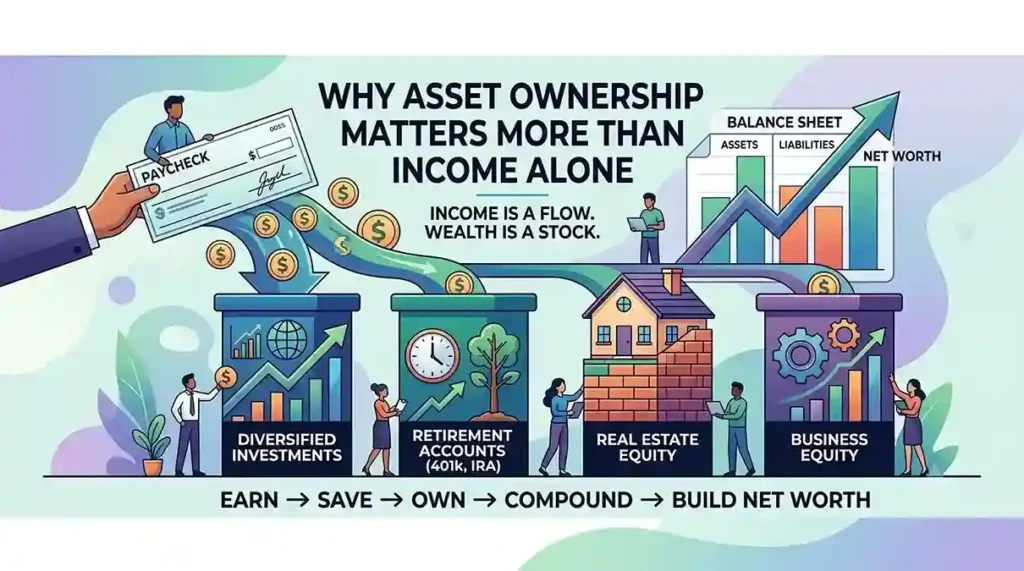
Why Asset Ownership Matters More Than Income Alone
Why Asset Ownership Matters More Than Income Alone
A six-figure salary can look like financial success from the outside. But a large paycheck does not automatically create wealth.
Consider two hypothetical Americans.
Alex earns $180,000 a year. Over time, Alex upgrades to a larger home, finances expensive vehicles, takes frequent vacations, carries substantial consumer debt, and invests very little.
Jordan earns $80,000 a year. Jordan maintains a manageable lifestyle, saves consistently, contributes to retirement accounts, invests in diversified assets, and gradually builds home equity.
Neither example proves who will ultimately become wealthier. Investment performance, taxes, debt, housing costs, family circumstances, career changes, and many other factors matter.
But the comparison reveals an important truth:
Income and wealth are not the same thing.
Income is money flowing into your household over a period of time. Wealth is reflected more broadly in your balance sheet—what you own after subtracting what you owe.
That distinction is at the heart of long-term wealth building.
The objective is not simply to earn more money. It is to create enough financial surplus to acquire and retain assets that can potentially appreciate, generate income, or participate in economic growth over time.
In simple terms:
Earn → Save → Own → Compound → Build Net Worth
That is why asset ownership matters.
Income Is a Flow, While Wealth Is a Stock
One of the easiest ways to understand the difference between income and wealth is to think about a river and a reservoir.
Income is the river. Wealth is the reservoir.
The river represents money arriving during a particular period—your salary, wages, business income, commissions, bonuses, or investment income.
The reservoir represents what has accumulated over time.
A person can have a large income stream but a relatively small reservoir if most of the money immediately flows back out through spending and debt payments.
Conversely, someone with a more modest income can gradually build substantial wealth if they consistently retain part of their income and convert it into assets.
What Is Income?
Income is money received during a specific period.
It can come from:
- Salary
- Wages
- Bonuses
- Commissions
- Self-employment
- Business activities
- Rental income
- Interest
- Dividends
Income is therefore a flow.
It tells you how much money is coming in, but not necessarily how much financial wealth you have accumulated.
What Is Wealth?
Wealth represents accumulated financial resources.
A basic measure is:
Net Worth = Total Assets − Total Liabilities
Assets can include:
- Cash
- Investments
- Retirement accounts
- Real estate
- Business equity
- Other valuable property
Liabilities can include:
- Mortgages
- Credit-card balances
- Auto loans
- Student loans
- Personal loans
The Federal Reserve tracks household wealth through balance-sheet measures that include financial assets, nonfinancial assets, liabilities, and net worth.
Income vs. Wealth
| Concept | Income | Wealth |
|---|---|---|
| What it measures | Money received | Assets minus liabilities |
| Time dimension | Flow | Stock |
| Main sources | Wages, salary, business and investment income | Assets and accumulated capital |
| Relationship to assets | Can be used to acquire assets | Represents accumulated ownership |
| Main question | How much do you earn? | What do you own after debt? |
| Long-term significance | Determines earning capacity | Shows accumulated financial position |
Why a High Income Does Not Automatically Create Wealth
A higher income provides an important advantage because it can create more room between earnings and spending.
But that advantage can disappear when expenses rise along with income.
Lifestyle Inflation
Lifestyle inflation occurs when spending increases as income increases.
A person receives a substantial raise and responds by:
- Buying a more expensive vehicle
- Moving into a more expensive home
- Increasing travel spending
- Upgrading everyday purchases
- Taking on larger monthly commitments
- Increasing discretionary expenses
The person may earn significantly more without building proportionately more wealth.
The Difference Between Earning More and Keeping More
Suppose someone receives an additional $1,000 of monthly income.
If the entire amount is absorbed by higher spending, the person’s lifestyle may improve, but the additional income may have little effect on long-term net worth.
If a portion is consistently saved and invested, however, that additional income can gradually become financial ownership.
The crucial question is therefore not only:
“How much more do I earn?”
It is also:
“How much of that additional income becomes wealth?”
The Wealth-Building Conversion Process
One of the most important financial transitions occurs when income begins to become ownership.
The basic process can be represented as:
Income − Expenses = Savings
Savings → Asset Ownership
Asset Ownership + Time + Reinvestment = Potential Wealth Growth
This is a simplified model. Actual outcomes are affected by taxes, inflation, investment performance, fees, debt costs, and many other factors.
But the framework illustrates the basic mechanism.
Step 1 — Earn
Income provides the financial resources needed to support life and potentially build wealth.
Step 2 — Spend
Some income must be used for housing, food, transportation, healthcare, education, entertainment, and other needs and priorities.
Step 3 — Save
Money that is not consumed can become savings.
Step 4 — Own
Savings can potentially be converted into investments and other assets.
Step 5 — Compound
Over time, investment returns may generate additional returns when they remain invested.
Step 6 — Build Net Worth
As assets grow and liabilities are managed or reduced, household net worth can potentially increase.
What Makes an Asset a Wealth-Building Asset?
Not every asset plays the same role in wealth building.
Productive Assets
Productive assets can potentially generate economic returns.
Examples include:
- Stocks
- Diversified stock funds
- Bonds
- Businesses
- Income-producing real estate
- Retirement investments
Financial Assets
Financial assets can represent claims on financial or economic value.
Examples include:
- Stocks
- Bonds
- Mutual funds
- ETFs
- Retirement investments
- Cash and deposits
Different financial assets have different levels of risk, liquidity, return potential, and volatility.
Real Estate
Real estate can potentially create wealth through:
- Appreciation
- Rental income
- Principal repayment
- Equity accumulation
But property ownership also involves:
- Mortgage interest
- Property taxes
- Insurance
- Maintenance
- Repairs
- Transaction costs
- Financing costs
Therefore, owning real estate does not automatically guarantee wealth creation.
Depreciating Assets
Some things have economic value but generally decline in value over time.
Examples can include:
- Vehicles
- Electronics
- Furniture
- Many consumer products
These purchases can still be useful and necessary.
The distinction is simply that useful consumption is not always the same as productive capital ownership.
The Power of Ownership
Ownership changes the financial equation because it gives you a claim on an asset’s future economic value.
Ownership of Businesses
When you own shares in a company, you have an ownership interest in that business.
If the business becomes more valuable, shareholders may potentially benefit through appreciation.
Some companies may also distribute profits through dividends.
Ownership of Real Estate
A property owner may potentially benefit from:
- Appreciation
- Rental income
- Equity accumulation
But those benefits come with financial responsibilities and risks.
Ownership of Investment Funds
A diversified investment fund can allow ordinary households to own portions of many businesses or other securities without individually selecting every investment.
The important principle is not that assets literally “work while you sleep.”
The more accurate concept is:
Capital you already own can potentially generate returns without requiring you to exchange another hour of labor for every dollar of potential growth.
Compounding: Why Starting Early Matters
Compounding is one of the most important concepts in long-term investing.
What Is Compound Growth?
Compound growth occurs when returns remain invested and subsequently have the opportunity to generate additional returns.
Imagine investing $500 per month for 30 years at a hypothetical 7% annual return, compounded monthly.
You would contribute:
$500 × 12 × 30 = $180,000
Under that hypothetical return assumption, the account could grow to approximately $610,000.
The difference would represent hypothetical investment growth.
This is only an illustration.
A 7% return is not guaranteed. Actual investment performance can be substantially different, and investments can lose value.
Why Time Matters
Compounding becomes more powerful as the investment period increases.
Three variables are particularly important:
- Amount invested
- Rate of return
- Time invested
This is one reason beginning the wealth-building process earlier can be valuable.
Why Asset Ownership Can Increase Financial Resilience
Asset ownership is not only about increasing wealth.
It can also strengthen financial resilience.
Liquid Assets
Cash and other highly liquid assets can provide flexibility when unexpected expenses occur.
Retirement Assets
Retirement investments can provide a pool of capital intended to support future financial needs.
Home Equity
Home equity can represent an important component of household wealth, although it is generally less liquid than cash or marketable securities.
Business Equity
Business ownership can represent substantial wealth but may also expose a household to considerable concentration risk.
The Importance of Diversification
Owning one asset is very different from owning a diversified collection of assets.
Diversification can reduce the impact of poor performance in one investment, although it cannot eliminate investment losses.
Real Estate Is Important, but It Is Not the Only Path to Wealth
Real estate has historically been an important component of household wealth in the United States.
The Federal Reserve’s 2022 Survey of Consumer Finances found that 66.1% of families owned their primary residence.
But owning a home does not automatically mean owning an equivalent amount of wealth.
Home Value vs. Home Equity
Suppose a home is worth:
$400,000
and the remaining mortgage is:
$300,000
The homeowner’s approximate equity would be:
$400,000 − $300,000 = $100,000
The $400,000 is the property’s value.
The $100,000 is approximately the owner’s equity, before considering other factors.
Costs of Homeownership
Homeowners may have to pay:
- Mortgage interest
- Property taxes
- Insurance
- Maintenance
- Repairs
- Closing costs
- Selling costs
Therefore:
Homeownership is not automatically superior to renting.
The financial outcome depends on the purchase price, financing, holding period, local market, maintenance costs, taxes, insurance, opportunity cost, and household circumstances.
Stocks and Funds Provide Another Form of Ownership
People do not need to start businesses to participate in business ownership.
Stocks
A stock represents an ownership interest in a company.
Mutual Funds and ETFs
Funds can allow investors to own exposure to many securities through a single investment vehicle.
Diversification
Diversification spreads exposure across multiple investments.
It cannot eliminate risk, but it can reduce dependence on the performance of a single investment.
Long-Term Investing
Long-term investing focuses on giving capital time to potentially compound rather than attempting to predict every short-term market movement.
Business Ownership and Equity
Business ownership can be another significant form of wealth.
How Business Equity Works
A business owner’s wealth can be connected to:
- Business profitability
- Revenue
- Growth prospects
- Assets
- Cash flow
- Market conditions
- Business debt
The Potential Benefits
Business ownership can potentially create:
- Income
- Equity
- Capital appreciation
- Greater control over economic activity
The Risks
Entrepreneurship can also involve:
- Loss of invested capital
- Variable income
- Business failure
- Concentration risk
- Debt
- Market competition
Starting a business is therefore one possible wealth-building path, not a requirement for becoming wealthy.
Retirement Accounts Are Ownership Vehicles Too
Retirement accounts can help households turn earned income into long-term investment ownership.
Common examples include:
- 401(k)
- 403(b)
- Traditional IRA
- Roth IRA
The Account Is Not the Investment
This distinction is important.
A 401(k) is an account structure.
The investments held inside that account may include:
- Stocks
- Bonds
- Mutual funds
- Other investment options
Likewise, an IRA is an account rather than a specific investment.
Why Tax Treatment Matters
Different retirement accounts can have different tax rules.
Those rules can affect how contributions, investment growth, and withdrawals are treated.
For that reason, retirement accounts should be understood as part of a broader wealth-building strategy rather than simply as savings containers.
Why Net Worth Can Be More Informative Than Salary
Salary tells you about current earning power.
Net worth tells you about accumulated financial position.
What Should You Track?
A household can periodically track:
Assets
- Checking and savings
- Investment accounts
- Retirement accounts
- Real estate equity
- Business interests
- Other meaningful assets
Liabilities
- Mortgage
- Credit cards
- Auto loans
- Student loans
- Personal loans
- Other debts
Then calculate:
Total Assets − Total Liabilities = Net Worth
Why Track Net Worth?
Tracking net worth can help reveal whether:
- savings are increasing
- debt is declining
- investments are growing
- lifestyle inflation is consuming raises
- asset ownership is increasing
The goal is not to obsess over a single number.
The goal is to observe the direction of your financial trajectory.
Income and Asset Ownership Are Partners, Not Opponents
It would be a mistake to conclude that income is unimportant.
Income matters enormously.
Higher income can create greater capacity to save and invest.
The more accurate relationship is:
Higher Income → Greater Potential Surplus → Greater Investment Capacity → Greater Asset Ownership → Potential Long-Term Wealth Growth
But each step depends on decisions and circumstances.
Why Higher Income Helps
Higher income can make it easier to:
- Cover essential expenses
- Build emergency savings
- Pay down debt
- Invest
- Acquire assets
- Increase retirement contributions
Why Income Alone Is Insufficient
If higher earnings are completely consumed, the household may not build proportionate wealth.
This is why the relationship between income and ownership matters more than income alone.
How Someone With an Average Income Can Begin Building Ownership
You do not need to become wealthy before beginning to build wealth.
Step 1 — Build Basic Financial Stability
Maintain an appropriate emergency reserve.
Step 2 — Address Expensive Debt
High-interest debt can make long-term wealth building more difficult.
Step 3 — Use Available Employer Benefits
Where appropriate, take advantage of employer-sponsored retirement plans and available employer contributions.
Step 4 — Automate Contributions
Automatic contributions can make long-term saving more consistent.
Step 5 — Diversify
Avoid allowing one investment, property, employer, or business to dominate your entire financial future.
Step 6 — Increase Ownership as Income Rises
When your income increases, consider directing at least part of the increase toward long-term assets rather than allowing the entire raise to become lifestyle inflation.
Step 7 — Track Net Worth
Review your financial position periodically.
Step 8 — Think in Decades
Wealth building is generally a long-term process.
The “Own More, Consume Less” Principle
The idea of consuming less and owning more does not mean eliminating enjoyment.
Money should support a meaningful life.
The objective is balance.
Consumption vs. Ownership
Money spent on consumption generally provides a current benefit.
Money invested in an asset becomes part of your financial capital.
Neither is inherently good or bad.
The key question is whether your household has enough financial surplus to do both:
Live today and build for tomorrow.
Why This Matters as Income Increases
A raise provides an opportunity.
Instead of allowing every additional dollar to disappear into higher expenses, part of the increase can potentially become long-term ownership.
That is how higher income can translate into higher net worth.
Common Misconceptions About Asset Ownership
“I Need a Huge Income Before I Can Invest.”
Not necessarily.
Small, sustainable contributions can establish the habit of turning income into ownership.
“Owning a House Automatically Makes Me Wealthy.”
No.
The homeowner’s equity—not the entire property value—is part of net worth.
“Every Asset Is a Good Investment.”
No.
Assets can lose value, produce poor returns, carry high costs, or expose investors to excessive risk.
“More Assets Always Mean More Wealth.”
No.
Liabilities matter.
Someone could have $1 million in assets and $1.2 million in liabilities.
Their net worth would be negative $200,000.
“Debt Is Always Bad.”
Not necessarily.
Debt can finance useful assets and opportunities, but borrowing introduces costs and risk.
“The Stock Market Is Only for Wealthy People.”
Public-market investing can be accessible to households with relatively modest amounts of capital, although all investments involve risk.
“Business Ownership Is the Fastest Route to Wealth.”
There is no universally fastest or safest route.
Entrepreneurship can create significant wealth but can also create significant losses.
“A High Salary Means I’m Financially Successful.”
A high salary is an advantage.
It is not the same thing as accumulated wealth.
Asset Ownership Does Not Mean Buying Everything
The objective is not to accumulate as many assets as possible.
The objective is to own appropriate assets at an appropriate level of risk.
Factors to Consider
A wealth-building strategy should consider:
- Risk
- Diversification
- Liquidity
- Taxes
- Fees
- Time horizon
- Debt
- Expected return
- Personal circumstances
Ownership Without Sound Judgment Can Still Destroy Wealth
Someone can technically own many assets while still making poor financial decisions.
For example, concentrating almost all household wealth in one speculative investment creates ownership but not necessarily financial security.
Similarly, purchasing an expensive property with excessive debt can create a valuable asset alongside a substantial liability.
Ownership matters, but the quality and structure of ownership matter too.
A Practical Wealth-Building Framework
Use this seven-step framework to think about wealth creation.
Step 1 — Earn
Increase your ability to generate income.
Step 2 — Protect
Build financial resilience and manage major financial risks.
Step 3 — Keep
Control unnecessary spending and expensive debt.
Step 4 — Own
Direct an appropriate portion of your surplus toward productive assets.
Step 5 — Compound
Give invested capital time to potentially grow.
Step 6 — Diversify
Avoid depending excessively on one investment, asset, employer, or business.
Step 7 — Preserve
Protect accumulated wealth through appropriate risk management, diversification, tax awareness, and financial planning.
Five Hypothetical Examples of Income Becoming Ownership
Example 1 — High Income, Low Ownership
A professional earns $180,000 but spends almost $170,000 annually while carrying significant consumer debt.
The person has high earning power but limited financial capital.
Example 2 — Moderate Income, Consistent Ownership
A household earns $80,000 and consistently directs part of its income toward diversified investments.
The household may gradually build financial assets even without a six-figure salary.
Example 3 — Home Equity
A homeowner owns a $400,000 property and has a $300,000 mortgage.
Approximate equity:
$400,000 − $300,000 = $100,000
Example 4 — Business Equity
An entrepreneur owns a business valued at $500,000.
That valuation is not the same as $500,000 in cash.
The business value can rise or fall depending on profitability, growth, debt, market conditions, and other factors.
Example 5 — Long-Term Investing
An investor contributes $500 per month for 30 years at a hypothetical 7% annual return compounded monthly.
Total contributions:
$180,000
Illustrative ending value:
Approximately $610,000
The result is hypothetical and does not represent a guaranteed investment outcome.
The Deeper Lesson: Ownership Changes the Direction of Money
The most important shift in wealth building happens when money stops being viewed only as something to spend.
It becomes something that can also be converted into capital.
A paycheck arrives.
Some pays for today’s life.
Some protects against emergencies.
Some pays down obligations.
And, when circumstances allow, some acquires assets.
Those assets may potentially generate returns.
Those returns may potentially be reinvested.
Reinvestment can create additional capital.
Over time, this can create a powerful financial cycle:
Income → Savings → Ownership → Potential Returns → Reinvestment → Greater Ownership
This is one of the fundamental mechanisms behind long-term wealth accumulation.
Bottom Line: Income Builds Possibility; Ownership Builds the Balance Sheet
Income matters.
It is often the starting point of wealth building because it provides the resources from which savings and investments can be made.
But income alone does not tell the whole financial story.
A paycheck can fund a lifestyle.
Ownership can help build a balance sheet.
The more useful questions are therefore not limited to:
“How much do I earn?”
Also ask:
“How much do I own?”
“How much do I owe?”
“How much of my income am I converting into long-term assets?”
This mindset changes how financial progress is measured.
Sustainable wealth building is rarely about one extraordinary financial decision. It is more often the result of a repeated process:
Earn well → Spend intentionally → Save consistently → Own productive assets → Manage risk → Reinvest when appropriate → Give time the opportunity to work.
Income creates the capacity to build wealth.
Asset ownership creates the foundation on which wealth can potentially grow.
Net worth is where many of those decisions ultimately show up.
Practical Checklist — Are You Converting Income Into Wealth?
- Do I know my current net worth?
- Do I know the total value of my major assets?
- Do I know how much I owe?
- Am I consistently saving part of my income?
- Am I converting some savings into long-term assets?
- Am I using appropriate retirement accounts?
- Are my investments appropriately diversified?
- Am I carrying expensive consumer debt?
- Has my lifestyle increased faster than my income?
- Do I understand the risks associated with my major assets?
- Am I increasing ownership as my income grows?
- Am I thinking about wealth over decades rather than months?
The goal is not to check every box immediately.
The goal is to move gradually from earning income toward building financial ownership.
Frequently Asked Questions
Is asset ownership more important than income?
Neither should be viewed in isolation. Income provides the resources that can be saved and invested, while asset ownership can allow capital to participate in potential growth and income generation.
Can You Build Wealth Without a High Income?
Yes. A high income can make wealth building easier, but savings behavior, debt management, investment choices, time, asset ownership, and compounding can all influence long-term wealth.
What Assets Are Commonly Used to Build Wealth?
Common categories include diversified stocks and funds, bonds, retirement investments, real estate, and business equity. Each has different risks, costs, liquidity characteristics, and potential returns.
Why Is Net Worth Useful for Measuring Wealth?
Net worth accounts for both sides of a household’s balance sheet. It considers what you own and subtracts what you owe, providing a broader picture of accumulated financial resources than income alone.
How Can Someone Start Building Assets With a Modest Income?
A practical starting point can include establishing financial stability, managing expensive debt, building appropriate savings, using available retirement benefits, and gradually directing affordable amounts toward diversified long-term investments.
If you want the broader picture, see How to Build Wealth in America: The Complete Guide to Growing, Protecting, and Preserving Your Money.
Financial Disclaimer
This article is provided for general educational and informational purposes only. It does not constitute individualized financial, investment, tax, legal, insurance, retirement, or estate-planning advice. Investments involve risk, including possible loss of principal. Tax laws, contribution limits, regulations, and financial conditions can change. Current IRS rules should be checked for tax-year-specific decisions, and individuals with complex circumstances should consider consulting appropriately qualified professionals.
