
Debt Avalanche vs. Debt Snowball: Which Strategy Is Better for Paying Off Debt?
Debt Avalanche vs. Debt Snowball: Which Strategy Is Better for Paying Off Debt?
Paying off debt can feel overwhelming when several balances compete for your attention. You may have credit card debt, a personal loan, medical bills, or multiple accounts with different interest rates and minimum payments. The challenge is not just finding extra money—it is deciding which debt to pay off first.
Two popular debt payoff strategies are the debt avalanche and debt snowball methods. Both require you to continue making at least the minimum payments on your debts while putting extra money toward one target account. The key difference is how that target is chosen.
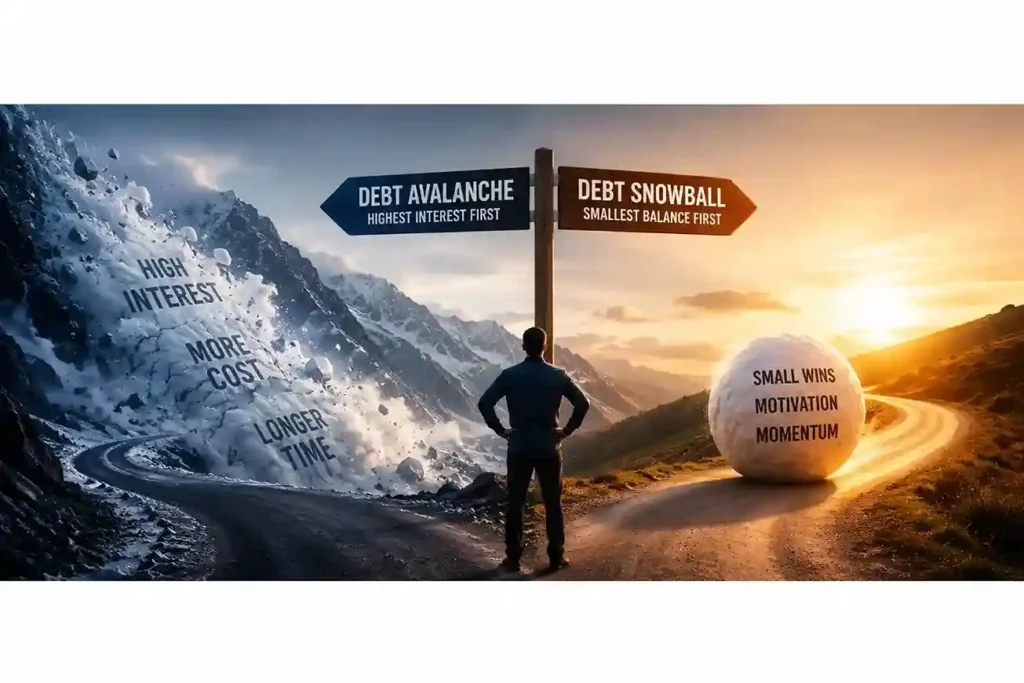
The debt avalanche prioritizes the debt with the highest interest rate. The debt snowball prioritizes the smallest balance.
The avalanche approach generally has a mathematical advantage because it targets more expensive debt first. The snowball approach can provide quicker victories, which may help some people stay motivated.
So, which strategy is better? The answer depends not only on the numbers, but also on your ability to follow the plan consistently.
What Is the Debt Avalanche Method?
The debt avalanche method is a repayment strategy that puts your extra money toward the debt with the highest interest rate first, regardless of its balance. You continue making at least the minimum payment on your other accounts while concentrating additional money on the most expensive debt.
To get started, list each debt along with its balance, APR, and minimum payment. Then rank your debts from the highest interest rate to the lowest. Make the required minimum payments on all accounts and direct any extra money toward the debt at the top of the list.
Once that debt is completely paid off, take the money you had been putting toward it and apply it to the next-highest-interest debt. Continue repeating the process until your balances are eliminated.
For example, imagine you have a $5,000 credit card balance at 25% APR, a $2,000 personal loan at 12%, and a $1,000 medical balance with no interest. Under the avalanche method, the 25% credit card would receive the extra payment first even though it has the largest balance.
The potential advantage is interest efficiency. By targeting high-interest debt first, you can potentially reduce the amount of interest that accumulates during repayment. The CFPB similarly describes the highest-interest-rate method as focusing on the debt that costs the most, which can save money over time.
The drawback is that your first payoff milestone may take longer if the highest-interest debt has a large balance.
What Is the Debt Snowball Method?
The debt snowball method takes a different approach. Instead of looking at interest rates, you prioritize your smallest debt balance first.
Start by listing your debts from the smallest balance to the largest. Continue making at least the minimum payment on every account, but direct any extra money toward the smallest balance. Once that debt reaches $0, roll the payment you were making into the next-smallest debt.
For example, suppose you have a $900 medical bill, a $2,000 personal loan, and a $5,000 credit card balance. Even if the credit card has the highest APR, the snowball method would have you focus on the $900 medical balance first.
The biggest potential advantage of the snowball method is quick visible progress. Eliminating an account can create a sense of accomplishment and make a larger debt problem feel easier to manage.
The CFPB explains that the snowball approach focuses on the smallest debt and can help borrowers see progress more quickly. However, because it does not prioritize the most expensive debt, it can result in paying more overall in some situations.
The trade-off is important: snowball may offer stronger psychological momentum, while avalanche generally offers stronger mathematical efficiency. Explore More
Debt Avalanche vs. Debt Snowball: What’s the Difference?
The simplest way to understand the difference is this:
Debt avalanche asks: “Which debt is costing me the most?”
Debt snowball asks: “Which debt can I eliminate first?”
Both methods require you to keep making the minimum payments on your other debts. The difference is where you direct your extra money.
| Factor | Debt Avalanche | Debt Snowball |
| First target | Highest APR | Smallest balance |
| Primary goal | Reduce interest | Build momentum |
| Early payoff | May take longer | Often happens sooner |
| Mathematical efficiency | Generally stronger | May be lower |
| Psychological benefit | Long-term savings focus | Quick victories |
| Best fit | Cost-conscious borrowers | Motivation-focused borrowers |
If your main priority is minimizing interest and you can stay committed to a longer-term plan, avalanche may be attractive.
If you find motivation difficult and want to see accounts disappear quickly, snowball may be easier to maintain.
Neither method is automatically right for everyone. Your debt amounts, interest rates, budget, and repayment behavior all matter.
Example: How Both Strategies Work
Consider a hypothetical borrower with four debts:
| Debt | Balance | APR |
| Credit Card A | $1,200 | 24.99% |
| Credit Card B | $3,500 | 19.99% |
| Personal Loan | $6,000 | 12% |
| Medical Debt | $900 | 0% |
Assume the borrower can make all minimum payments and has additional money available each month.
Debt Avalanche Order
The avalanche method looks at interest rates.
The highest APR is Credit Card A at 24.99%, so that becomes the first target.
Avalanche order:
- Credit Card A — 24.99%
- Credit Card B — 19.99%
- Personal Loan — 12%
- Medical Debt — 0%
After Credit Card A is paid off, the borrower rolls that payment toward Credit Card B.
Debt Snowball Order
The snowball method looks only at balances.
The smallest balance is the $900 medical debt.
Snowball order:
- Medical Debt — $900
- Credit Card A — $1,200
- Credit Card B — $3,500
- Personal Loan — $6,000
The borrower may eliminate the medical debt relatively quickly, creating an early victory before moving to the $1,200 credit card.
Notice what happens: the two strategies produce different repayment orders even though the borrower has exactly the same debts.
The avalanche method attacks the most expensive debt first, while the snowball method attacks the smallest debt first.
Actual repayment times and interest costs will depend on the balances, APRs, minimum payments, fees, and amount of extra money paid each month.
Which Method Saves More Money?
If your primary goal is to minimize interest, the debt avalanche generally has the mathematical advantage.
That is because your extra payment goes toward the debt with the highest interest rate first. Paying down an expensive balance sooner can reduce the amount of interest that accumulates compared with leaving that balance untouched while paying off a lower-interest debt.
This distinction can be particularly important when credit card debt carries a significantly higher APR than other types of debt.
The snowball method does not prioritize interest rates. A borrower may pay off a small, low-interest balance while continuing to carry a larger balance with a higher APR.
That can mean paying more interest in some circumstances.
However, the potential difference is not identical for every borrower. Your actual results depend on your individual debt structure and payment behavior.
There is also an important practical consideration: the mathematically efficient strategy is not necessarily the strategy you will successfully follow.
If using the snowball method helps you make consistent extra payments for years, it may be more useful to you than choosing avalanche and abandoning the plan after a few months.
Which Method Helps You Stay Motivated?
Debt repayment can take months or years, so motivation can become just as important as mathematics.
This is where the debt snowball may appeal to some borrowers. Because it targets the smallest balance, it can produce an account with a $0 balance relatively quickly.
That visible progress can make a large debt problem feel less intimidating. Instead of seeing four accounts that still need attention, you may eventually see three.
For someone who feels overwhelmed by debt, that psychological win can be meaningful.
The avalanche method can also provide motivation, especially for people who enjoy seeing their interest costs decrease or prefer making financially optimized decisions. But if the highest-interest debt is large, the first payoff milestone may take longer.
The key question is therefore not simply:
“Which method is mathematically better?”
It is also:
“Which method am I most likely to follow consistently?”
A repayment plan only works when you actually follow it.
Debt Avalanche vs. Debt Snowball: Pros and Cons
Debt Avalanche Pros
- Targets high-interest debt first.
- Can reduce interest costs over time.
- Provides a clear repayment priority.
- Makes sense for borrowers focused on mathematical efficiency.
Debt Avalanche Cons
- The first payoff may take longer.
- Progress may feel slower.
- Requires attention to APRs.
- Can be less emotionally rewarding for borrowers who prefer quick victories.
Debt Snowball Pros
- Targets the smallest balance first.
- Can create quick wins.
- Provides visible progress.
- Simple to understand and organize.
- May help some borrowers maintain motivation.
Debt Snowball Cons
- Does not prioritize the highest-interest debt.
- May result in higher interest costs in some situations.
- Can delay repayment of an expensive balance.
- May be less mathematically efficient than avalanche.
The important point is that neither method eliminates the need for budgeting and consistent payments.
Which Debt Payoff Method Is Right for You?
The best debt payoff method depends on your priorities, financial situation, and behavior.
Avalanche may be a better fit if:
- You want to prioritize interest savings.
- You are comfortable waiting for larger payoff milestones.
- You have high-interest credit card debt.
- You are comfortable organizing debts by APR.
- You can stay disciplined with a long-term strategy.
Snowball may be a better fit if:
- You need quick victories to stay motivated.
- You feel overwhelmed by multiple accounts.
- You prefer a simple repayment system.
- You have struggled to maintain debt repayment plans.
- Seeing balances reach $0 gives you momentum.
There is no requirement to choose the strategy that someone else considers “best.” Your circumstances are different from another borrower’s.
If you can follow avalanche consistently, its focus on high-interest debt may be attractive. If snowball gives you the motivation to continue making extra payments, that behavioral advantage may be more important.
The best plan is one that is realistic, sustainable, and aligned with your financial priorities.
Can You Combine Debt Avalanche and Debt Snowball?
Yes. Some borrowers may prefer a hybrid approach.
For example, you could pay off one very small balance first to create momentum and then switch to the avalanche method for the remaining debts.
Another possibility is to prioritize a particularly expensive debt while considering whether a very small balance can be eliminated without significantly disrupting your broader repayment plan.
The important thing is to avoid constantly changing strategies without a clear reason. A repayment plan should remain simple enough to track and follow.
A hybrid approach is not automatically better than avalanche or snowball. It is simply another option for someone who wants to balance mathematical efficiency with motivation.
How to Start Paying Off Debt
Once you have chosen your strategy, turn it into a specific repayment plan.
- List every debt.
Include credit cards, personal loans, medical bills, student loans, and other balances. - Record each balance.
Write down the current amount owed on every account. - Record each APR.
Interest rates are essential if you are considering the avalanche method. - Record minimum payments.
Your budget needs to account for the required payment on every debt. - Determine your extra payment.
Review your monthly income and expenses and identify an amount you can realistically put toward your target debt. - Choose avalanche, snowball, or a hybrid.
- Continue making minimum payments.
Do not neglect your other accounts while concentrating on your target debt. - Direct extra money toward your target.
- Roll the payment forward.
When one debt is eliminated, redirect that payment toward the next debt. - Track your progress.
Update your balances regularly so you can see your progress and adjust your plan when necessary.
If your income or expenses change, reassess the plan rather than assuming you have failed.
Common Debt-Payoff Mistakes to Avoid
Choosing a repayment method is only one part of becoming debt-free. Avoiding common mistakes can help protect your progress.
Continuing to add new debt can make it difficult to reduce existing balances. If possible, avoid using credit for purchases you cannot comfortably repay.
Ignoring interest rates can also be costly. Even if you choose the snowball method, understand which accounts carry the highest APRs so you know the potential trade-off.
Using all of your savings to pay debt can leave you without money for unexpected expenses. An emergency expense could force you to borrow again.
Paying only minimums indefinitely can make high-interest debt difficult to eliminate.
Another mistake is creating an overly complicated repayment system. If you cannot easily understand your own plan, it may become difficult to follow.
Finally, do not assume that one difficult month means your strategy has failed. Review your budget, make reasonable adjustments, and continue working toward your goal.
Other Debt Relief Options to Consider
Avalanche and snowball are repayment strategies, but they are not the only options available to people struggling with debt.
A balance transfer credit card may offer eligible borrowers a promotional interest rate for transferred balances. However, fees, eligibility requirements, and promotional periods can affect whether this option makes financial sense.
A debt consolidation loan combines multiple debts into one loan. It may simplify payments, but the new interest rate, fees, repayment period, and total cost should be compared carefully with your existing debts.
Credit counseling is another option. The CFPB says credit counseling organizations can help consumers review their finances, develop budgets, and create debt-management plans.
If you consider professional debt-relief services, research the organization carefully. The FTC warns consumers about debt-relief scams, including companies that demand upfront fees or make unrealistic promises about eliminating debt.
If you are having difficulty making payments, contacting creditors directly may also be worth considering. Depending on the situation, a creditor may discuss payment options with you.
No debt-relief option is automatically right for everyone. Review the costs, risks, eligibility requirements, and potential effects before making a decision.
Debt Avalanche vs. Debt Snowball: Final Verdict
So, which is better—the debt avalanche or debt snowball?
If your main objective is to minimize interest costs, the debt avalanche generally has the mathematical edge because it prioritizes your highest-interest debt.
If your biggest challenge is staying motivated, the debt snowball may be more appealing because it can produce faster visible victories.
The right choice depends on your balances, APRs, budget, and personal behavior.
You can also use a hybrid approach if that helps you create a repayment plan you can realistically maintain.
Ultimately, the “best” debt payoff strategy is not simply the one that looks best on paper. It is the strategy you can consistently follow.
Choose a method, make a realistic plan, keep making your required payments, and direct additional money toward your target debt whenever your budget allows.
This article is for educational purposes only and is not personalized financial advice.
Frequently Asked Questions
Is debt avalanche better than debt snowball?
Neither method is universally better. Debt avalanche generally has the mathematical advantage because it prioritizes higher-interest debt, while debt snowball focuses on eliminating smaller balances first. Your priorities and ability to stay consistent should influence the decision.
Does debt avalanche save more interest?
It can. By targeting the highest-interest debt first, avalanche can reduce interest costs compared with prioritizing lower-interest debts. Actual savings depend on your balances, APRs, minimum payments, fees, and repayment amount.
Is debt snowball easier to follow?
For some borrowers, yes. The snowball method is simple and can produce quick wins by eliminating smaller balances. Those visible milestones may help people who struggle with motivation stay engaged with their repayment plan.
Should I pay the smallest debt or highest-interest debt first?
Pay the smallest balance first if you are using the snowball method. Pay the highest-interest debt first if you are using the avalanche method. If minimizing interest is your priority, avalanche is generally the more mathematically efficient approach.
Can I switch from snowball to avalanche?
Yes. You can change your repayment strategy if your circumstances or priorities change. For example, you might eliminate one small balance for motivation and then switch to the highest-interest debt.
What if I can only afford minimum payments?
Focus first on keeping your accounts current and avoiding additional debt when possible. Review your budget for ways to increase payments. If you are struggling to manage your debts, consider speaking with a reputable credit counselor.
Can I use the debt avalanche method for credit card debt?
Yes. The avalanche method can be used for credit card debt by prioritizing the card with the highest APR while continuing to make the required minimum payments on your other accounts.
Can I combine debt snowball and avalanche?
Yes. A hybrid strategy can combine elements of both approaches. For example, you could eliminate one small balance to create momentum and then prioritize the highest-interest debt. The key is maintaining a clear and sustainable plan.
Disclaimer
This article is provided for general informational and educational purposes only and does not constitute financial, investment, tax, legal, or retirement advice. Everyone’s financial situation, goals, income, risk tolerance, and circumstances are different. Before making financial decisions, including investing, choosing retirement accounts, purchasing insurance, or taking on or paying off debt, consider consulting a qualified financial, tax, or legal professional. Investment values can rise or fall, and past performance does not guarantee future results. Always verify current rules, limits, fees, and tax requirements with official sources and qualified professionals.

Pingback: 10 Proven Ways To Build Wealth From Scratch In America