
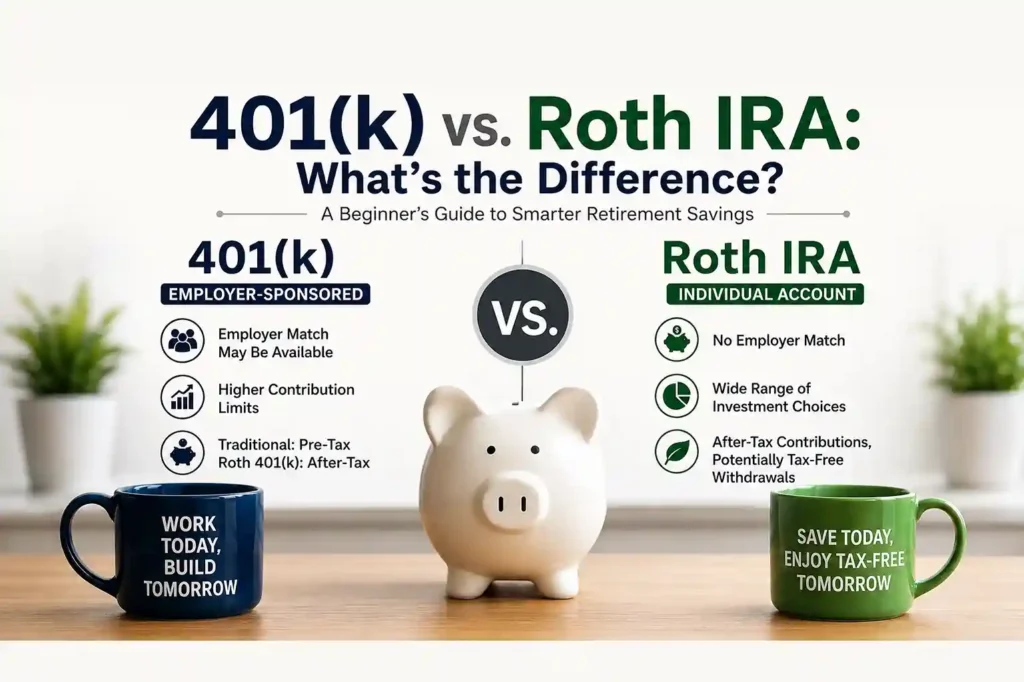
401(k) vs. Roth IRA: What’s the Difference? A Beginner’s Guide
401(k) vs. Roth IRA: What’s the Difference? A Beginner’s Guide
Saving for retirement can feel complicated when you’re faced with terms like 401(k), Roth IRA, traditional IRA, pre-tax contributions, after-tax contributions, and employer matching. For many Americans, one of the biggest questions is simple: Should I save for retirement in a 401(k) or a Roth IRA?
The good news is that you don’t always have to choose just one.
A 401(k) and a Roth IRA are both designed to help you build retirement savings, but they work differently. They have different tax rules, contribution limits, investment options, and eligibility requirements. Understanding those differences can help you make smarter decisions with your retirement dollars.
In many cases, the most effective strategy isn’t choosing between a 401(k) and a Roth IRA. It may be learning how to use both accounts strategically.
Let’s break down the differences in plain English.
What Is a 401(k)?
A 401(k) is an employer-sponsored retirement plan. If your company offers one, you can generally contribute money directly from your paycheck into the account.
The money is then invested according to the choices available through your employer’s retirement plan.
One major advantage of a 401(k) is convenience. Contributions can happen automatically every pay period, which makes retirement saving easier to maintain over the long term.
There are two major types of 401(k) contributions you may encounter: traditional 401(k) contributions and Roth 401(k) contributions.
Traditional 401(k)
With a traditional 401(k) Plan , contributions are generally made with pre-tax dollars for federal income-tax purposes. This can potentially reduce your taxable income for the year in which you contribute.
However, you generally pay ordinary income taxes when you take taxable distributions from the account in retirement.
In simple terms:
Tax benefit potentially comes today → taxes generally come later.
Roth 401(k)
A Roth 401(k) works differently. Contributions are made with after-tax dollars, meaning you don’t generally receive an upfront federal income-tax deduction for those contributions.
If the applicable requirements are met, qualified withdrawals can generally be tax-free.
This gives workers another way to build retirement savings while paying taxes on the money today rather than later.
What Is a Roth IRA?
A Roth IRA is an individual retirement account that you can generally open through a financial institution such as a brokerage firm or investment company.
Unlike a 401(k), it isn’t dependent on your employer offering a retirement plan.
With a Roth IRA, you contribute money that has already been taxed. You generally don’t receive a current federal income-tax deduction for making a contribution.
The potential long-term benefit is that qualified withdrawals can generally be tax-free.
That can be particularly valuable because investment growth inside the account may compound for many years without creating federal income tax on qualified withdrawals.
However, Roth IRA contributions are subject to annual limits and income-based eligibility rules. These rules can change, so investors should check current IRS guidance when making contribution decisions.
401(k) vs. Roth IRA: Key Differences at a Glance
The easiest way to understand these accounts is to compare their major features.
| Feature | 401(k) | Roth IRA |
| Who offers it? | Usually an employer | Individual financial institution |
| Contributions | Traditional 401(k) generally pre-tax; Roth 401(k) after-tax | After-tax |
| Employer match | May be available | No employer match |
| Contribution limits | Generally higher than IRA limits | Generally lower than 401(k) limits |
| Income restrictions | Rules depend on the type of 401(k); generally no Roth IRA-style income limit for traditional 401(k) participation | Income can affect direct Roth IRA eligibility |
| Investment choices | Depends on the employer’s plan | Usually broad, depending on provider |
| Current tax deduction | Generally available for traditional 401(k) contributions | Generally not available |
| Qualified withdrawals | Traditional: generally taxable; Roth 401(k): potentially tax-free | Generally tax-free |
| Automatic contributions | Usually available through payroll | Usually set up separately |
| Employer required? | Generally yes | No |
The exact contribution limits, income thresholds, and tax rules can change. Always check current IRS rules before making retirement decisions.
The Biggest Difference: When Do You Pay Taxes?
Tax treatment is one of the most important differences between a traditional 401(k) and a Roth IRA.
Think about it this way:
Traditional 401(k): Pay taxes later.
Roth IRA: Pay taxes now, potentially avoid taxes on qualified withdrawals later.
Suppose you have $5,000 available for retirement savings.
If you put eligible money into a traditional 401(k), you may receive a current federal income-tax benefit, depending on your circumstances. The tradeoff is that withdrawals from the account are generally taxable as ordinary income.
If you put $5,000 into a Roth IRA, you contribute after-tax money. You don’t generally receive a current federal income-tax deduction. But qualified withdrawals in retirement can generally be tax-free.
The better tax treatment depends partly on your current tax situation and what you expect your tax situation to look like in the future.
That’s why there’s no universal answer to the question, “Is Roth always better?”
Why the Employer 401(k) Match Matters
One of the biggest reasons to pay attention to your 401(k) is the employer match.
Some employers contribute additional money to your 401(k) when you contribute. The formula varies from company to company.
For example, imagine an employer says it will match a portion of employee contributions up to a certain percentage of salary.
If you contribute enough to receive the full available match, your employer may add money to your retirement savings according to the plan’s rules.
That’s a valuable benefit because you’re not relying entirely on your own contributions.
This is why employees should carefully read their employer’s 401(k) plan information. Find out:
- Whether your employer offers a match
- How the match is calculated
- How much you need to contribute to receive the maximum available match
- Whether a vesting schedule applies
- What investment options are available
- What fees the plan charges
The employer match can make a 401(k) particularly attractive.
When a Roth IRA May Be More Attractive
A Roth IRA can be a useful retirement account for many eligible investors.
- Potentially tax-free qualified withdrawals
Because you contribute after-tax money, qualified Roth IRA withdrawals can generally be tax-free.
That can provide valuable flexibility during retirement.
- Investment flexibility
A workplace 401(k) usually provides a menu of investments selected by the plan. A Roth IRA can potentially give you access to a broader selection of investments, depending on the financial institution you choose.
- You control the account
A Roth IRA isn’t tied to your employer. If you change jobs, the account generally remains yours.
- It can complement a 401(k)
You don’t necessarily need to think of a Roth IRA as an alternative to a 401(k).
For an eligible saver, the two accounts can potentially work together.
You might use a workplace 401(k) for employer matching and additional retirement savings while also contributing to a Roth IRA.
When a 401(k) May Be the Better Choice
A 401(k) can have several advantages, particularly when your employer offers a strong matching program.
Employer matching
This can be one of the most valuable features of a workplace retirement plan.
Higher contribution potential
401(k) contribution limits are generally much higher than IRA contribution limits. That can make a 401(k) especially useful for people who want to save aggressively for retirement.
Automatic payroll deductions
Automatic contributions make saving easier.
Instead of waiting until the end of the month to see what’s left in your checking account, you can direct part of each paycheck toward retirement before you have a chance to spend it.
Potential current tax benefits
Traditional 401(k) contributions generally receive favorable federal income-tax treatment in the year of contribution, subject to applicable rules.
For workers in higher tax brackets, that immediate tax benefit may be worth considering.
Should You Have Both a 401(k) and a Roth IRA?
For many people, the answer can be yes.
There’s no rule that says you have to choose one retirement account and ignore the other.
A possible strategy could look like this:
First: Check whether your employer offers a 401(k) match.
Second: Consider contributing enough to the 401(k) to receive the full available employer match, if that fits your budget and plan rules.
Third: If you’re eligible, consider whether a Roth IRA makes sense for your long-term tax strategy.
Fourth: If you still have money available for retirement savings, consider increasing your 401(k) contributions within applicable limits.
The exact order can vary depending on your income, tax situation, debt, emergency savings, investment choices, fees, and retirement goals.
The key idea is that retirement accounts don’t necessarily have to compete with each other.
They can work together.
401(k) vs. Roth IRA for Different Types of Savers
Your circumstances matter.
If you’re early in your career
A Roth IRA may be appealing because you’re potentially giving your contributions many years to grow. If you expect your income and tax rate to increase as your career progresses, paying taxes on contributions today and potentially receiving tax-free qualified withdrawals later may be attractive.
However, your current tax bracket and overall financial situation still matter.
If you’re currently in a higher tax bracket
A traditional 401(k) may deserve serious consideration because eligible contributions can provide a current federal income-tax benefit.
You may prefer receiving a tax benefit today rather than waiting for potential tax advantages in retirement.
If your employer offers a strong match
The 401(k) deserves special attention.
An employer match can significantly enhance the amount going toward retirement compared with relying only on your own contributions.
If you want greater investment flexibility
A Roth IRA may offer a wider range of investment choices, depending on the provider.
A workplace plan may have a more limited menu.
If you’re just starting to save
Don’t get stuck trying to find the perfect account before you start.
The habit of consistently saving and investing for retirement is extremely important.
A good retirement strategy that you actually follow is generally more useful than a theoretically perfect strategy that you never implement.
What About a Roth 401(k)?
Here’s where retirement terminology can become confusing.
A Roth 401(k) and a Roth IRA are not the same thing.
A Roth 401(k) is an employer-sponsored retirement plan option.
A Roth IRA is an individual retirement account.
Both use after-tax contributions, and qualified distributions can generally be tax-free. But their contribution limits, eligibility rules, and other features differ.
A Roth 401(k) may be especially interesting for someone who wants Roth tax treatment but also wants access to the generally higher contribution limits associated with a 401(k).
Some employers offer both traditional and Roth 401(k) options, allowing employees to decide how they want their contributions treated for tax purposes.
Common 401(k) and Roth IRA Mistakes to Avoid
Understanding the differences is important, but avoiding common mistakes can be just as valuable.
Mistake #1: Ignoring the employer match
If your employer offers a match, understand the rules and consider whether contributing enough to receive the full available match fits your financial plan.
Mistake #2: Assuming Roth is always better
Roth accounts have attractive tax advantages, but traditional retirement accounts can also be valuable.
Your current tax rate, expected future tax rate, income, and retirement goals all matter.
Mistake #3: Focusing only on tax benefits
Don’t overlook investment expenses, diversification, risk, and the quality of the investment options available through your account.
Mistake #4: Confusing a Roth 401(k) with a Roth IRA
They have similarities, but they are different retirement accounts with different rules.
Mistake #5: Forgetting contribution limits
Retirement accounts have annual contribution limits and other restrictions. These limits can change, so check current rules before making large contributions.
Mistake #6: Waiting too long to start
You don’t need to know everything about retirement investing before putting a sensible savings plan in place.
Starting early and contributing consistently can give your money more time to potentially compound.
A Simple Decision Framework
If you’re unsure where to begin, use a simple five-step framework.
Step 1: Check your employer’s 401(k)
Find out whether your employer offers a plan and whether it provides a matching contribution.
Step 2: Understand the match
Determine how much you need to contribute to receive the full available employer match.
Step 3: Check Roth IRA eligibility
If you’re interested in a Roth IRA, determine whether you’re eligible to make direct contributions under current IRS rules.
Step 4: Consider your tax situation
Ask yourself whether receiving a potential tax benefit today or potentially receiving tax-free qualified withdrawals later is more attractive for your circumstances.
Step 5: Look beyond the account name
Compare investment options, fees, diversification, risk, and how consistently you can contribute.
The account is only the container. What you put inside it and how consistently you save matter enormously.
401(k) vs. Roth IRA: Which Is Better?
So, which is better: a 401(k) or a Roth IRA?
There isn’t one answer that works for everyone.
A 401(k) can be especially valuable because of employer matching, automatic payroll contributions, and generally higher contribution limits.
A Roth IRA can be attractive because contributions are made with after-tax money and qualified withdrawals can generally be tax-free. It can also provide substantial investment flexibility depending on the provider.
For many savers, the better question isn’t:
“Should I choose a 401(k) or a Roth IRA?”
It’s:
“How can I use the retirement accounts available to me to build a flexible, long-term retirement strategy?”
For an eligible investor, using both may be a reasonable approach.
Frequently Asked Questions
Is a 401(k) better than a Roth IRA?
Not necessarily. A 401(k) can offer employer matching and higher contribution limits, while a Roth IRA can offer tax-free qualified withdrawals and potentially broad investment choices. The better option depends on your circumstances.
Can I have a 401(k) and a Roth IRA at the same time?
Yes. Having a workplace 401(k) generally doesn’t prevent you from also having a Roth IRA. However, Roth IRA eligibility and contribution rules apply.
Should I contribute to my 401(k) or Roth IRA first?
A common starting point is to consider contributing enough to a 401(k) to receive the full employer match, if one is available. After that, you can evaluate whether a Roth IRA and additional 401(k) contributions fit your goals.
Your individual tax situation and financial priorities should guide the decision.
Can I lose money in a 401(k) or Roth IRA?
The accounts themselves aren’t investments. They hold investments such as mutual funds, exchange-traded funds, stocks, bonds, or other available assets.
Those investments can rise or fall in value.
That’s why diversification, risk tolerance, investment selection, and time horizon matter.
Is a Roth IRA tax-free?
Roth IRAs are funded with after-tax contributions, and qualified distributions can generally be tax-free. However, Roth IRA withdrawals are subject to specific IRS rules, so not every withdrawal should automatically be assumed to be tax-free.
What happens to my 401(k) if I change jobs?
Depending on your circumstances and the plan’s rules, you may have several options. You might leave the money in the former employer’s plan if permitted, roll it into another eligible retirement account, or potentially move it into a new employer’s plan.
Before moving retirement money, understand the tax consequences, fees, investment options, and applicable rollover rules.
Read other article also For detailed information on Building Wealth From Scratch in America
Final Thoughts
A 401(k) and Roth IRA are both powerful tools for retirement planning, but they solve different problems.
A 401(k) can provide employer matching, automatic contributions, higher contribution limits, and potentially valuable tax benefits. A Roth IRA can provide tax-free qualified withdrawals and potentially greater investment flexibility.
You don’t necessarily have to choose one forever.
For many Americans, the most effective approach may be to understand how each account works and then use the combination that fits their income, tax situation, employer benefits, retirement timeline, and long-term goals.
Before making a decision, review your employer’s retirement plan, understand its matching policy and fees, check current IRS contribution and eligibility rules, and consider speaking with a qualified financial or tax professional if you need advice specific to your situation.
Most importantly, don’t let the terminology stop you from taking action.
The sooner you build a consistent retirement-saving habit, the more time your money may have to potentially grow and compound.
Disclaimer
This article is provided for general informational and educational purposes only and does not constitute financial, investment, tax, legal, or retirement advice. Everyone’s financial situation, goals, income, risk tolerance, and circumstances are different. Before making financial decisions, including investing, choosing retirement accounts, purchasing insurance, or taking on or paying off debt, consider consulting a qualified financial, tax, or legal professional. Investment values can rise or fall, and past performance does not guarantee future results. Always verify current rules, limits, fees, and tax requirements with official sources and qualified professionals.
