
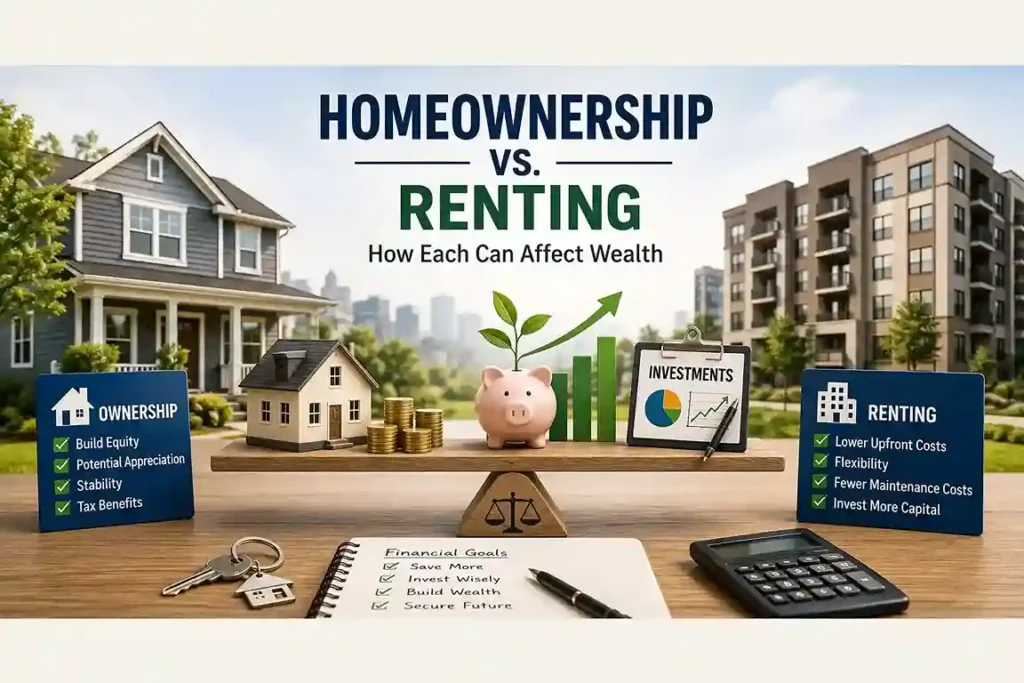
Homeownership vs. Renting: How Each Can Affect Wealth
Homeownership vs. Renting: How Each Can Affect Wealth
For decades, buying a home has been presented as one of the most reliable ways to build wealth in America. At the same time, renting is often described as “throwing money away.”
Both statements are too simplistic.
A home can become a powerful wealth-building asset because homeowners can build equity, benefit from potential appreciation, and eventually eliminate mortgage debt. But owning also comes with interest, property taxes, insurance, maintenance, transaction costs, and the opportunity cost of tying up a large amount of capital.
Renting has a different financial structure. A renter does not build home equity, but may have lower upfront costs, greater mobility, and more capital available for diversified investments.
The real question, therefore, is not “Is buying always better than renting?”
It is: Which choice is more likely to leave you with greater financial flexibility and net worth after considering all costs, investment opportunities, risks, and the length of time you expect to stay?
That answer can be very different from one household and city to another. If you want the broader picture, see How to Build Wealth in America: The Complete Guide to Growing, Protecting, and Preserving Your Money.
Homeownership vs. Renting: The Basic Difference
At the simplest level, buying means acquiring an asset while renting means paying for the use of an asset owned by someone else.
But the financial comparison is more complicated than that.
| Factor | Buying a Home | Renting |
|---|---|---|
| Upfront cash | Usually substantial | Usually much lower |
| Monthly housing cost | Mortgage, taxes, insurance, maintenance, HOA, etc. | Rent plus renter-related expenses |
| Home equity | Can increase over time | None in the rented property |
| Property appreciation | Homeowner benefits | Landlord generally benefits |
| Maintenance | Homeowner’s responsibility | Generally landlord’s responsibility |
| Flexibility | Lower | Higher |
| Investment concentration | Often high | Potentially lower |
| Transaction costs | Significant when buying/selling | Generally lower |
| Housing-cost predictability | Can be higher with fixed-rate mortgage | Rent can change |
| Investment opportunity | Capital tied to property | More capital may remain available |
The important point is that neither column automatically produces more wealth.
A homeowner can build substantial wealth—or become financially stretched by an oversized mortgage. A renter can build a large investment portfolio—or spend the money that might otherwise have been invested.
Your behavior and the underlying economics matter.
How Homeownership Builds Wealth
Homeownership can contribute to wealth through several different mechanisms.
1. Mortgage Principal Builds Equity
A mortgage payment contains two fundamentally different components: principal and interest.
Principal reduces what you owe.
Interest compensates the lender for providing the money.
Suppose you purchase a $400,000 home with a $320,000 mortgage. Your initial equity is approximately $80,000, ignoring transaction costs.
As you make principal payments, the mortgage balance gradually falls.
If the home remains worth $400,000 while your mortgage falls from $320,000 to $300,000, your gross equity rises from $80,000 to approximately $100,000.
That is one reason homeownership can function as a form of forced saving.
However, the entire mortgage payment should not be considered savings. Interest, taxes, insurance, and other expenses are costs of owning the property.
2. Home Appreciation Can Increase Net Worth
If a property rises in value, the homeowner’s equity can increase.
For example:
- Purchase price: $400,000
- Mortgage: $320,000
- Initial equity: $80,000
- Future home value: $500,000
- Mortgage balance after repayment: $290,000
The homeowner would have approximately $210,000 of gross equity.
That increase comes from two sources:
- Paying down the mortgage
- Appreciation in the property’s market value
But appreciation is never guaranteed.
The Federal Housing Finance Agency reported that U.S. house prices increased 1.8% year over year from the fourth quarter of 2024 to the fourth quarter of 2025. Yet the performance varied considerably by location: prices declined in nine states and the District of Columbia during that period.
This illustrates an important principle:
Real estate is a local market, not one uniform national investment.
3. Leverage Can Magnify Returns—and Losses
One of the unique characteristics of residential real estate is leverage.
You may control a $400,000 asset while contributing only $80,000 of your own money as a down payment.
If the home rises 10%, its value increases by $40,000.
Relative to the original $80,000 down payment, that represents a 50% increase before considering interest, taxes, maintenance, transaction costs, and changes in the mortgage balance.
But leverage works in both directions.
A 10% decline in the property’s value would reduce the home’s value by $40,000.
That would represent a 50% decline relative to the original $80,000 down payment, again before considering principal repayment and other costs.
Therefore: Leverage can accelerate wealth creation, but it can also accelerate losses.
This is one reason buying a home should not be treated as a risk-free investment strategy.
4. Homeownership Can Create Forced Savings
Some people struggle to consistently invest money that remains available in their checking account.
Mortgage principal repayment can create a form of automatic wealth accumulation.
Every month, part of the payment reduces the outstanding mortgage balance.
This can be particularly valuable over decades.
But there is an important caveat: a homeowner who puts too much of their income into housing may have little money left for retirement accounts, emergency savings, or diversified investments.
A house should not become an excuse to stop investing elsewhere.
The Costs of Owning a Home That People Often Forget
One of the biggest mistakes in a rent-vs.-buy comparison is looking only at rent versus mortgage principal and interest.
The Consumer Financial Protection Bureau emphasizes that homeowners may also need to account for property taxes, homeowners insurance, mortgage insurance, HOA fees, maintenance, repairs, and other costs. Major ownership costs include:
Mortgage interest
Interest can represent a substantial portion of payments, particularly during the early years of a long mortgage.
Property taxes
Property taxes vary substantially by location and can increase over time.
Homeowners insurance
Insurance protects against covered risks and is generally required by mortgage lenders.
Mortgage insurance
Some borrowers may have mortgage insurance, particularly when making a smaller down payment.
HOA fees
Condominiums and many planned communities charge homeowners association dues.
Maintenance
Roofs, HVAC systems, plumbing, appliances, landscaping, electrical systems, and other components eventually require maintenance or replacement.
Utilities
Some homeowners pay costs that may have been included in a rental arrangement.
Closing costs
Buying a home involves more than the down payment. Mortgage origination charges, title services, government fees, prepaid expenses, and other transaction costs may apply.
Selling costs
When you eventually sell, you may face commissions, taxes, fees, repairs, concessions, and other transaction expenses.
This is why comparing a $2,000 rent payment with a $2,000 mortgage payment can be misleading.
They are not necessarily equivalent financial costs.
How Renting Can Support Wealth Building
Renting does not automatically prevent wealth creation.
In some circumstances, it can actually provide a better financial platform.
1. Lower Upfront Capital Requirements
Buying generally requires substantially more cash upfront than renting.
A renter may need a security deposit and other moving expenses, while a buyer may need:
- Down payment
- Closing costs
- Inspection costs
- Moving expenses
- Initial repairs
- Furnishing expenses
- Emergency reserves
The capital not required for a home purchase can potentially remain invested.
2. Renting Can Leave More Money Available for Investments
Consider a simplified example.
Suppose buying requires $100,000 of upfront capital.
A renter instead keeps that $100,000 invested in a diversified portfolio.
The renter may also have lower monthly housing costs and invest some or all of the difference.
Over several decades, the compounding of those investments can become significant.
But this advantage exists only if the renter actually invests the money.
If the renter spends the difference on lifestyle upgrades, restaurants, travel, cars, and other consumption, the theoretical advantage disappears.
That leads to an important principle:
Renting can create an investment opportunity; it does not automatically create investment wealth.
The Opportunity Cost of Buying a Home
The down payment is one of the most important opportunity costs in a rent-vs.-buy decision.
Suppose you have $100,000 available.
You could use it as part of a home purchase.
Alternatively, you could invest it in financial assets.
If the money is invested, it has the potential to compound.
If the money becomes part of your home’s equity, it is tied to the property.
That does not mean home equity is bad. It means you must consider what the money could have earned elsewhere.
The same principle applies to monthly cash flow.
If owning costs $3,000 per month while renting a comparable property costs $2,200, the $800 monthly difference is economically important.
A renter who invests that $800 consistently could accumulate substantial financial assets.
A homeowner, meanwhile, may be accumulating additional equity through mortgage repayment.
The correct comparison is therefore:
Home equity + property appreciation − ownership costs
versus
Investment portfolio growth − rental costs and other relevant expenses
A Hypothetical Rent-vs.-Buy Example
Consider a fictional household comparing two choices.
Buying scenario
Assume:
- Home price: $400,000
- Down payment: $80,000
- Mortgage: $320,000
- Holding period: 10 years
- Illustrative home appreciation: 3% annually
- Property taxes, insurance, maintenance and other costs are paid separately
Renting scenario
Assume:
- Comparable monthly rent: $2,200
- The renter keeps the $80,000 down payment invested
- The renter invests any meaningful monthly savings compared with the ownership scenario
- Illustrative investment return: 6% annually
These are illustrative assumptions, not forecasts.
At 3% annual appreciation, the $400,000 home would be worth roughly $538,000 after 10 years.
But that is not the homeowner’s profit.
The homeowner would still have a remaining mortgage balance, and the homeowner has paid interest, taxes, insurance, maintenance, and transaction costs during the decade.
The renter’s $80,000, if it compounded at 6% annually for 10 years, would grow to roughly $143,000, before taxes and fees.
The renter may also have additional investments from monthly savings.
This example demonstrates why a simple statement such as “the house went up $138,000, so buying was better” is inadequate.
The complete calculation must include all relevant cash flows.
Why the Time You Stay Matters
Time is one of the most important variables in the rent-vs.-buy decision.
Buying and selling property involves transaction costs.
If you purchase a home and sell it after a short period, those costs can consume a substantial portion of any appreciation.
The CFPB specifically notes that buying and selling are expensive processes and that people who expect to move within a few years may find renting more financially attractive.
Short-term ownership
Buying may be less attractive when you expect to move soon because:
- Closing costs are incurred when purchasing
- Selling can create additional costs
- Home prices may not rise enough to offset those expenses
- Your mortgage balance may still be relatively high
- You have less time to spread transaction costs over the period of ownership
Medium-term ownership
The calculation becomes more balanced.
Mortgage principal has had more time to decline, and appreciation—if it occurs—has had more time to compound.
Long-term ownership
Long-term ownership can strengthen the case for buying because transaction costs become less significant when spread over many years, and mortgage principal may eventually be paid down substantially.
But even long-term ownership is not automatically superior. The purchase price, mortgage rate, taxes, maintenance costs, and alternative investment returns still matter.
Mortgage Rates Matter
Mortgage rates can dramatically change the economics of buying.
As of August 20, 2026, Freddie Mac’s Primary Mortgage Market Survey showed an average U.S. 30-year fixed mortgage rate of 6.65%, while the 15-year rate averaged 5.95%. These are national survey averages, not personalized offers.
At higher mortgage rates, borrowers generally pay more interest over the life of a loan.
For example, the difference between borrowing at 4% and 7% can substantially change the monthly payment and total interest expense.
This is why two households buying similar homes at different times can have very different financial outcomes.
However, waiting solely for lower rates also has risks.
Home prices may change, and future mortgage rates are uncertain.
The better approach is to determine whether the home is affordable under today’s realistic conditions rather than assuming future refinancing opportunities.
Homeownership and Net Worth
Homeownership is strongly associated with higher household net worth in U.S. household surveys.
The Federal Reserve’s 2022 Survey of Consumer Finances reported median net worth of approximately $396,200 for homeowners compared with $10,400 for renters or other non-homeowners.
But this statistic needs careful interpretation.
It does not prove that buying a home automatically causes someone to become wealthy.
Higher-income households may be more likely to own homes. Homeowners may also have other assets, higher incomes, different family structures, and longer investment histories.
In other words:
Correlation is not the same as causation.
Still, the data demonstrate that housing equity can be an important component of American household wealth.
Homeownership Does Not Automatically Mean Wealth
Someone can own a home and still have serious financial problems.
Consider a household that:
- Buys more house than it can comfortably afford
- Has a large mortgage
- Carries credit-card debt
- Has no emergency fund
- Makes minimal retirement contributions
- Cannot afford necessary repairs
- Has most of its wealth concentrated in one property
That household may have substantial gross home equity while remaining financially fragile.
This is why net worth and financial resilience matter more than simply owning property.
A $700,000 home does not make someone wealthy if it is accompanied by $650,000 of debt and little financial savings.
Renting Does Not Automatically Mean Financial Failure
The opposite misconception is equally dangerous.
A renter who consistently invests can build substantial wealth.
For example, a disciplined renter could direct money toward:
- Employer retirement plans
- IRAs
- Taxable brokerage accounts
- Emergency savings
- Other diversified investments
Over long periods, compound growth can turn regular contributions into significant wealth.
But renting requires discipline.
If a renter saves $800 per month by avoiding homeownership but spends the entire $800, there is no investment advantage.
The wealth-building power of renting comes largely from what the renter does with the capital that remains available.
Taxes and Homeownership
Taxes can influence the financial comparison, but homeowners should not assume that buying automatically produces a major tax benefit.
Mortgage interest may be deductible in certain circumstances when taxpayers itemize deductions and meet applicable requirements. The IRS explains that mortgage-interest deductions are subject to specific rules concerning qualified residences, debt, and other conditions.
Homeowners may also benefit from the federal tax rules concerning the sale of a qualifying main home.
Generally, eligible taxpayers may exclude up to $250,000 of gain, or up to $500,000 for certain married couples filing jointly, subject to the applicable ownership and use requirements.
However, tax benefits should be treated as one component of the analysis—not as the primary reason to purchase an unaffordable home.
Tax laws can change, and individual circumstances differ. Readers should consult a qualified tax professional for personal tax advice.
Inflation and Housing Costs
Inflation affects both renters and homeowners.
Renters may face higher rents over time, particularly when renewing or signing new leases.
Homeowners with fixed-rate mortgages have a different form of exposure.
The principal-and-interest portion of a fixed-rate mortgage generally does not rise simply because inflation rises. However, that does not mean total housing costs remain fixed.
Property taxes, insurance, maintenance, utilities, and HOA fees can change.
Therefore, a fixed-rate mortgage can provide greater payment predictability, but it does not eliminate inflation-related housing expenses.
Is a Primary Home Really an Investment?
This question deserves special attention.
A primary residence is both:
- A place to live
- A financial asset
But it is not exactly the same as an investment property.
An investment property is generally purchased with the expectation of generating financial returns through rent, appreciation, or both.
A primary residence also provides something economically valuable: housing.
If you buy a home and live in it, you are receiving a housing service from the property.
This is why simply comparing the home’s purchase price with its eventual selling price does not provide a complete investment-return calculation.
You must account for the value of the housing you consumed as well as the costs you paid to own it.
When Renting May Make More Financial Sense
Renting may be worth serious consideration when:
You expect to move soon
Buying and selling costs can make short-term ownership expensive.
Your employment or income is uncertain
A large mortgage can reduce financial flexibility.
Buying would consume your emergency savings
A home purchase should not leave you unable to handle unexpected expenses.
Comparable homes cost substantially more to own
If the all-in ownership cost is far above rent, the difference deserves careful analysis.
You can invest consistently
A renter who invests the difference can potentially build significant financial assets.
You value flexibility
Renting may make it easier to relocate for work, education, family circumstances, or other opportunities.
When Buying May Make More Financial Sense
Buying can be attractive when:
You expect to stay for a long time
A longer holding period can help spread transaction costs over more years.
You have stable income
A mortgage is a long-term financial commitment.
You have adequate emergency savings
Homeowners need financial reserves for repairs and unexpected expenses.
You can comfortably afford the total cost
Do not evaluate affordability using only principal and interest.
You want to build equity
Mortgage principal repayment and potential appreciation can contribute to net worth.
You value housing stability
Owning can provide greater control over the property and reduce exposure to landlord decisions.
A Practical Framework for Deciding Whether to Rent or Buy
Before making the decision, ask yourself these questions.
1. How long will I probably stay?
The shorter the expected stay, the more important transaction costs become.
2. What is the true cost of owning?
Include:
- Principal
- Interest
- Taxes
- Insurance
- Mortgage insurance
- HOA fees
- Maintenance
- Repairs
- Utilities
- Closing costs
- Selling costs
3. What would my down payment earn elsewhere?
Calculate the opportunity cost of investing the money instead.
4. What would I do with the monthly savings from renting?
If you would invest the difference, renting may have a stronger financial case.
5. Can I maintain an emergency fund after buying?
Do not use every dollar available for the down payment and closing.
6. Will buying reduce retirement savings?
A house should not crowd out every other wealth-building asset.
7. What happens if the property loses value?
Consider whether you could remain financially stable during a housing downturn.
8. Am I buying a house I need—or simply the largest house I qualify for?
A lender’s maximum approval is not the same thing as a financially comfortable budget.
Think About the Complete Household Balance Sheet
The best way to evaluate housing is to look at your entire financial picture.
Assets
- Home equity
- Retirement accounts
- Brokerage investments
- Cash
- Business interests
- Other assets
Liabilities
- Mortgage
- Credit-card balances
- Student loans
- Auto loans
- Other debts
Then calculate:
Net Worth = Total Assets − Total Liabilities
A housing decision should ideally improve your long-term balance sheet without damaging your financial resilience.
Common Rent-vs.-Buy Mistakes
Mistake 1: Comparing rent with only the mortgage payment
The mortgage is only one part of ownership costs.
Mistake 2: Ignoring maintenance
Homes require repairs eventually.
Mistake 3: Assuming prices always rise
The FHFA’s recent data demonstrate that housing performance varies significantly across states and metropolitan areas.
Mistake 4: Ignoring investment opportunity cost
A down payment could have been invested elsewhere.
Mistake 5: Buying too much house
Higher housing costs can reduce retirement savings and other investments.
Mistake 6: Assuming renting automatically means wasting money
Rent purchases housing. The financial question is what happens to the rest of the renter’s money.
Mistake 7: Ignoring selling costs
The price you receive when selling is not necessarily the amount you ultimately keep.
Mistake 8: Treating home equity as emergency cash
Equity is valuable, but accessing it can require selling, refinancing, or borrowing.
Mistake 9: Failing to diversify
A household whose largest asset is its home may have significant exposure to one local real-estate market.
Mistake 10: Making the decision because of social pressure
Buying a home because friends, relatives, or society says you “should” is not a financial analysis.
Frequently Asked Questions ( Homeownership vs. Renting: Affecting Wealth)
Is buying a home always better than renting for wealth building?
No. Buying can build wealth through equity and appreciation, but ownership also involves substantial costs. Renting can be financially competitive when the renter invests the capital that would otherwise be tied up in the property.
Is renting throwing money away?
No. Rent is the cost of housing. Homeowners also spend money on interest, taxes, insurance, maintenance, and other housing costs. The important question is how the complete financial outcomes compare.
Can renters become wealthier than homeowners?
Yes. A renter who consistently invests savings and maintains disciplined financial habits can accumulate substantial wealth. The outcome depends on investment returns, housing costs, income, savings behavior, and many other factors.
How does home equity build wealth?
Equity can grow as you repay mortgage principal and as the property’s market value increases. However, equity can also decline if property values fall.
What costs should I include when comparing rent and buying?
Include mortgage principal and interest, property taxes, insurance, mortgage insurance, HOA fees, maintenance, repairs, utilities where applicable, closing costs, selling costs, and the opportunity cost of the down payment.
How long should you stay in a home for buying to make financial sense?
There is no universal number. The appropriate holding period depends on transaction costs, mortgage terms, local prices and rents, expected appreciation, and other assumptions. Buying generally becomes harder to justify financially when you expect to move again very soon.
Does paying a mortgage build wealth?
Mortgage principal repayment can increase home equity. But mortgage interest and other ownership expenses are costs, so the entire mortgage payment should not be viewed as wealth creation.
Is a house an investment?
A primary residence is both a housing asset and a place to live. It can appreciate and build equity, but it should not automatically be evaluated like a pure investment property.
Should I invest instead of buying a house?
That depends on your housing needs, finances, local rent-to-price relationship, investment discipline, time horizon, and risk tolerance. The decision should compare the complete financial outcomes rather than treating either option as universally superior.
The Bottom Line: Housing Is Part of Your Wealth Strategy
Homeownership can be one of America’s most important paths to household wealth.
Mortgage principal can gradually build equity. Property appreciation can increase net worth. Leverage can amplify gains. And a mortgage that is eventually paid off can reduce the need to make a large housing payment in retirement.
But these benefits come with costs and risks.
Homeowners must pay interest, property taxes, insurance, maintenance, repairs, and transaction costs. Property values can decline. A large mortgage can reduce financial flexibility. And putting too much wealth into a home can leave a household under-diversified.
Renting has its own advantages.
It can require less upfront capital, provide mobility, transfer many maintenance responsibilities to the landlord, and leave more money available for other investments.
But renting does not automatically create wealth. A renter must actually save and invest the money that would otherwise have gone toward ownership.
Ultimately, the smartest question is not:
“Should I rent or buy?”
It is:
“Which housing choice allows me to live comfortably while maximizing my ability to save, invest, manage risk, and increase my net worth over the long term?”
For some households, the answer will be buying.
For others, it will be renting.
And for many people, the answer can change as their income, family situation, location, housing market, and financial goals change.
The strongest wealth-building strategy is therefore not simply owning a home.
It is building a financial system in which income, savings, investing, asset ownership, time, and risk management work together.
Housing is one important part of that system—but it should not become the entire strategy.
