
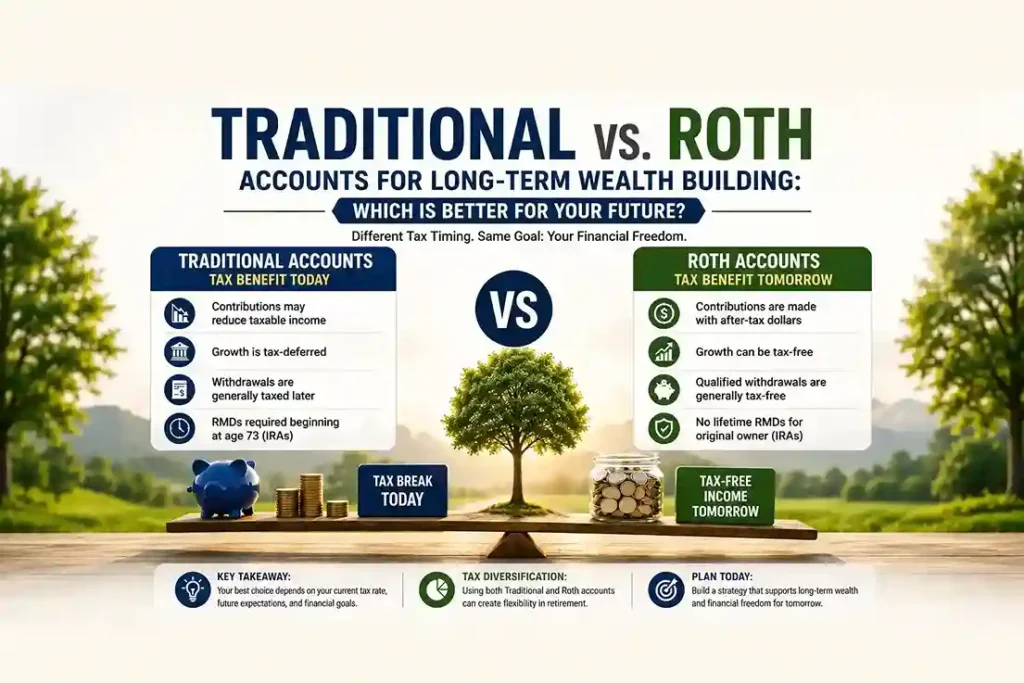
Traditional vs. Roth Accounts for Long-Term Wealth Building: Which Is Better for Your Future?
Traditional vs. Roth Accounts for Long-Term Wealth Building: Which Is Better for Your Future?
Building long-term wealth is not only about how much you save or how your investments perform. Taxes can also influence how much of your money you ultimately get to keep.
That is why the choice between Traditional and Roth retirement accounts matters.
Traditional accounts generally provide their main tax advantage upfront: contributions may reduce taxable income when the rules allow it, while withdrawals are generally taxed later. Roth accounts work differently: contributions are made with after-tax money, but qualified withdrawals can generally be tax-free.
Neither option is automatically better for everyone. The more useful question is:
Would you rather receive the tax benefit today or potentially receive it in retirement?
That decision can become increasingly important over a 20-, 30-, or 40-year investing period.
This guide explains how Traditional and Roth accounts work, how taxes affect long-term wealth, when each approach may make sense, and why using both can sometimes create valuable tax diversification.
Note: Retirement-account rules and tax limits can change. The figures and rules discussed here reflect 2026 information where applicable.
If you want the broader picture, see How to Build Wealth in America: The Complete Guide to Growing, Protecting, and Preserving Your Money.
Traditional vs. Roth: The Basic Idea
The simplest way to understand the difference is to think about when the tax advantage occurs.
| Feature | Traditional | Roth |
|---|---|---|
| Contributions | Generally pre-tax for workplace plans; IRA contributions may be deductible depending on circumstances | After-tax |
| Main tax benefit | Potential benefit today | Potential benefit in retirement |
| Investment growth | Generally tax-deferred | Potentially tax-free for qualified distributions |
| Qualified withdrawals | Generally taxable as ordinary income | Generally tax-free |
| Roth IRA lifetime RMDs | Not applicable | Original owner has no RMDs |
| Income restrictions | Traditional IRA deduction may be limited in some circumstances | Roth IRA contributions are subject to income limits |
| Potentially attractive when | Current tax rate is higher than expected future rate | Future tax rate may be higher than current rate |
The key is not simply whether an account is called “Traditional” or “Roth.” The tax treatment of contributions, investment growth, and withdrawals is what matters.
What Is a Traditional Retirement Account?
A Traditional retirement account allows you to receive the tax benefit primarily before retirement.
There are several types of Traditional accounts, including:
- Traditional IRA
- Traditional 401(k)
- Traditional 403(b)
- Traditional 457(b)
The exact tax rules depend on the account type.
Traditional IRA
With a Traditional IRA, contributions may be deductible if you meet the applicable requirements. The deduction can be reduced or eliminated based on income and whether you or your spouse is covered by an employer retirement plan.
Investment earnings generally accumulate without being taxed each year. When taxable amounts are withdrawn, they are generally included in ordinary income.
For 2026, the IRA contribution limit is $7,500, with an additional $1,100 catch-up contribution for individuals age 50 or older, making the maximum generally $8,600 for those eligible. The limit applies collectively to Traditional and Roth IRAs rather than giving you a separate $7,500 limit for each.
Traditional 401(k)
A Traditional 401(k) is an employer-sponsored retirement plan.
Employee contributions are generally made before federal income tax, although payroll-tax treatment is different from income-tax treatment. The money can then grow inside the account on a tax-deferred basis.
For 2026, the basic employee elective-deferral limit for most 401(k) plans is $24,500. The regular catch-up contribution for people age 50 and older is $8,000, while a higher $11,250 catch-up limit applies to eligible participants ages 60 through 63.
Employer matching contributions can provide an additional source of retirement savings.
What Is a Roth Retirement Account?
Roth accounts reverse much of the Traditional tax structure.
You generally pay income tax on money before it goes into the Roth account. The potential reward comes later: qualified withdrawals can generally be made without federal income tax.
Common Roth accounts include:
- Roth IRA
- Roth 401(k)
- Roth 403(b)
- Roth 457(b)
Roth IRA
Roth IRA contributions are not deductible.
However, qualified Roth IRA distributions are generally excluded from income.
For a Roth IRA distribution to generally be qualified, the applicable five-year requirement must be satisfied and a qualifying condition—such as reaching age 59½—must generally apply.
Roth IRA contributions are also subject to income-based eligibility rules.
For 2026, the Roth IRA contribution phase-out range is:
- $153,000–$168,000 for single taxpayers and heads of household
- $242,000–$252,000 for married couples filing jointly
Different rules apply to married taxpayers filing separately.
Roth 401(k)
A Roth 401(k) is a designated Roth account within an employer-sponsored retirement plan.
Contributions are made after tax, and qualified distributions can generally be tax-free.
Unlike Roth IRAs, Roth 401(k)s generally do not impose the same income-based contribution restriction. The plan’s own terms determine whether the Roth option is available.
Importantly, current law generally does not require lifetime RMDs from a designated Roth account while the owner is alive.
Traditional vs. Roth: Why Taxes Matter for Wealth Building
The real difference between these accounts becomes more interesting when you look at decades of compounding.
Suppose an investor contributes money to an account and earns investment returns for 30 years.
The investment itself may grow substantially. But eventually, the tax treatment determines how much of that wealth can be used without additional federal income tax.
With a Traditional account:
Tax benefit now → tax-deferred growth → generally taxable withdrawals later
With a Roth account:
Taxes paid now → potential tax-free qualified growth/withdrawals later
This creates a fundamental question:
Which tax environment is likely to be more valuable for you: today’s or tomorrow’s?
Nobody knows exactly what future tax rates will be. That uncertainty is one reason tax diversification can be useful.
A Simple Hypothetical Example
Imagine two investors each have money available for retirement investing.
Assume, purely for illustration, that an investment earns an average annual return of 7% and that contributions are made consistently over 30 years.
If someone invested $500 per month, the future value before considering taxes would be approximately $610,000.
That figure is only a mathematical illustration. Actual investments can produce very different returns, and markets do not deliver a fixed 7% return every year.
The important point is that both Traditional and Roth accounts can shelter investments from annual taxation in different ways.
The major difference appears when the money is eventually withdrawn.
A Traditional account may produce taxable retirement income.
A Roth account can potentially provide qualified withdrawals without federal income tax.
That difference can become meaningful when a retirement portfolio has had decades to compound.
When a Traditional Account May Make Sense
A Traditional account may be particularly attractive when the value of receiving a tax benefit today is high.
For example, someone may consider Traditional contributions when:
1. Their current marginal tax rate is relatively high
If today’s tax rate is substantially higher than the rate they expect to face in retirement, receiving a deduction today and paying taxes later may be attractive.
2. They want to reduce current taxable income
Where permitted, Traditional contributions can potentially lower current taxable income.
However, the exact deduction depends on the account and the taxpayer’s circumstances.
3. They expect retirement income to be lower
Someone who expects significantly less taxable income after leaving the workforce may ultimately withdraw Traditional money at lower tax rates.
4. They want to maximize tax-deferred savings
Traditional workplace accounts can allow substantial contributions.
For 2026, the employee contribution limit for most 401(k) plans is $24,500 before applicable catch-up contributions.
When a Roth Account May Make Sense
A Roth account may be attractive in the opposite situation.
1. Current tax rates are relatively low
If someone is currently in a lower tax bracket but expects substantially higher taxable income later, paying taxes now may be appealing.
2. There is a long investment horizon
The longer money remains invested, the more important the eventual tax treatment can become.
3. Tax-free retirement income is valuable
Qualified Roth distributions generally do not increase federal taxable income.
That can provide additional flexibility when managing retirement income.
4. The investor wants greater tax flexibility
Having Roth assets alongside Traditional assets can give retirees different sources of money to draw from.
5. Avoiding lifetime RMDs from a Roth IRA is important
An original Roth IRA owner generally does not have to take RMDs during their lifetime. Traditional IRAs generally require RMDs beginning at age 73 under current rules.
Traditional vs. Roth at Different Life Stages
There is no universal answer because a person’s tax situation can change considerably over a lifetime.
Early Career
Early-career workers may have relatively modest taxable income.
For some, this can make Roth contributions attractive because they are paying taxes at today’s potentially lower rate in exchange for potentially tax-free qualified withdrawals later.
The long investment horizon can also make the Roth structure appealing.
Mid-Career
Income often becomes higher during the middle of a career.
At that point, Traditional contributions may become more attractive if the current tax deduction is valuable.
But this does not automatically mean someone should abandon Roth contributions.
A combination of account types can provide tax diversification.
High-Income Years
Higher-income households need to pay particular attention to:
- Current marginal tax rates
- Traditional IRA deduction rules
- Roth IRA income restrictions
- Employer-sponsored retirement plans
- Roth 401(k) availability
- Future retirement income
The Roth IRA income limits for 2026 make eligibility an important consideration for higher-income taxpayers.
Near Retirement
As retirement approaches, the question changes.
Instead of simply asking:
“Where should I contribute?”
the investor may need to consider:
“How will I withdraw money efficiently?”
That can involve Traditional accounts, Roth accounts, taxable investments, Social Security, pensions, and other sources of income.
Traditional IRA vs. Roth IRA
The distinction between these two accounts is particularly important.
| Feature | Traditional IRA | Roth IRA |
|---|---|---|
| Contributions deductible? | Potentially, depending on circumstances | No |
| Qualified withdrawals | Generally taxable | Generally tax-free |
| Income limits for contributions | No general income limit for making a Traditional IRA contribution, but deduction rules can apply | Yes |
| Lifetime RMD for original owner | Yes | No |
| Early withdrawals | May trigger taxes/additional tax depending on circumstances | Rules depend on whether contributions, earnings, or conversions are being withdrawn |
| Tax advantage | Primarily upfront/deferred | Primarily later |
The IRA contribution limit is shared across Traditional and Roth IRAs. For 2026, the combined annual limit is $7,500, or $8,600 for eligible individuals age 50 or older.
That means you cannot generally contribute $7,500 to a Traditional IRA and another $7,500 to a Roth IRA simply because they are different account types.
Traditional 401(k) vs. Roth 401(k)
Employer retirement plans introduce another important comparison.
| Feature | Traditional 401(k) | Roth 401(k) |
|---|---|---|
| Employee contribution | Generally pre-tax | After-tax |
| Current income-tax deduction | Generally yes | No |
| Qualified retirement withdrawals | Generally taxable | Generally tax-free |
| Income restriction | Generally no Roth IRA-style income phase-out | Generally no Roth IRA-style income phase-out |
| Employer matching | Depends on plan rules | Employer contributions follow applicable plan rules |
| Lifetime RMD for owner | Generally applicable under current rules | Generally not required while owner is alive |
The 2026 employee elective-deferral limit for most 401(k) plans is $24,500, regardless of whether the employee divides contributions between Traditional and Roth sources within the plan.
One important point: the employer match should not be ignored when choosing between Traditional and Roth contributions.
If an employer offers a match, understanding the plan’s matching rules and capturing available matching contributions can be an important part of retirement saving.
Can You Use Both Traditional and Roth Accounts?
Yes.
In many situations, investors can have both Traditional and Roth retirement assets.
This can create what is often called tax diversification.
Consider a hypothetical retirement portfolio containing:
- Traditional 401(k)
- Roth IRA
- Taxable brokerage account
Each account has different tax characteristics.
During retirement, the investor may have more flexibility because money does not have to come from one single tax category.
For example, depending on the individual’s circumstances, they might take some taxable income from a Traditional account while using qualified Roth withdrawals for additional spending needs.
The objective is not necessarily to eliminate taxes.
Instead, it is to create flexibility around when and how taxable income is recognized.
Why Tax Diversification Can Be Powerful
Future tax rates are uncertain.
Your income may change.
Your retirement expenses may change.
Government tax laws may change.
Your investment portfolio may perform differently than expected.
These uncertainties make it difficult to predict exactly which account will produce the lowest lifetime tax bill.
Owning both Traditional and Roth assets can reduce dependence on a single tax outcome.
For example:
Traditional money can provide tax-deferred savings today.
Roth money can potentially provide tax-free qualified withdrawals later.
This combination can create more choices.
That flexibility can itself be valuable.
What Is a Roth Conversion?
A Roth conversion involves moving money from a Traditional retirement account into a Roth account in a transaction that qualifies for conversion treatment.
The important issue is taxation.
Previously untaxed amounts converted to Roth generally become taxable income in the year of conversion.
That means a Roth conversion can create a tax bill today in exchange for potential future tax-free qualified withdrawals.
The IRS explains that previously untaxed amounts transferred to a designated Roth account through an in-plan Roth rollover must generally be included in gross income for the year of the transfer.
Roth conversions can therefore be useful in some tax-planning situations, but they are not automatically beneficial.
The size of the conversion, current tax bracket, other income, future tax expectations, and available cash to pay taxes can all matter.
Traditional vs. Roth: A Practical Decision Framework
Instead of asking which account is “best,” consider these questions.
Step 1: What is your current tax situation?
Determine your current marginal tax rate and overall taxable income.
Step 2: What might retirement income look like?
Consider possible sources such as:
- Social Security
- Pension income
- Traditional retirement accounts
- Roth accounts
- Taxable investments
- Rental or business income
Step 3: Do you expect your tax rate to change?
You cannot know future tax rates with certainty, but reasonable assumptions can help frame the decision.
Step 4: Are you eligible for the desired account?
Check:
- Roth IRA income restrictions
- Traditional IRA deduction rules
- Employer-plan availability
- Contribution limits
Step 5: Does your employer offer a match?
If so, understand the plan’s matching formula and eligibility rules.
Step 6: Would tax diversification improve flexibility?
If you already have a large Traditional balance, adding Roth assets could potentially create a more balanced tax profile.
Step 7: Revisit the strategy
A decision that makes sense early in a career may not make sense later.
Income, tax brackets, retirement goals, and legislation can change.
Traditional vs. Roth Decision Matrix
| Situation | Account type that may be attractive |
|---|---|
| High current marginal tax rate | Traditional may be attractive |
| Lower current tax rate | Roth may be attractive |
| Expect lower taxable income in retirement | Traditional may be attractive |
| Expect higher taxable income later | Roth may be attractive |
| Want a current tax deduction where available | Traditional |
| Want potentially tax-free qualified withdrawals | Roth |
| Uncertain future tax rates | A combination may provide diversification |
| Want no lifetime RMDs from an original Roth IRA | Roth IRA |
| Employer offers a 401(k) match | Evaluate the plan and prioritize capturing available match |
| Need greater retirement tax flexibility | Consider a mix of tax treatments |
This table is a framework, not a personalized recommendation.
Common Mistakes to Avoid
1. Assuming Roth Is Always Better
Tax-free qualified withdrawals are attractive, but paying taxes upfront is not automatically better than receiving a deduction today.
2. Assuming Traditional Is Always Better
A current tax deduction may be valuable, but future taxable withdrawals can be substantial.
3. Confusing Tax-Deferred With Tax-Free
Traditional account growth is generally tax-deferred, not permanently tax-free.
Taxes generally become relevant when taxable money is withdrawn.
4. Ignoring Future Retirement Income
A retiree with substantial pension, Social Security, rental, business, and Traditional-account income may have a very different tax situation from someone with limited taxable income.
5. Ignoring RMDs
Traditional IRAs generally require RMDs beginning at age 73 under current law, while Roth IRAs do not require lifetime RMDs for the original owner.
6. Forgetting Roth IRA Income Rules
Roth IRA contributions are subject to income-based limits.
For 2026, the phase-out begins at $153,000 for single taxpayers and $242,000 for married couples filing jointly.
7. Ignoring Account Contribution Limits
The IRA limit is shared between Traditional and Roth IRAs.
For 2026, that combined limit is $7,500, or $8,600 for eligible people age 50 and older.
8. Focusing Only on Taxes
Investment selection, fees, savings rate, diversification, time horizon, and behavior can all have major effects on long-term wealth.
An excellent tax strategy cannot compensate for consistently saving too little or taking inappropriate investment risk.
9. Treating Tax Rules as Permanent
Tax laws can change.
A strategy should therefore be reviewed periodically rather than treated as a one-time decision.
The Role of Compound Growth
Tax treatment becomes especially important because retirement investing usually takes place over many years.
Consider a hypothetical investor contributing $500 per month for 30 years at a hypothetical 7% annual return, compounded monthly.
The resulting account value would be approximately $610,000.
But the calculation does not mean the investor will actually earn 7% every year.
Real-world investment returns fluctuate, and fees, taxes, contribution changes, inflation, and market performance can materially affect results.
The example simply demonstrates why a small recurring contribution can become substantial over a long period.
The longer the investment horizon, the more important it becomes to consider both:
How much wealth you accumulate
and
How much of that wealth you can ultimately use after taxes.
Traditional vs. Roth and Long-Term Wealth Building
A successful wealth-building strategy generally has several components.
Save consistently
The account type cannot compensate for inadequate savings.
Invest for the long term
Compounding requires time.
Control costs
Investment fees can reduce long-term returns.
Diversify
A diversified portfolio can help manage investment risk.
Use tax-advantaged accounts
Traditional and Roth accounts can both provide valuable tax advantages.
Diversify tax exposure
Traditional and Roth assets can potentially provide different sources of retirement income.
Review the strategy
Your tax situation can change throughout your career.
This is why Traditional versus Roth should be viewed as part of a larger wealth-building system rather than as an isolated decision.
Frequently Asked Questions (Traditional vs. Roth Accounts)
Is Roth always better than Traditional?
No.
Roth may be attractive when paying taxes today is relatively inexpensive compared with expected future taxation. Traditional may be attractive when the current tax deduction is valuable and future taxable income is expected to be lower.
Can I have both Traditional and Roth accounts?
Yes. Many people have both.
Having both can create tax diversification and provide different sources of retirement income.
Can I contribute to both a Traditional IRA and Roth IRA?
Generally, yes, if you meet the applicable requirements. However, the annual IRA contribution limit applies to the combined contributions to your Traditional and Roth IRAs. For 2026, the combined limit is $7,500, or $8,600 for eligible individuals age 50 and older.
Is Traditional IRA growth tax-free?
Not generally.
Investment growth is generally tax-deferred. Taxable amounts are generally taxed when distributed.
Are Roth withdrawals always tax-free?
No.
Roth withdrawals must satisfy applicable requirements to receive qualified-distribution treatment. For Roth IRAs, the five-year rule and qualifying conditions such as reaching age 59½ can matter.
Do Roth IRAs have RMDs?
An original Roth IRA owner generally does not have lifetime RMDs.
However, beneficiaries can be subject to distribution rules after the owner’s death.
What is tax diversification?
Tax diversification means holding assets with different tax treatments, such as Traditional, Roth, and potentially taxable investments.
The purpose is to create greater flexibility in managing taxable income.
What is a Roth conversion?
A Roth conversion generally moves money from a Traditional retirement account into a Roth account.
Previously untaxed amounts can generally become taxable income when converted.
Should everyone choose Roth in their 20s?
Not necessarily.
Young workers may find Roth attractive because of potentially lower current tax rates and a long investment horizon, but individual circumstances differ.
What about people in their 40s or 50s?
They may benefit from evaluating both options because income, tax rates, retirement balances, and expected retirement income can all be significantly different from earlier career years.
The Bigger Picture: Building Wealth Efficiently
Traditional and Roth accounts are not competing investment philosophies.
They are different tax structures surrounding retirement savings.
A Traditional account can provide an opportunity to receive a tax benefit today and defer taxation.
A Roth account can require taxes today but potentially provide tax-free qualified withdrawals later.
The best choice depends heavily on the relationship between:
Your tax rate today
and
Your potential tax rate when the money is withdrawn.
Because nobody can predict future tax law perfectly, a combination of Traditional and Roth assets can sometimes provide useful flexibility.
More importantly, retirement-account selection should be part of a broader wealth-building strategy that includes saving consistently, investing appropriately, controlling costs, managing risk, and planning how assets will eventually be used.
Final Takeaway
The Traditional-versus-Roth decision is ultimately a question about tax timing.
Traditional accounts generally offer their primary tax advantage today, while Roth accounts generally offer their primary tax advantage in retirement through potentially tax-free qualified withdrawals.
For some investors, Traditional accounts may be particularly valuable when current tax rates are high and expected retirement income is lower.
For others, Roth accounts may be attractive when current tax rates are relatively low, the investment horizon is long, or future taxable income may be higher.
And for many households, the answer does not have to be either-or.
Traditional plus Roth can create tax diversification.
That flexibility can become increasingly valuable during retirement, when the goal shifts from simply accumulating wealth to managing taxes, income, withdrawals, and spending efficiently.
The most important lesson is simple:
Don’t choose a retirement account solely because someone says it is “better.” Choose based on how its tax treatment fits into your long-term wealth-building plan.
Financial Disclaimer
This article is provided for general educational and informational purposes only. It does not constitute individualized financial, investment, tax, legal, insurance, retirement, or estate-planning advice. Investments involve risk, including possible loss of principal. Tax laws, contribution limits, regulations, and financial conditions can change. Current IRS rules should be checked for tax-year-specific decisions, and individuals with complex circumstances should consider consulting appropriately qualified professionals.
