
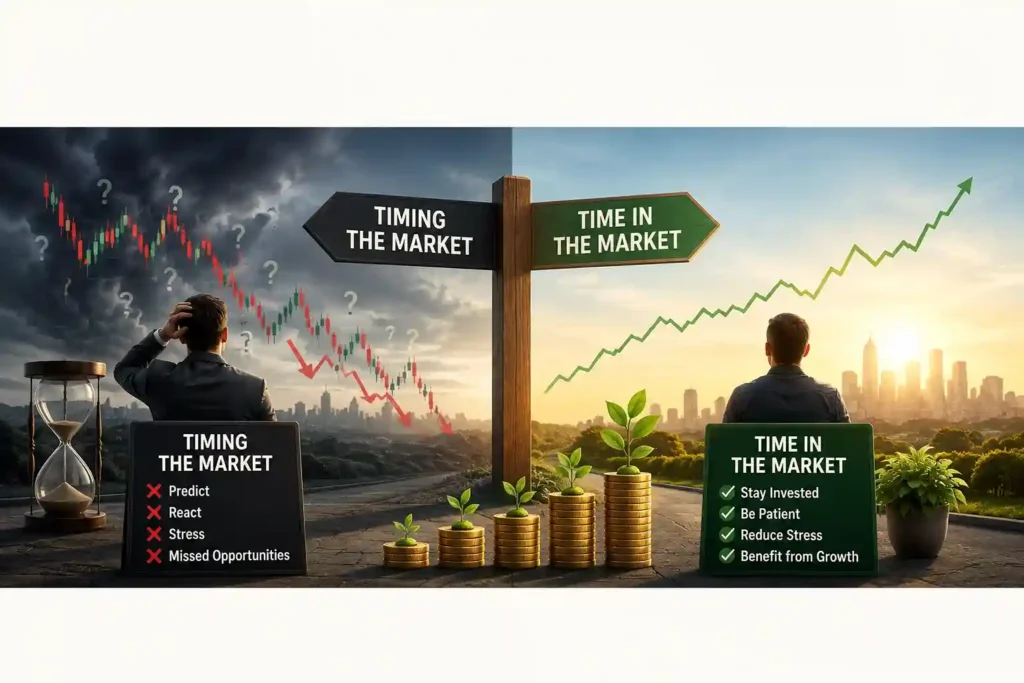
Time in the Market vs Timing the Market: Why Long-Term Investing Matters
Time in the Market vs Timing the Market: Why Long-Term Investing Matters
Trying to predict the stock market can be tempting. Investors naturally want to avoid major declines and invest before prices begin rising again.
The idea sounds simple: sell before a market drop, wait safely in cash, and buy again near the bottom.
The difficulty is that these decisions must be made before anyone knows exactly what will happen next.
That is one reason long-term investing is often built around a different approach. Instead of trying to predict every short-term movement, investors can focus on building an appropriate portfolio, investing consistently, managing risk, and allowing their investments time to work through different market conditions.
Successful long-term investing does not require correctly predicting every rally, correction, recession, or recovery.
A more practical goal is to create a financial strategy that can continue functioning through periods of uncertainty. If you want the broader picture, see How to Build Wealth in America: The Complete Guide to Growing, Protecting, and Preserving Your Money.
What Does Time in the Market Mean?
Time in the market means remaining invested for a period that matches your long-term financial goals rather than repeatedly moving money in and out of investments based on short-term predictions.
A long-term investor may choose to:
- Build a diversified portfolio.
- Contribute money regularly.
- Reinvest investment income when appropriate.
- Maintain an asset allocation suited to personal goals.
- Review and rebalance the portfolio periodically.
- Continue following the investment plan during both rising and falling markets.
Time in the market does not mean ignoring risk.
It also does not mean keeping every investment forever, regardless of whether it still makes sense.
The main idea is simpler: long-term wealth building does not require an investor to correctly predict every short-term movement in financial markets.
That distinction is important.
An appropriate investment strategy should reflect factors such as financial goals, investment horizon, ability to tolerate losses, and overall financial circumstances. Diversification can help reduce certain risks, but no investment strategy can completely eliminate the possibility of losses.
What Is Market Timing?
Market timing is the practice of changing investment exposure based primarily on expectations about short-term market movements.
An investor attempting to time the market may try to:
- Sell investments before an expected decline.
- Move money into cash.
- Wait for prices to fall.
- Decide when the market has reached a favorable entry point.
- Buy investments again.
- Repeat the process during future market cycles.
At first glance, this strategy may appear logical.
The problem is that the investor must make several difficult decisions correctly.
They need to decide when to sell.
They need to determine how long to remain out of the market.
They then need to decide when to return.
In some cases, they may also try to predict which industries, companies, or investments will perform best next.
Why Multiple Predictions Create a Problem
Successfully predicting one market movement is difficult enough.
Market timing often requires getting several decisions right in sequence.
For example, correctly predicting that a decline is coming does not automatically guarantee a successful result. The investor must still determine when to reinvest.
Returning too early may expose the investor to additional declines.
Returning too late may mean missing part of the recovery.
The challenge is not simply predicting a market decline. It is managing the entire sequence of decisions surrounding that decline.
Why Predicting Every Market Move Is So Difficult
Financial markets respond to an enormous number of changing factors.
Prices are influenced by current conditions, future expectations, investor behavior, business developments, economic trends, and unexpected events.
No single indicator can reliably explain every market movement.
Economic Conditions Can Change Quickly
Employment, consumer spending, inflation, business activity, and economic growth can change unexpectedly.
An economic forecast that appears reasonable today may become less relevant after new information emerges.
Markets often respond not only to what is happening now but also to what investors expect to happen in the future.
Business Conditions Are Constantly Changing
Companies face changing circumstances throughout their operations.
These may include:
- Revenue growth or decline.
- Rising or falling costs.
- Competition.
- New technology.
- Changes in consumer behavior.
- Regulatory developments.
- Management decisions.
- Supply chain disruptions.
Even experienced professionals cannot predict every development affecting every company.
Interest Rates Influence Investment Decisions
Changes in interest rates can affect borrowing costs, consumer spending, business investment, bond prices, and stock valuations.
However, predicting future rate decisions is only part of the challenge.
Investors must also predict how financial markets will interpret and react to those decisions.
The same event can sometimes produce a different market reaction than investors expected.
Investor Psychology Can Move Markets
Markets are influenced by more than financial data.
Fear can encourage rapid selling.
Optimism can encourage aggressive buying.
Investors may also become overly influenced by recent events. After a long market decline, they may assume that prices will continue falling. After a strong rally, they may assume that gains will continue indefinitely.
These emotional reactions can make market timing even more difficult.
Unexpected Events Cannot Be Scheduled
Financial markets can respond rapidly to events that were difficult or impossible to predict precisely.
New information can change expectations within hours or even minutes.
This creates a major challenge for anyone trying to predict short-term movements.
The market is constantly responding to new information.
That makes perfect forecasting extremely difficult.
The Biggest Problem With Market Timing: You Have to Be Right Twice
Imagine an investor believes that a major market decline is approaching.
The investor sells stock investments and moves into cash.
Soon afterward, the market falls.
Initially, the decision appears successful.
However, a second problem immediately appears.
When Should the Investor Buy Back In?
The investor now needs to decide when the decline is over.
If they wait for the news to improve, prices may already have recovered.
If they wait until the economy looks stronger, the market may already be significantly higher.
If they wait until they feel confident, they may miss the early stages of the recovery.
This is one of the fundamental weaknesses of market timing.
Avoiding a decline is only half of the decision.
The investor must also successfully identify a reasonable time to return.
Getting out at the right time is difficult.
Getting back in at the right time is another difficult decision.
Doing both repeatedly over many market cycles is even harder.
Why Strong and Weak Market Days Can Occur Close Together
Periods of high market volatility can contain both significant declines and strong recoveries.
This creates a challenge for investors who move into cash after a market decline.
The market may fall sharply.
An investor may decide to sell.
Soon afterward, the market may begin recovering.
If the investor waits for greater confidence before returning, prices may rise before they re-enter.
As a result, an investor may avoid part of a market decline but still miss an important part of the subsequent recovery.
Market Movements Can Happen Faster Than Expected
Many investors imagine market recoveries as slow and predictable.
In reality, financial markets can change direction quickly.
Strong trading days may occur during periods when the overall economic environment still feels uncertain.
This means waiting until everything appears safe can sometimes result in waiting until prices have already recovered.
The challenge is that investors usually do not know in advance which trading days will become the most important.
The Potential Cost of Missing Strong Market Days
One of the most important arguments for remaining invested is the potential cost of missing periods of strong market performance.
Historical illustrations have shown that missing a relatively small number of strong trading days can significantly reduce long-term hypothetical investment results.
For example, consider an investor who remains invested over several decades.
If that investor misses some of the strongest market days because they are waiting in cash, the difference in long-term growth may become substantial.
This does not mean that investors should never sell an investment.
It also does not mean that every investor should remain invested in the same portfolio forever.
The more important lesson is that investors do not know beforehand which trading days will produce the strongest returns.
A Small Number of Days Can Matter
Long-term investment returns are not generated evenly every day.
Some days have little effect.
Other days can have a significant influence on long-term performance.
When investors leave the market while waiting for greater certainty, they risk missing some of those important periods.
The longer the investment horizon, the more the effect of missed growth opportunities may compound.
Why the Best-Days Argument Should Be Understood Carefully
The idea of missing strong market days can sometimes be misunderstood.
It does not mean that selling an investment automatically destroys long-term wealth.
It does not mean that every market decline is followed by an immediate recovery.
It does not mean that investors should ignore changing financial circumstances.
Instead, the concept highlights a practical problem.
The Future Cannot Be Identified in Advance
Investors do not receive advance notice of the market’s strongest days.
Strong recoveries can occur when economic conditions still appear uncertain.
Weak days and strong days can occur relatively close together.
This makes it difficult to consistently exit before declines while also remaining invested during recoveries.
The issue is not that market timing is impossible on every occasion.
The problem is trying to do it consistently over long periods.
How Compounding Makes Time Valuable
Time can be one of the most important resources available to a long-term investor.
This is largely because investment returns may have the opportunity to generate additional returns when gains remain invested.
Suppose an investment earns a return.
If that return remains invested, future growth may occur on:
- The original amount invested.
- Previous investment gains.
This process is known as compounding.
A Simple Compounding Illustration
Imagine an investment of $10,000 that earns an average annual return of 7%, with returns remaining invested.
The approximate value could grow to:
- About $19,672 after 10 years.
- About $38,697 after 20 years.
- About $76,123 after 30 years.
- About $149,745 after 40 years.
These figures are mathematical illustrations rather than predictions.
Actual investment returns can rise or fall, and investments can lose value.
However, the example demonstrates an important principle.
As an investment grows, future returns may affect a larger amount of money.
That is why additional years can become increasingly valuable.
Starting Early Can Create More Opportunity
Starting earlier does not guarantee investment success.
However, beginning earlier may provide more time for:
- Contributions to accumulate.
- Investment gains to potentially compound.
- Market declines and recoveries to occur.
- Long-term goals to develop gradually.
Time cannot eliminate risk.
But it may increase the opportunity for a disciplined strategy to work through multiple market environments.
Time in the Market Does Not Eliminate Investment Risk
Long-term investing should never be presented as a guarantee.
Markets can decline significantly.
Individual companies can fail.
Some investments may never recover.
Inflation can reduce purchasing power.
A portfolio can lose value even after being held for many years.
Time in the market is therefore not a replacement for risk management.
A Long Time Horizon Does Not Fix a Poor Portfolio
Simply holding an unsuitable investment for a long period does not automatically make it a good investment.
For example, placing all available money into one highly speculative company creates a very different level of risk from maintaining a diversified portfolio.
A long-term strategy should consider:
- Investment goals.
- Time horizon.
- Risk tolerance.
- Diversification.
- Liquidity needs.
- Financial obligations.
- Overall portfolio structure.
Time can be valuable, but it cannot correct every poor investment decision.
Time in the Market Is Not the Same as Blindly Holding Everything
Staying invested does not mean refusing to make changes.
A disciplined investor may still adjust a portfolio when circumstances change.
Legitimate Portfolio Adjustments
An investor may decide to:
- Rebalance investments.
- Reduce excessive exposure to one company or sector.
- Adjust asset allocation as a financial goal approaches.
- Replace an unsuitable investment.
- Increase or reduce contributions.
- Reconsider risk after a major life change.
The difference is the reason behind the decision.
Making changes because a financial plan has changed is different from making changes because of a prediction about what the market might do next week.
What Should You Do During a Market Crash?
Market declines can be emotionally difficult.
When investment values fall sharply, many investors feel pressure to act immediately.
Before making a major decision, it can be helpful to ask an important question:
Has my financial situation changed, or has only the market changed?
If the investment goal remains many years away and the portfolio is still appropriate, a temporary decline may not automatically require abandoning the original strategy.
However, every investor has different circumstances.
Someone who needs money soon may need a different level of investment risk from someone investing for several decades.
Questions to Consider During Market Volatility
Before making a major portfolio change, consider:
- Has my financial goal changed?
- Has my investment time horizon changed?
- Do I need this money soon?
- Is my portfolio still appropriate for my risk tolerance?
- Am I reacting to fear or to a genuine change in my circumstances?
A market decline does not automatically require action.
But a change in your financial situation may.
Dollar-Cost Averaging vs Market Timing
Dollar-cost averaging involves investing a predetermined amount at regular intervals.
Instead of waiting for what appears to be the perfect market entry point, the investor follows a consistent schedule.
For example, an employee may contribute regularly from each paycheck.
Sometimes investments will be purchased when prices are relatively high.
Sometimes they will be purchased when prices are lower.
At other times, prices may be somewhere in between.
The investor continues following the plan.
Why Consistency Can Be Helpful
Regular investing can reduce the number of emotional decisions an investor has to make.
Instead of repeatedly asking whether today is the perfect day to invest, the investor follows a predetermined process.
This may help reduce the temptation to react to headlines and short-term market movements.
Dollar-cost averaging does not guarantee better investment results.
The most suitable approach depends on individual circumstances.
Lump-Sum Investing vs Waiting for a Better Opportunity
Suppose an investor receives a large amount of money and wants to invest it for a long-term goal.
There are several possible approaches.
The investor could invest according to a planned asset allocation.
They could spread the investment over a period of time.
Or they could keep the money in cash while waiting for a market decline.
Waiting Is Also a Decision
Waiting for a better entry point can feel cautious.
However, it involves an assumption that future prices will offer a better opportunity.
That may happen.
It may not.
The market could continue rising.
If the investor waits too long, they may eventually invest at higher prices than those available when the money first became available.
The decision should therefore be considered in the context of:
- Financial goals.
- Risk tolerance.
- Investment horizon.
- Opportunity cost.
- Emergency savings.
- Personal circumstances.
There is no single strategy that is automatically right for every investor.
Automatic Investing Can Reduce Emotional Decisions
Automation can make long-term investing easier to maintain.
Examples may include:
- Automatic retirement contributions.
- Recurring investment transfers.
- Scheduled brokerage contributions.
- Automatic reinvestment of investment income when appropriate.
Automation does not guarantee positive investment performance.
However, it can help transform investing from a repeated emotional decision into a regular financial habit.
A Process Can Reduce the Pressure to Predict
Without a system, an investor may repeatedly ask:
“Should I invest now?”
“Should I wait?”
“Will the market fall tomorrow?”
“Is this rally going to continue?”
A predetermined investment schedule can reduce the need to answer these questions constantly.
The investor can focus more on the long-term plan and less on short-term predictions.
Investor Behavior Can Have a Major Effect on Results
Investment selection is important.
However, investor behavior can also influence long-term outcomes.
Poor decisions made during periods of fear or excitement can disrupt an otherwise reasonable investment strategy.
Panic Selling
Panic selling occurs when an investor sells after a significant decline because they fear prices will continue falling.
The investor may convert a temporary decline into a permanent loss and may later struggle to decide when to reinvest.
Performance Chasing
Performance chasing occurs when investors buy an investment primarily because it has recently performed exceptionally well.
Recent performance can create the impression that gains will continue indefinitely.
Markets, however, do not move in straight lines forever.
Constant Portfolio Checking
Checking investment values constantly can make ordinary market fluctuations feel like emergencies.
Short-term volatility may appear more significant when viewed repeatedly.
For a long-term investor, excessive monitoring can sometimes encourage unnecessary action.
Reacting to Every Headline
Financial news changes constantly.
Economic reports, corporate announcements, political developments, and market predictions appear every day.
A long-term financial plan does not necessarily need to change every time the news changes.
Waiting for Complete Certainty
Markets rarely provide complete certainty before major movements.
By the time an economic recovery appears obvious, investment prices may already reflect improved expectations.
Waiting for certainty can sometimes mean waiting until the opportunity has already changed.
A Better Alternative to Constant Market Timing
Instead of trying to predict every market movement, investors can build a structured investment process.
Step 1: Define Your Financial Goal
Know why you are investing.
Different goals may require different strategies.
Retirement, education, purchasing a home, building long-term wealth, and funding a near-term expense may all have different time horizons.
Why Clear Goals Matter
An investment strategy should begin with the purpose of the money.
Without a clear goal, it becomes more difficult to determine how much risk may be appropriate.
Step 2: Determine Your Time Horizon
Your investment horizon is the amount of time before you expect to use the money.
A goal that is decades away may allow more time to recover from market volatility than a goal that is only a few years away.
Short-Term and Long-Term Goals Require Different Thinking
Money needed soon may require a different strategy from money intended for a distant goal.
Time horizon is one of the most important factors in determining appropriate investment risk.
Step 3: Establish an Appropriate Asset Allocation
Asset allocation refers to how investments are distributed among different types of assets.
The appropriate mix depends on personal circumstances.
Important Factors to Consider
An investor may consider:
- Financial goals.
- Investment horizon.
- Ability to tolerate losses.
- Need for income.
- Liquidity requirements.
- Overall financial situation.
There is no universal portfolio that is suitable for everyone.
Step 4: Diversify Your Investments
Diversification means avoiding unnecessary dependence on a single investment.
A portfolio may be diversified across different companies, industries, asset categories, or regions depending on the investor’s strategy.
Diversification Does Not Guarantee Protection
Diversification cannot guarantee profits or prevent all losses.
However, excessive concentration in one investment can create additional risk.
A diversified portfolio may reduce the impact of problems affecting a single company or sector.
Step 5: Invest Consistently
Regular contributions can help make investing a habit.
Consistency may be especially valuable because it reduces the pressure to identify the perfect entry point.
Focus on the Process
Rather than trying to predict every short-term movement, an investor can focus on whether they are consistently following their financial plan.
Over time, regular contributions may become one of the most controllable parts of a wealth-building strategy.
Step 6: Automate When Appropriate
Automation can reduce emotional decision-making.
A scheduled contribution plan may make it easier to continue investing during periods of uncertainty.
Fewer Decisions Can Mean Less Emotional Pressure
The more frequently an investor feels required to predict the market, the greater the opportunity for fear and excitement to influence decisions.
Automation can help simplify the process.
Step 7: Rebalance Periodically
Market movements can cause a portfolio to drift away from its original asset allocation.
Rebalancing involves reviewing whether the portfolio still reflects the intended level of risk.
Rebalancing Is Different From Market Timing
Rebalancing is generally based on maintaining a planned portfolio structure.
Market timing is based on predicting future price movements.
The two approaches may involve buying or selling investments, but the reason for the decision is different.
Step 8: Review the Plan Instead of Every Market Headline
Portfolio reviews should focus on important factors.
These may include:
- Financial goals.
- Time horizon.
- Risk tolerance.
- Major changes in income.
- Debt.
- Savings needs.
- Retirement plans.
A financial plan does not need to change simply because the market experiences a volatile week.
Step 9: Increase Contributions When Appropriate
As income grows, investors may have opportunities to increase long-term savings.
Increasing contributions can potentially have a meaningful effect over long investment periods.
Contributions Are Within Your Control
Investors cannot control daily market returns.
However, they may have more control over:
- How much they save.
- How consistently they invest.
- How much debt they carry.
- How diversified their portfolio is.
- How closely they follow their financial plan.
Focusing on controllable decisions can be more productive than attempting to forecast uncontrollable market movements.
Step 10: Adjust the Plan When Life Changes
Financial plans should not remain frozen forever.
A major change in life circumstances may justify changes to an investment strategy.
Examples include changes in:
- Income.
- Family responsibilities.
- Retirement plans.
- Financial goals.
- Time horizon.
- Risk tolerance.
- Major expenses.
The objective is not to avoid all changes.
The objective is to make changes for meaningful financial reasons rather than short-term market predictions.
When Should You Actually Change Your Investment Strategy?
Staying invested does not mean refusing to adjust a portfolio.
There are several legitimate reasons to review or change an investment strategy.
Your Financial Goal Changes
You may originally have invested for a distant goal but now need the money for something sooner.
A shorter time horizon may require a different approach.
Your Time Horizon Changes
As an important financial goal approaches, the amount of risk that is appropriate may change.
Someone preparing to use investment money soon may have different needs from someone with several decades remaining.
Your Risk Tolerance Changes
An investor may discover that their portfolio creates more volatility than they can comfortably tolerate.
This can be a reason to review the investment strategy.
Your Portfolio Becomes Too Concentrated
A large increase in the value of one investment may create excessive concentration.
Reviewing and managing that risk may be appropriate.
Your Financial Circumstances Change
Income, debt, emergency savings, family responsibilities, and major expenses can all influence investment decisions.
Retirement Is Approaching
An investor who will soon depend on portfolio assets may have different financial priorities from someone in the early stages of wealth building.
These decisions are based on financial planning.
They are different from making a change simply because you believe the market will decline next month.
Three Different Types of Investors
Consider three hypothetical investors with different approaches.
Investor A: The Market Timer
Alex invests when market conditions feel attractive.
When the outlook becomes frightening, Alex moves money into cash.
The market later begins recovering.
Alex waits for confirmation that conditions have improved.
Prices continue rising.
Eventually, Alex returns to the market at higher prices.
Alex may sometimes make successful decisions, but the strategy requires repeatedly predicting both declines and recoveries.
Investor B: The Long-Term Investor
Jordan maintains a diversified portfolio designed for a long-term financial goal.
Jordan contributes regularly.
During market declines, Jordan continues following the investment plan.
Jordan does not know when the next market crash will occur.
Jordan also does not know when the next major recovery will begin.
Instead of trying to predict either event, Jordan focuses on maintaining the strategy.
Investor C: The Disciplined Rebalancer
Taylor also follows a long-term investment plan.
Taylor periodically reviews whether the portfolio still reflects the intended asset allocation.
When market movements create a significant difference between the target allocation and the actual allocation, Taylor considers rebalancing.
Taylor is not attempting to predict tomorrow’s market movement.
The objective is to maintain the intended level of investment risk.
Common Myths About Time in the Market
Long-term investing is often misunderstood.
Several common beliefs deserve clarification.
Myth 1: You Must Predict the Next Market Crash
Reality
Investors do not need to predict every market decline to follow a long-term investment strategy.
A portfolio can be designed around the possibility that market declines will occur.
Myth 2: Cash Is Always Safer
Reality
Cash generally experiences less short-term price volatility than stocks.
However, cash can lose purchasing power because of inflation.
It may also provide less long-term growth potential for certain financial goals.
The appropriate amount of cash depends on an individual’s needs and circumstances.
Myth 3: Wait Until the Market Feels Safe
Reality
Markets can begin recovering before the economic environment feels comfortable.
Waiting for complete confidence may mean waiting until prices have already risen.
Myth 4: You Can Always Buy Back After a Market Crash
Reality
The difficult part is knowing when the recovery has actually begun.
Markets can rise while investors are still expecting further declines.
Myth 5: Long-Term Investing Means Losses Are Impossible
Reality
Long-term investing does not eliminate investment risk.
Investments can lose value over both short and long periods.
Myth 6: Buy and Hold Means Never Reviewing Your Portfolio
Reality
A long-term strategy can still include periodic reviews, diversification adjustments, and rebalancing.
Staying invested does not mean ignoring changes in your financial situation.
Myth 7: Every Investment Will Eventually Recover
Reality
Individual companies and investments can experience permanent losses.
Time may help a diversified strategy participate in potential long-term growth, but time cannot guarantee that every investment will recover.
The Psychological Challenge of Staying Invested
The mathematics behind long-term investing can be relatively easy to understand.
The emotional side can be much harder.
When markets rise, investors may feel confident.
When markets fall, they may begin questioning their entire strategy.
This can create a damaging cycle.
The Emotional Investment Cycle
Investors may:
- Buy when optimism is high.
- Sell when fear becomes intense.
- Wait for greater certainty.
- Buy again after prices have recovered.
This pattern can cause investors to repeatedly make decisions based on emotions rather than long-term planning.
How a Written Investment Plan Can Help
A written plan can provide structure before emotions become intense.
Before a major market decline occurs, an investor can decide:
- What level of risk is acceptable.
- How much emergency cash to maintain.
- What asset allocation is appropriate.
- How often the portfolio should be reviewed.
- When rebalancing may be appropriate.
- What circumstances would justify changing the strategy.
Making these decisions in advance may make it easier to avoid impulsive reactions during periods of market stress.
What Time in the Market Can Potentially Help You Do
Time in the market may provide an investor with the opportunity to:
- Participate in long-term market growth.
- Benefit from the potential effects of compounding.
- Remain invested during market recoveries.
- Reduce the need for repeated short-term predictions.
- Build wealth through regular contributions.
- Develop a more disciplined investment process.
These are potential benefits, not guarantees.
What Time in the Market Cannot Do
Time in the market cannot:
- Guarantee profits.
- Eliminate market volatility.
- Prevent bear markets.
- Protect every investment from permanent losses.
- Guarantee that an individual stock will recover.
- Make an unsuitable portfolio appropriate.
This distinction is essential.
Time can be a valuable investment resource, but it is not a substitute for sound financial planning and risk management.
A Practical Checklist for Long-Term Investors
Before changing an investment strategy because of market news, consider the following questions.
- Do I know the purpose of this money?
- Has my investment time horizon changed?
- Is my emergency savings adequate?
- Is my portfolio appropriately diversified?
- Does my asset allocation match my risk tolerance?
- Am I reacting to my financial plan or to today’s headlines?
- Am I selling because my circumstances changed or because I am afraid?
- Do I have a clear rebalancing strategy?
- Am I investing consistently?
- Have my long-term goals actually changed?
These questions can help shift attention away from predicting the market and toward managing a financial plan.
Frequently Asked Questions (Time in the Market vs Timing the Market)
Time in the market means maintaining investment exposure according to a long-term strategy rather than repeatedly moving money in and out of investments based on short-term market predictions.
Is Time in the Market Better Than Timing the Market?
For many long-term investors, following an appropriate investment strategy may be more practical than repeatedly trying to predict short-term market movements.
Market timing requires making difficult decisions about both when to leave and when to return.
Can Market Timing Ever Work?
An investor can sometimes make successful short-term market predictions.
The challenge is making those predictions consistently over many market cycles while considering potential costs, taxes, and missed investment opportunities.
Why Is Market Timing So Difficult?
Markets respond to changing economic conditions, business developments, interest rates, expectations, investor psychology, and unexpected events.
Strong and weak market periods can also occur close together.
Should I Stay Invested During a Market Crash?
There is no single answer for every investor.
The appropriate decision depends on financial goals, time horizon, risk tolerance, asset allocation, and personal circumstances.
A market decline alone does not automatically mean that a financial plan should be abandoned.
What Happens If I Miss Strong Market Days?
Missing periods of strong market performance can reduce hypothetical long-term returns.
However, historical examples are illustrations rather than guarantees about future results.
The main challenge is that investors do not know beforehand which days will produce the strongest returns.
Is Dollar-Cost Averaging the Same as Market Timing?
No.
Dollar-cost averaging generally involves investing predetermined amounts on a regular schedule.
Market timing involves changing investment exposure based on expectations about future price movements.
Should I Invest During a Recession?
A recession alone does not determine whether a particular investment strategy is appropriate.
The more important questions involve financial goals, time horizon, risk tolerance, and the overall investment plan.
Does Long-Term Investing Guarantee Profits?
No.
Long-term investing may provide more time for compounding and participation in potential market growth, but it does not guarantee profits or prevent losses.
How Long Should I Stay Invested?
There is no universal number of years.
The appropriate investment period depends on the purpose of the money, the investment type, risk tolerance, and time horizon.
The Bigger Lesson: Build a Plan You Can Follow
The greatest benefit of time in the market is not that it allows investors to predict the future.
It is that it reduces the amount of prediction required.
Nobody knows exactly when the next major market correction will begin.
Nobody knows exactly when the next bear market will end.
Nobody knows which future trading days will become the strongest days.
Nobody can accurately forecast every economic surprise.
However, investors can control many parts of their financial process.
They can decide:
- How much they save.
- How consistently they invest.
- How much risk they are willing to take.
- How diversified their investments are.
- How they respond to market volatility.
- How often they review their portfolio.
- How closely their investments match their financial goals.
This shift in focus can be powerful.
Instead of trying to forecast every market movement, investors can concentrate on managing the things they can actually control.
Final Takeaway
Trying to predict every market movement is appealing because it creates the feeling of control.
However, successful long-term investing does not require knowing exactly when markets will rise, fall, reach a peak, or begin recovering.
The challenge with market timing is that investors often need to make multiple predictions correctly. They must decide when to sell, how long to remain out of the market, and when to invest again.
Strong market recoveries can also occur during periods when investors still feel uncertain.
For many long-term investors, a more practical approach may be to build a diversified strategy that reflects personal goals and risk tolerance, contribute consistently, review the portfolio periodically, and avoid making major financial decisions based solely on short-term market fear or excitement.
Time in the market is not about ignoring risk.
It is about giving a well-designed investment strategy the opportunity to work through different market cycles.
In the end, long-term wealth building is often less about predicting what the market will do next and more about creating a financial plan that you can realistically follow through changing market conditions.
Financial Disclaimer
This article is provided for general educational and informational purposes only. It does not constitute individualized financial, investment, tax, legal, insurance, retirement, or estate-planning advice. Investments involve risk, including possible loss of principal. Tax laws, contribution limits, regulations, and financial conditions can change. Current IRS rules should be checked for tax-year-specific decisions, and individuals with complex circumstances should consider consulting appropriately qualified professionals.
