
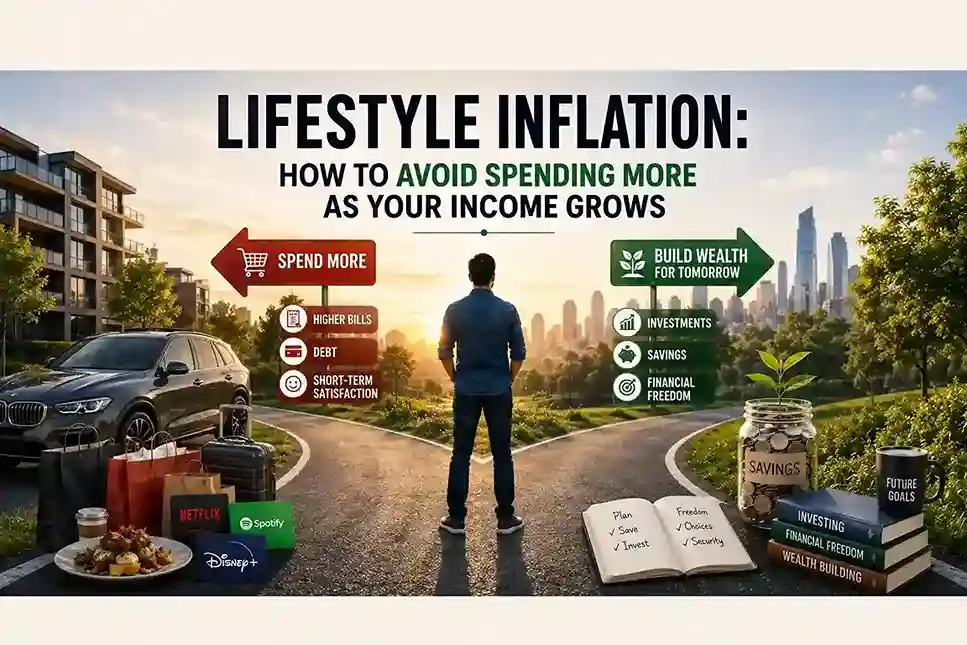
Lifestyle Inflation: How to Avoid Spending More as Your Income Grows
Lifestyle Inflation: How to Avoid Spending More as Your Income Grows
Getting a raise should feel like a financial victory.
Maybe you move from $60,000 to $75,000 a year. Perhaps you receive a promotion, start earning more from your business, take on a second income stream, or finally reach a salary you have been working toward for years.
At first, the extra money feels like freedom.
Then something interesting happens.
You move into a more expensive apartment. Your car payment gets larger. You start eating out more often. A few new streaming services appear on your credit card. Weekend trips become more frequent. Suddenly, the salary that once seemed impressive doesn’t feel like enough anymore.
This is commonly called lifestyle inflation or lifestyle creep.
Lifestyle inflation isn’t necessarily about reckless spending. In many cases, it happens gradually and almost invisibly. As your income increases, your definition of what is “normal” spending can increase with it.
The result can be frustrating: you earn more but don’t feel significantly wealthier.
The good news is that you don’t have to choose between enjoying your money today and building wealth for tomorrow. The goal is to make higher income work harder for you while allowing room for the things that genuinely improve your life.
What Is Lifestyle Inflation?
Lifestyle inflation occurs when your spending rises as your income rises.
Suppose your take-home pay increases by $800 a month after a promotion.
You might think:
- $300 for a nicer apartment
- $200 for a new car payment
- $100 for restaurants
- $100 for shopping
- $100 for subscriptions and entertainment
Your entire increase has disappeared.
You are earning more, but your financial position may not have improved much.
Now imagine a different approach.
You could direct part of that additional income toward savings, debt repayment, retirement, investing, and other financial goals while using the remainder to improve your lifestyle.
That’s the difference between automatic lifestyle inflation and intentional lifestyle improvement.
Lifestyle inflation isn’t inherently bad. Earning more money can legitimately allow you to live better. You may want healthier food, a safer vehicle, a better home, more travel, or more time-saving services.
The problem is when every increase in income automatically becomes an increase in recurring expenses.
A budget can help you see the difference. The Consumer Financial Protection Bureau defines a budget as a plan for how you expect to receive and spend or save money, and recommends looking realistically at your actual spending rather than what you think you “should” be spending.
Why Does Lifestyle Inflation Happen?
Lifestyle inflation is partly a math problem, but it is also a behavior problem.
1. Your spending quickly becomes your new normal
Imagine you spent $3,000 a month when you earned $5,000.
After several years, your income rises to $8,000 and your spending rises to $6,000.
At first, $6,000 might seem extravagant. Eventually, it simply becomes your normal monthly lifestyle.
If your income reaches $10,000, you may begin thinking about what additional $2,000 can buy rather than recognizing that you already have considerably more financial flexibility.
2. Social comparison can influence spending
People naturally compare themselves with those around them.
A coworker buys a new SUV. A friend moves into a luxury apartment. Someone you follow on social media posts photos from an expensive vacation.
It can gradually create the feeling that your own lifestyle is falling behind.
But someone’s visible spending tells you almost nothing about their:
- Savings
- Debt
- Retirement accounts
- Mortgage
- Financial obligations
- Income stability
- Net worth
A lifestyle that looks wealthy isn’t necessarily a financially healthy lifestyle.
3. Raises can feel like permission to spend
After working hard for a promotion, it is natural to want to reward yourself.
There is nothing wrong with that.
The problem begins when a temporary reward becomes a permanent monthly expense.
A $500 dinner is a one-time expense.
A $500 increase in your monthly recurring bills is potentially a $6,000-a-year lifestyle commitment.
That distinction matters.
4. Higher income makes larger purchases easier to justify
When your paycheck gets bigger, expensive purchases may appear more affordable.
You may qualify for a larger car loan or mortgage, for example.
But qualifying for something isn’t the same as comfortably affording it.
The CFPB recommends examining your actual spending and budgeting for new or changed expenses before taking on major commitments.
The Hidden Cost of Lifestyle Inflation
The biggest cost of lifestyle inflation isn’t always the purchase itself.
It is what that money could have accomplished somewhere else.
Suppose your after-tax income increases by $10,000 a year.
You could spend the entire amount.
Or you could divide it among several priorities:
- Emergency savings
- High-interest debt repayment
- Retirement contributions
- Long-term investments
- A home fund
- Education
- Family goals
- Meaningful experiences
The important concept is opportunity cost.
Every dollar spent on a recurring expense is a dollar that cannot simultaneously be saved, invested, or used to reduce debt.
That doesn’t mean you should save every dollar.
It means that raises create an opportunity to make meaningful progress.
For example, someone who receives a raise might decide that 50% of the additional take-home pay goes toward financial goals and the remaining 50% can improve their lifestyle.
There is no universal percentage that works for everyone. Someone with significant high-interest debt may need a different approach from someone who has no debt and substantial savings.
The important part is having a plan before the extra money gets absorbed into everyday spending.
Signs That Lifestyle Inflation Is Happening
You may be experiencing lifestyle inflation if several of these statements sound familiar:
- Your income has increased, but your savings haven’t.
- Every raise seems to disappear.
- You regularly spend most or all of your paycheck.
- You upgraded your car soon after receiving a raise.
- Your housing costs increased whenever your income increased.
- You have accumulated subscriptions you rarely use.
- Restaurant and delivery spending has steadily increased.
- Bonuses disappear into purchases rather than financial goals.
- You feel that your old lifestyle is no longer “good enough.”
- You don’t know exactly where your additional income is going.
- Your financial goals keep getting postponed.
- You earn considerably more than you did several years ago but still feel financially stressed.
One particularly useful question is:
If my income stopped increasing tomorrow, could I comfortably maintain my current lifestyle?
If the answer is no, your fixed expenses may have grown faster than your financial flexibility.
Lifestyle Inflation vs. Lifestyle Improvement
It is important not to turn this topic into an argument for living as cheaply as possible.
Higher income should improve your life.
The question is whether the improvement is intentional.
A lifestyle upgrade may be worthwhile if it gives you genuine value.
For example:
- A safer vehicle may reduce stress.
- Better-quality food may support your priorities.
- A more suitable home may improve family life.
- Professional education may improve your earning potential.
- Paying for convenience may give you more time.
- Travel may create meaningful experiences.
- A hobby may contribute significantly to your quality of life.
On the other hand, some purchases may primarily exist because your income increased.
Ask yourself:
“Would I still want this if nobody knew I owned it?”
That question can reveal whether a purchase is about genuine value or social comparison.
The goal isn’t to reject a better lifestyle.
It’s to choose your upgrades instead of allowing every upgrade to choose you.
What Should You Do When You Get a Raise?
A raise is one of the best opportunities to fight lifestyle inflation because you can make decisions before the new money becomes part of your routine.
Step 1: Calculate your real increase
Don’t look only at your new salary.
Consider your actual increase in take-home pay after taxes, retirement contributions, insurance, and other payroll deductions.
For example, suppose a promotion eventually gives you an additional $600 a month in take-home pay.
Don’t immediately ask:
“What can I buy for $600?”
Ask:
“What should this $600 accomplish?”
That small change in thinking can dramatically alter your financial trajectory.
Step 2: Give the raise a job
Before the first larger paycheck arrives, decide where the additional money will go.
For example:
| Use | Monthly Amount |
| Retirement/investing | $250 |
| Emergency fund or debt | $150 |
| Lifestyle improvement | $150 |
| Fun/flexible spending | $50 |
| Total | $600 |
These numbers are simply an example—not a government-recommended formula.
Your allocation should reflect your own debt, savings, income stability, family responsibilities, and goals.
Step 3: Automate the important part
Don’t depend entirely on willpower.
The CFPB recommends making saving part of your routine, including automatic transfers, and notes that even relatively small amounts can help build emergency savings.
If your employer’s retirement plan allows you to increase your contribution through payroll, that can also be a convenient way to direct part of a raise toward retirement before the money reaches your checking account.
Use the “Save First, Upgrade Later” Rule
A useful approach to lifestyle inflation is:
Increase your financial progress before increasing your fixed lifestyle costs.
Consider this sequence when your income rises:
- Review your emergency savings.
- Address high-interest debt.
- Review your workplace retirement contributions.
- Take advantage of an available employer retirement match according to your plan’s rules.
- Increase long-term savings or investing.
- Fund important short- and medium-term goals.
- Use some remaining income for lifestyle improvements.
The Department of Labor recommends that workers understand their workplace retirement plans and, when an employer offers matching contributions, determine how much they need to contribute to receive the full match.
For 2026, the IRS says the basic employee contribution limit for most 401(k), 403(b), governmental 457 plans and the federal Thrift Savings Plan is $24,500. The IRA contribution limit is $7,500, subject to the applicable rules and eligibility requirements.
These limits aren’t targets everyone must reach. They simply illustrate that a higher income can create additional opportunities to save within tax-advantaged accounts when you are eligible.
Watch the Biggest Lifestyle Inflation Traps
Some categories deserve special attention because they can create large recurring expenses.
1. Cars
A higher salary doesn’t automatically require a more expensive vehicle.
Remember that the cost of a car isn’t just the monthly payment.
Consider:
- Purchase price
- Financing
- Insurance
- Fuel
- Maintenance
- Registration
- Taxes
- Depreciation
A $400 increase in your monthly vehicle cost is not just $400. It is $4,800 every year before considering related costs.
2. Housing
Housing can be one of the most powerful forms of lifestyle inflation.
You receive a promotion and decide that your new salary means you should move into a much more expensive home.
The danger is that housing can increase several expenses simultaneously:
- Mortgage or rent
- Property taxes
- Insurance
- Utilities
- Maintenance
- Furnishing
- Repairs
The CFPB specifically recommends budgeting for the full range of housing costs rather than looking only at the basic mortgage payment.
3. Dining and delivery
Eating out occasionally isn’t the problem.
The problem is when convenience becomes a default.
If restaurant and delivery spending increases every time your income rises, your raise can disappear without creating much lasting value.
4. Subscriptions
Subscriptions are particularly easy to overlook because each individual charge may seem small.
Review:
- Streaming services
- Apps
- Gym memberships
- Software
- Cloud storage
- Gaming services
- Premium memberships
Cancel anything you aren’t actually using.
5. Vacations
A higher income can make more expensive vacations possible.
That’s perfectly reasonable if travel is important to you.
But consider whether every vacation needs to become more expensive simply because you can afford it.
6. Shopping
Higher income can make impulse purchases easier to justify.
Instead of asking:
“Can I afford this?”
also ask:
“Does this deserve a place in my financial plan?”
Create a Lifestyle Upgrade Budget
One of the easiest ways to make lifestyle inflation manageable is to deliberately allow some of it.
You don’t have to tell yourself:
“I can never spend more.”
Instead, create a lifestyle upgrade budget.
For example, whenever your take-home pay increases, you might decide:
- 50% goes toward financial goals
- 30% can improve your lifestyle
- 20% remains flexible
Again, these percentages are examples, not universal rules.
The CFPB teaches the 50/30/20 budgeting framework as one possible budgeting rule—50% for needs, 30% for wants and 20% for savings goals—but explicitly notes that people should develop guidelines that work for their own financial situation.
Your own raise rule could be more aggressive if you have major financial goals.
For example:
“For every raise, I will direct at least half of the additional take-home pay toward savings, investing, or debt repayment.”
The advantage is psychological as well as financial.
You still get to enjoy your success.
You simply don’t allow your entire raise to become a permanent obligation.
Build a Lifestyle You Actually Value
One of the best ways to avoid lifestyle inflation is to understand what you actually value.
Take a piece of paper and answer:
What expenses genuinely improve my life?
Maybe your answers are:
- Traveling with family
- Eating healthy food
- Living closer to work
- Having a comfortable home
- Fitness
- Hobbies
- Education
- More free time
Now ask:
What am I spending money on mostly because other people do?
You might discover:
- An expensive car you don’t really care about
- Clothing you rarely wear
- Restaurants you visit for status
- Subscriptions you don’t use
- A larger home than you need
This exercise can help you redirect money from low-value spending toward high-value spending.
The objective isn’t simply to spend less.
It is to get more value from the money you spend.
Automate Your Financial Progress
Automation is one of the most practical defenses against lifestyle inflation.
If additional money remains in your checking account, it can easily become spending money.
Instead, automatically direct money toward your priorities.
Depending on your circumstances, that might include:
- Emergency savings
- 401(k)
- IRA
- Debt payments
- Home savings
- Education savings
- Other long-term investments
The IRS confirms that workplace retirement plans allow employees to make contributions subject to annual limits, while employers may also make matching or other contributions according to the plan’s terms.
The Department of Labor also encourages workers to understand their retirement plans and take advantage of available employer contributions when appropriate.
Automation changes the question from:
“Will I remember to save this month?”
to:
“How much should I automatically direct toward my goals?”
That is a much easier problem to solve.
Don’t Forget to Enjoy Your Money
There is another mistake worth avoiding: becoming so focused on preventing lifestyle inflation that you never allow yourself to enjoy your financial progress.
Money is not only about retirement.
You may want to:
- Take a vacation
- Eat at a favorite restaurant
- Buy something you’ve wanted
- Spend more time with family
- Pursue a hobby
- Improve your home
- Reduce stress through convenience
Those things can have real value.
The goal is not to keep your lifestyle frozen forever.
Instead, create a balance where your financial security grows alongside your lifestyle.
A financially healthy raise might mean you save more, invest more, pay off debt faster, and also enjoy some additional spending.
That’s very different from spending the entire raise automatically.
A Simple 30-Day Plan to Stop Lifestyle Inflation
If you believe lifestyle creep has already taken hold, don’t try to overhaul everything overnight.
Use a four-week reset.
Week 1: Track everything
Review at least one month of bank and credit-card activity.
The CFPB recommends reviewing actual spending and looking for expenses that may be missing from a budget, including irregular expenses.
Look specifically for:
- Recurring subscriptions
- Restaurant spending
- Shopping
- Delivery
- Transportation
- Entertainment
- New expenses added after a raise
Don’t judge yourself.
Just collect the facts.
Week 2: Identify your priorities
Choose your most important financial goals.
For example:
Goal 1: Build emergency savings
Goal 2: Pay down credit-card debt
Goal 3: Increase retirement contributions
Goal 4: Save for a home
Goal 5: Fund meaningful travel
Your priorities will determine where additional income should go.
The CFPB notes that emergency savings can help households handle unexpected expenses such as repairs, medical bills, or income loss without immediately turning to debt.
Week 3: Automate
Set up automatic transfers or payroll contributions for the goals you selected.
Make the important financial decision once instead of repeatedly relying on motivation.
Week 4: Create your personal raise rule
Write down a rule you can use whenever your income increases.
For example:
“Whenever my take-home income increases, at least 50% of the increase will go toward financial goals before I increase recurring lifestyle expenses.”
Your rule may be 25%, 50%, 70%, or another amount.
The important thing is consistency.
Frequently Asked Questions About Lifestyle Inflation
What is lifestyle inflation?
Lifestyle inflation is the tendency for spending to increase as income increases. It can happen gradually after raises, promotions, bonuses, business growth, or other increases in earnings.
Is lifestyle inflation always bad?
No. Increasing spending can be completely reasonable when it reflects your priorities and fits within your financial plan. The problem is uncontrolled or automatic increases that prevent you from making progress toward important goals.
How can I avoid lifestyle inflation after getting a raise?
Decide where the additional income will go before you receive it. Consider increasing savings, retirement contributions, debt payments, or other financial goals first, then use part of the remaining money for lifestyle improvements.
How much of my raise should I save?
There is no single percentage that is appropriate for everyone. Your ideal amount depends on your debt, emergency savings, retirement progress, income stability, family obligations, and goals.
A simple starting point is to choose a percentage of your additional take-home pay that will automatically go toward financial goals.
Should I never buy a more expensive car or home?
Not necessarily. The question is whether the purchase fits comfortably into your broader financial plan.
A higher income may justify better housing or transportation. Just consider the total cost rather than focusing only on the monthly payment.
How do I stop lifestyle creep?
Start by tracking your spending, identifying recurring expenses, setting financial priorities, automating savings and retirement contributions, and creating a personal rule for how you will handle future raises.
Final Thoughts: Let Your Income Grow Faster Than Your Lifestyle
A higher income can change your life—but only if you give the additional money a purpose.
The biggest mistake is assuming that every raise should immediately produce a larger house, newer car, more expensive vacations, and more monthly subscriptions.
Instead, think of higher income as an opportunity to build financial flexibility.
You can use additional money to:
- Strengthen your emergency savings
- Pay down expensive debt
- Increase retirement contributions
- Invest for long-term goals
- Save for major purchases
- Support your family
- Enjoy meaningful experiences
- Improve the parts of your life that matter most
You don’t have to reject every lifestyle upgrade.
You simply need to stop making them automatically.
The next time your income increases, don’t ask only:
“What can I afford now?”
Ask a better question:
“What can this extra income help me build?”
That mindset can turn a raise from a temporary increase in spending power into a long-term increase in financial freedom.
Read more related articles on finance
Disclaimer
This article is provided for general informational and educational purposes only and does not constitute financial, investment, tax, legal, or retirement advice. Everyone’s financial situation, goals, income, risk tolerance, and circumstances are different. Before making financial decisions, including investing, choosing retirement accounts, purchasing insurance, or taking on or paying off debt, consider consulting a qualified financial, tax, or legal professional. Investment values can rise or fall, and past performance does not guarantee future results. Always verify current rules, limits, fees, and tax requirements with official sources and qualified professionals.
