
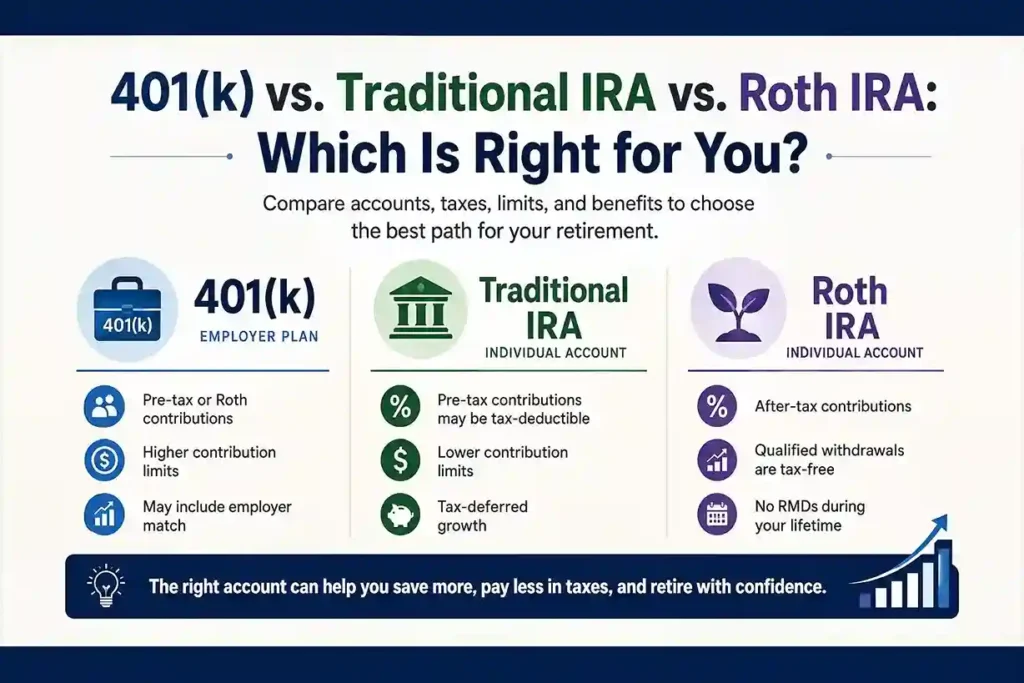
401(k) vs. Traditional IRA vs. Roth IRA: Which Is Right for You?
401(k) vs. Traditional IRA vs. Roth IRA: Which Is Right for You?
Saving for retirement sounds simple until you start looking at the different account options available in the United States.
Should you contribute to your employer’s 401(k)? Would a Traditional IRA give you a better tax advantage? Or should you choose a Roth IRA and pay taxes now in exchange for potentially tax-free qualified withdrawals later?
The truth is that there is no single retirement account that is best for everyone.
A 401(k), Traditional IRA, and Roth IRA each have different rules, tax advantages, contribution limits, and withdrawal requirements. Your income, tax situation, employer benefits, age, investment preferences, and expectations about retirement can all influence which option makes the most sense.
For 2026, the IRS allows employees to contribute up to $24,500 in elective deferrals to most 401(k) plans. The combined annual contribution limit for Traditional and Roth IRAs is $7,500, or $8,600 for people age 50 or older, assuming they have enough taxable compensation.
So which account should you choose?
In many cases, the best answer isn’t “one or the other.” A combination of retirement accounts may provide greater flexibility and tax diversification.
Let’s break down how each account works and how to make a smarter choice.
What Is a 401(k)?
A 401(k) is an employer-sponsored retirement plan that allows eligible employees to save money through their workplace.
Instead of opening the account entirely on your own, you typically enroll through your employer. Contributions are commonly made through payroll deductions, making it relatively easy to automate retirement savings.
A traditional 401(k) generally allows employees to make contributions before federal income taxes are applied to those contributions. The money can then grow within the account on a tax-deferred basis. Taxes generally become due when taxable money is withdrawn.
Some employers also offer a Roth 401(k), which works differently. Roth 401(k) contributions are made with after-tax dollars, and qualified distributions can generally be excluded from income.
Why a 401(k) can be valuable
One of the biggest advantages of a workplace 401(k) is the possibility of an employer match.
For example, suppose your employer says it will match a portion of your contributions. By contributing enough to receive the full available match, you may receive additional employer money toward your retirement.
The exact matching formula varies by employer, so you should read your plan documents rather than assuming that every 401(k) works the same way.
Another advantage is the relatively high contribution limit.
For 2026, employees can generally contribute up to $24,500 to a 401(k), subject to the applicable rules and plan limitations.
Workers age 50 and older may generally make an additional $8,000 catch-up contribution in 2026 if their plan permits it.
There is also a higher catch-up contribution for employees who are age 60, 61, 62, or 63 during the year. For 2026, that higher catch-up limit is $11,250.
Potential disadvantages of a 401(k)
A 401(k) isn’t automatically perfect.
Your employer determines the plan’s available investment menu, and some plans may have fewer investment choices or higher fees than an IRA at a brokerage firm.
Plan rules can also vary considerably.
That’s why you shouldn’t judge a 401(k) solely by its name. Look at:
- Employer matching
- Investment choices
- Expense ratios
- Administrative fees
- Vesting rules
- Roth availability
- Withdrawal options
- Loan provisions
- Overall plan quality
A good 401(k) can be an excellent retirement tool. A poorly designed or expensive plan deserves more scrutiny.
What Is a Traditional IRA?
A Traditional IRA is an individual retirement account that you establish independently rather than through your employer.
The IRS describes a Traditional IRA as a tax-advantaged personal savings plan. Contributions may be fully or partially deductible depending on factors such as income and filing status, while investment earnings generally aren’t taxed until distributed.
That creates a simple tax concept:
Potential tax deduction today → taxes generally paid when money is withdrawn later
This can be particularly useful for someone who wants to reduce taxable income today and is eligible for the deduction.
However, the deduction isn’t automatically available to everyone.
If you or your spouse is covered by a retirement plan at work, your ability to deduct a Traditional IRA contribution can be limited or eliminated depending on your income and filing status.
2026 Traditional IRA deduction phase-outs
For 2026, the IRS lists the following phase-out ranges when the taxpayer making the contribution is covered by a workplace retirement plan:
- Single taxpayers: $81,000 to $91,000
- Married filing jointly: $129,000 to $149,000 when the contributor is covered by a workplace plan
- Married filing jointly when the contributor isn’t covered but the spouse is: $242,000 to $252,000
- Married filing separately: $0 to $10,000 when covered by a workplace retirement plan
These are phase-out ranges, not simple “eligible/not eligible” income cutoffs.
If neither you nor your spouse is covered by a workplace retirement plan, the deduction phase-outs described above generally don’t apply.
Advantages of a Traditional IRA
A Traditional IRA can offer:
- Potential tax deductions
- Tax-deferred investment growth
- A broad range of investment choices
- An account that isn’t tied to a particular employer
You can generally establish an IRA at a bank, financial institution, mutual fund company, or brokerage firm.
Potential disadvantages
The main drawback is that the tax deduction may not be available to you.
Another important consideration is retirement taxation.
Generally, taxable distributions from a Traditional IRA are included in income. In addition, Traditional IRAs are subject to required minimum distribution rules.
What Is a Roth IRA?
A Roth IRA takes almost the opposite approach to a Traditional IRA.
With a Roth IRA, contributions are made with money that has already been taxed. You generally don’t receive an upfront federal income-tax deduction for making a Roth IRA contribution.
In return, qualified withdrawals can generally be tax-free.
The IRS states that Roth IRA contributions aren’t deductible and that qualified distributions aren’t included in income.
Think of the basic difference this way:
Traditional IRA: Potential tax benefit now, taxes generally later.
Roth IRA: Taxes generally paid now, potentially tax-free qualified withdrawals later.
Why people like Roth IRAs
The biggest attraction is future tax-free treatment of qualified withdrawals.
Generally, a Roth IRA distribution is qualified when the five-year requirement is satisfied and the distribution occurs after age 59½, because of disability, after the owner’s death, or for certain qualified first-time homebuyer expenses subject to the applicable rules.
Another important advantage is that the original owner of a Roth IRA isn’t required to take lifetime RMDs.
That can make Roth money particularly useful as a source of tax-free retirement income and estate-planning flexibility.
Roth IRA income limits
There is an important catch: direct Roth IRA contributions are subject to income limits.
For 2026, the phase-out range is:
- $153,000 to $168,000 for single taxpayers and heads of household
- $242,000 to $252,000 for married couples filing jointly
- $0 to $10,000 for married individuals filing separately who meet the applicable conditions
These are phase-out ranges. Your ability to contribute directly can depend on your modified adjusted gross income and filing status.
Also remember that the IRA contribution limit applies collectively to your Traditional and Roth IRAs.
401(k) vs. Traditional IRA vs. Roth IRA
Here’s the big-picture comparison:
| Feature | Traditional 401(k) | Traditional IRA | Roth IRA |
| Employer-sponsored | Yes | No | No |
| Contributions | Generally pre-tax | May be deductible | After-tax |
| Upfront tax deduction | Generally yes | May be available | No |
| Qualified withdrawals | Generally taxable | Generally taxable | Generally tax-free |
| Employer match | Possible | No | No |
| Investment choices | Plan-dependent | Generally broad | Generally broad |
| 2026 basic contribution limit | $24,500 | $7,500 combined IRA limit | $7,500 combined IRA limit |
| Catch-up age 50+ | Generally $8,000 | $1,100 | $1,100 |
| Lifetime RMD for original owner | Generally yes | Yes | No |
The 2026 limits are based on current IRS guidance. The $7,500 IRA limit is a combined limit across Traditional and Roth IRAs, not $7,500 for each account.
The Most Important Difference: When Do You Pay Taxes?
If you understand the tax timing, much of the retirement-account comparison becomes easier.
Traditional accounts: tax advantage now
With a traditional 401(k), contributions are generally made before federal income tax, reducing taxable income for the year in which the contribution is made.
With a Traditional IRA, you may receive a deduction if you qualify.
But eventually, taxable withdrawals generally become part of your income.
This approach can make sense when you value a tax break today.
For example, someone in a relatively high tax bracket today who expects a lower taxable income in retirement might find traditional contributions attractive.
That isn’t guaranteed, however. Your future tax situation is impossible to know with certainty.
Roth accounts: tax advantage later
Roth contributions don’t generally provide an upfront federal income-tax deduction.
Instead, you pay taxes before contributing.
If the requirements for qualified distributions are met, the money can potentially come out tax-free.
That can be extremely valuable after decades of investment growth.
Imagine you contribute money to a Roth account and it grows substantially over many years. If the eventual distribution is qualified, the investment growth isn’t generally included in federal taxable income.
That’s one reason Roth accounts can be powerful for long-term retirement planning.
2026 Contribution Limits You Should Know
For anyone planning retirement contributions in 2026, these numbers are important.
401(k)
The 2026 employee elective deferral limit is:
$24,500
For participants age 50 or older, the general catch-up amount is:
$8,000
For eligible participants who are 60 through 63 during 2026, the higher catch-up amount is:
$11,250
That means an eligible employee age 60–63 could generally contribute up to $35,750 through elective deferrals in 2026, assuming the plan permits the applicable catch-up contribution.
The IRS also has separate overall contribution limits that include employer contributions. For 2026, the annual additions limit is generally the lesser of 100% of compensation or $72,000, with special higher amounts when catch-up contributions are included.
Traditional IRA and Roth IRA
For 2026, the combined contribution limit is:
$7,500
For people age 50 or older:
$8,600
That $8,600 consists of the $7,500 regular limit plus a $1,100 catch-up contribution.
Importantly, if you contribute $5,000 to a Traditional IRA, you generally have only $2,500 remaining under the annual IRA limit for contributions to a Roth IRA, assuming you otherwise qualify.
Should You Choose a 401(k) or Roth IRA First?
This is one of the most common questions—and there isn’t a universal answer.
But there is a practical framework.
Step 1: Check your employer match
If your employer offers a matching contribution, find out exactly how it works.
For example, your employer might match a percentage of your contributions up to a certain percentage of your salary.
If you aren’t contributing enough to receive the full available match, increasing your contribution may deserve serious consideration.
The exact match and vesting rules are plan-specific, so check your Summary Plan Description.
Step 2: Look at your 401(k)’s quality
Don’t assume an employer plan is good simply because it is a 401(k).
Check:
- Fees
- Investment options
- Target-date funds
- Index funds
- Administrative costs
- Employer match
- Roth 401(k) availability
If the plan offers low-cost investment choices and a valuable match, it may be very attractive.
Step 3: Consider a Roth IRA
If you’re eligible for direct Roth IRA contributions, the account can provide another tax bucket and potentially tax-free qualified withdrawals.
A Roth IRA can also provide more investment flexibility than many employer plans.
Step 4: Continue building retirement savings
After capturing an employer match, some savers may choose to use an IRA for additional retirement savings and investment flexibility.
Others may prefer to increase their 401(k) contributions.
The right choice depends on your tax situation, plan quality, investment choices, and long-term goals.
401(k) vs. Traditional IRA: Which Is Better?
Neither is automatically better.
A 401(k) often has the advantage when:
- Your employer provides matching contributions
- You want to save more than the IRA annual limit
- You prefer automatic payroll deductions
- Your workplace plan offers good investment choices and reasonable fees
A Traditional IRA may be attractive when:
- You qualify for a tax deduction
- You want more investment choices
- Your employer plan has expensive investment options
- You want an additional retirement account outside your workplace
You don’t necessarily have to choose only one.
A person can potentially contribute to both a 401(k) and an IRA, subject to the applicable rules.
Traditional IRA vs. Roth IRA: Which Is Better?
This comparison is primarily about tax timing.
A Traditional IRA can be attractive if you want a potential tax deduction today.
A Roth IRA can be attractive if you prefer to pay taxes now and potentially receive tax-free qualified distributions later.
Consider two hypothetical workers.
Worker A
Alex is earning a high income today and expects retirement income to be considerably lower.
Alex may place significant value on reducing taxable income today and could find traditional contributions attractive if eligible for the deduction.
Worker B
Jordan is early in a career and currently has a relatively modest income but expects earnings to increase significantly over time.
Jordan may value paying taxes at today’s rates and building a pool of potentially tax-free qualified retirement income through a Roth IRA.
Neither strategy is automatically superior.
The key is understanding your current tax position and making a reasonable judgment about your future.
Roth IRA vs. Roth 401(k): Don’t Confuse Them
The names are similar, but these are different accounts.
A Roth IRA is an individual account.
A Roth 401(k) is a designated Roth account inside an employer’s 401(k) plan.
Both use after-tax contributions and can provide tax-free qualified distributions.
However, their contribution rules are different.
A Roth 401(k) is subject to the 401(k) elective deferral limit, while a Roth IRA is subject to the much lower IRA limit and Roth IRA income eligibility rules.
For 2026, the employee 401(k) elective deferral limit is $24,500, while the combined Traditional/Roth IRA limit is $7,500.
This means a person could potentially save substantially more through a workplace Roth 401(k) than through a Roth IRA.
At the same time, the Roth IRA may offer broader investment choices depending on the financial institution you use. Explore more
What Happens When You Retire?
The account type becomes particularly important when you begin taking money out.
Traditional IRA
Traditional IRA distributions are generally taxable to the extent they represent taxable amounts.
Traditional IRAs are also generally subject to required minimum distributions beginning at age 73 under current law.
Traditional 401(k)
Traditional 401(k) distributions are generally taxable.
RMD rules generally apply beginning at age 73, although a workplace plan may allow a participant who continues working to delay RMDs until retirement, subject to the rules and exceptions. A 5% owner generally doesn’t receive that same “still working” delay.
Roth IRA
The original owner of a Roth IRA doesn’t have to take lifetime RMDs under current rules.
Qualified withdrawals are generally tax-free.
Roth 401(k)
Designated Roth accounts in 401(k) plans also no longer require lifetime RMDs for the original account owner under the SECURE 2.0 changes.
This distinction can become very important when creating a retirement-income strategy.
Don’t Ignore Investment Fees
Here’s something many retirement savers overlook:
The account isn’t the investment.
A 401(k), Traditional IRA, or Roth IRA is essentially a tax-advantaged account that holds investments.
The actual investments could include:
- Stock funds
- Bond funds
- Target-date funds
- Index funds
- Money market investments
- Other options permitted by the plan or account provider
Two people could have identical 401(k) balances but very different investment portfolios.
Likewise, having a Roth IRA doesn’t guarantee better investment results.
Your long-term outcome depends on factors including:
- How much you contribute
- How long you invest
- Investment performance
- Fees and expenses
- Asset allocation
- Diversification
- Whether you stay invested
Don’t select an account solely because of its tax label.
Common Retirement-Saving Mistakes
- Ignoring the employer match
If your employer offers a matching contribution, understand the formula and contribution requirements.
- Thinking an IRA and 401(k) have the same limits
They don’t.
The 2026 employee 401(k) contribution limit is $24,500, while the combined Traditional and Roth IRA limit is $7,500.
- Assuming every Traditional IRA contribution is deductible
Your ability to deduct a Traditional IRA contribution can depend on income, filing status, and workplace retirement-plan coverage.
- Assuming every Roth IRA contribution is allowed
Direct Roth IRA contributions are subject to income limitations.
- Forgetting that Roth doesn’t mean “always tax-free”
Qualified Roth distributions can be tax-free, but nonqualified distributions can have different tax consequences.
The five-year rules and other requirements matter.
- Choosing investments without looking at fees
A low-cost diversified investment can be very different from an expensive investment with similar objectives.
- Treating retirement savings like an emergency fund
Retirement accounts are designed for long-term savings. Taking money out early can result in taxes or additional taxes unless an exception applies.
Three Real-World Examples
These examples are simplified illustrations, not personalized financial advice.
Example 1: A young employee with an employer match
Maria is 27 and has just started working for a company that offers a 401(k) with an employer match.
A sensible starting point could be learning the match formula and contributing enough to receive the full available match, assuming the plan is otherwise appropriate.
If Maria can save more, she could then consider whether a Roth IRA or additional 401(k) contributions better fit her goals.
The important lesson isn’t “always choose a Roth IRA.”
It’s:
Don’t overlook valuable employer benefits.
Example 2: A worker who wants a current tax benefit
David is 45 and earns a substantial salary.
He wants to reduce his taxable income today and expects his retirement income to be lower.
Depending on his circumstances, traditional pre-tax retirement contributions may be attractive.
He should also consider the quality and fees of his workplace plan and whether he qualifies for a deductible Traditional IRA contribution.
Example 3: A younger worker expecting higher future income
Emma is 25 and currently has a relatively modest income.
She expects her career earnings to rise substantially.
She may appreciate the idea of paying taxes now through Roth contributions and potentially receiving qualified withdrawals tax-free in retirement.
She might use a Roth IRA if eligible, while also contributing enough to her employer’s 401(k) to capture an available match.
Again, the right decision depends on her actual tax situation and financial goals.
Which Retirement Account Is Right for You?
Here’s the simplest way to think about it.
A 401(k) may be especially attractive if:
- Your employer offers a match
- You want to save substantial amounts
- You want automatic payroll contributions
- Your plan has good investment choices and reasonable fees
A Traditional IRA may be attractive if:
- You qualify for a deduction
- You want additional retirement savings
- You want greater investment flexibility
- You value a potential tax benefit today
A Roth IRA may be attractive if:
- You are eligible to contribute directly
- You want tax-free qualified withdrawals
- You are comfortable paying taxes on contributions today
- You want additional tax diversification
- You want an account without lifetime RMDs for the original owner
A Roth 401(k) may be attractive if:
- Your employer offers it
- You want Roth tax treatment
- You want the higher 401(k) contribution capacity
- Your plan’s investment choices and fees are reasonable
A Simple Retirement Account Strategy
For many workers, the decision doesn’t have to be complicated.
Start with these questions:
- Does my employer offer a 401(k)?
If yes, learn the plan’s rules.
- Does my employer match contributions?
If yes, understand how much you need to contribute to receive the full available match.
- Are the plan’s fees and investment options reasonable?
Review the investment menu and costs.
- Am I eligible for a Roth IRA?
Check your income and filing status against the current IRS rules.
- Do I want a tax deduction now or potentially tax-free qualified withdrawals later?
This is the core Traditional-versus-Roth question.
- Am I saving enough overall?
Choosing the perfect account matters less if you’re not saving consistently.
- Do I have tax diversification?
Having retirement money in different tax categories can provide flexibility later.
The Bottom Line
There is no universal winner in the 401(k) vs. Traditional IRA vs. Roth IRA debate.
Each account solves a slightly different problem.
A 401(k) can be particularly powerful because of its higher contribution limit and potential employer matching.
A Traditional IRA can provide tax-deferred growth and, for eligible taxpayers, a potential deduction.
A Roth IRA sacrifices the upfront deduction in exchange for the possibility of tax-free qualified withdrawals and no lifetime RMDs for the original owner.
For many Americans, the smartest strategy isn’t choosing just one account. It may be combining them in a way that takes advantage of an employer match, available tax deductions, Roth opportunities, investment flexibility, and long-term tax diversification.
And remember: retirement investing is a marathon, not a race.
Consistently saving, choosing sensible investments, keeping costs under control, and staying invested over the long term can matter just as much as deciding which account name appears at the top of your statement.
Important 2026 Note
Retirement-account rules can change, and eligibility for deductions, Roth contributions, catch-up contributions, and distributions depends on individual circumstances.
The figures in this article are based on IRS guidance for tax year 2026. The IRS currently lists the 2026 401(k) employee contribution limit at $24,500, the IRA contribution limit at $7,500, and the IRA age-50-and-over catch-up contribution at $1,100.
Before making a large contribution, rollover, Roth conversion, or withdrawal decision, check the latest IRS rules and your retirement-plan documents. If your situation is complicated, consider speaking with a qualified tax or financial professional.
Disclaimer
This article is provided for general informational and educational purposes only and does not constitute financial, investment, tax, legal, or retirement advice. Everyone’s financial situation, goals, income, risk tolerance, and circumstances are different. Before making financial decisions, including investing, choosing retirement accounts, purchasing insurance, or taking on or paying off debt, consider consulting a qualified financial, tax, or legal professional. Investment values can rise or fall, and past performance does not guarantee future results. Always verify current rules, limits, fees, and tax requirements with official sources and qualified professionals.
