
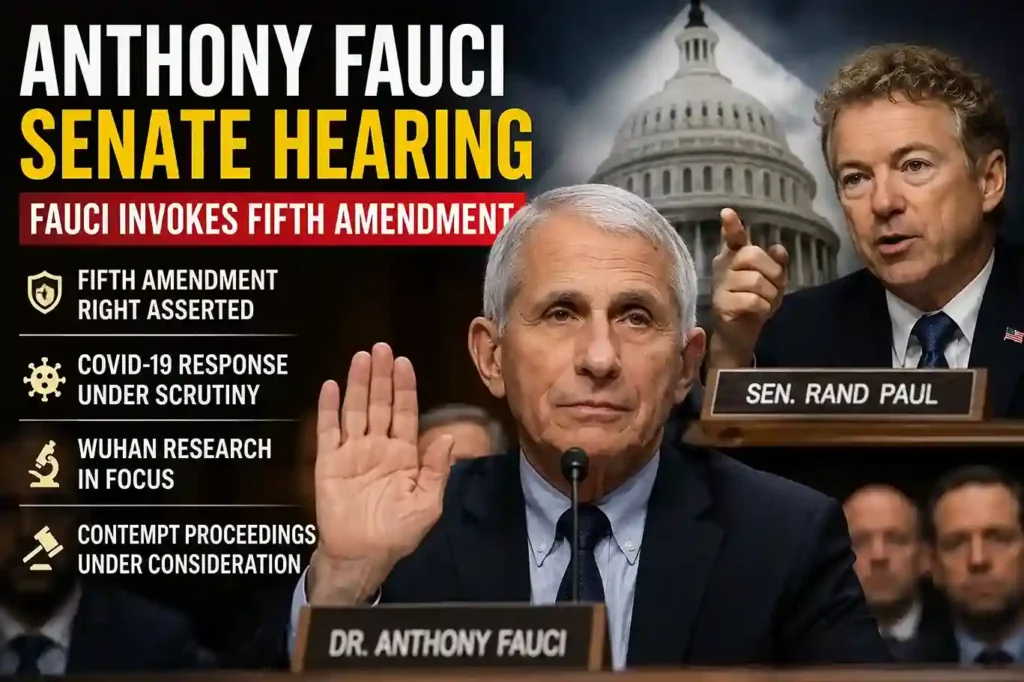
Anthony Fauci Senate Hearing
Anthony Fauci Senate Hearing
Former U.S. infectious disease expert Dr. Anthony Fauci invoked his constitutional Fifth Amendment right against self-incrimination during a closely watched U.S. Senate hearing on July 29, 2026, declining to answer questions from lawmakers investigating aspects of the federal government’s COVID-19 response.
The hearing, led by Republican Senator Rand Paul of Kentucky, centered on Fauci’s previous congressional testimony, federal funding for research connected to Wuhan, China, and broader questions surrounding the origins of COVID-19. Fauci, who retired in 2022 after leading the National Institute of Allergy and Infectious Diseases (NIAID) for nearly four decades, declined to answer more than 100 questions, arguing that the proceedings were politically motivated.
The hearing renewed a long-running national debate over pandemic policies, scientific research, and government accountability.
Quick Facts
| Topic | Details |
| Event | U.S. Senate Hearing |
| Date | July 29, 2026 |
| Main Figure | Dr. Anthony Fauci |
| Committee Chair | Senator Rand Paul |
| Main Issue | Invocation of the Fifth Amendment |
| Key Topics | COVID-19 response, Wuhan research, congressional testimony |
| Status | Senate committee considering contempt proceedings |
Anthony Fauci Senate Hearing: Why Did Anthony Fauci Invoke the Fifth Amendment?
Fauci declined to answer questions by invoking the Fifth Amendment during Anthony Fauci Senate Hearing, a constitutional protection that allows individuals to refuse testimony that could potentially be used against them in future criminal proceedings.
In a statement before the hearing, Fauci argued that the investigation was designed to create legal exposure rather than uncover new facts. He accused Senator Paul of pursuing what he described as an “obsessive” effort to prosecute him.
His legal team also criticized the hearing, calling it politically driven and maintaining that Fauci had previously testified truthfully before Congress on multiple occasions. Explore more
Anthony Fauci Senate Hearing: What Is the Fifth Amendment? |
The Fifth Amendment to the U.S. Constitution protects individuals from being forced to provide testimony that could incriminate themselves.
Legal experts note that invoking the Fifth Amendment is a constitutional right and should not, by itself, be interpreted as an admission of guilt. Witnesses may exercise this protection whenever they believe their answers could expose them to legal risk.
Rand Paul Calls for Contempt Proceedings
Senator Rand Paul sharply criticized Fauci’s decision to remain silent during the hearing.
Paul argued that a presidential pardon would not shield anyone from legal consequences if false statements were made before Congress. He announced that the Senate committee intends to vote on whether Fauci should be held in contempt for refusing to answer lawmakers’ questions.
The dispute focuses primarily on Fauci’s previous testimony regarding U.S.-funded research involving laboratories in Wuhan, China, and whether that research met the government’s definition of gain-of-function studies.
Why Has Rand Paul Criticized Fauci?
For several years, Senator Paul has questioned Fauci’s testimony regarding federal funding connected to virus research in Wuhan.
Paul argues that certain experiments supported through U.S. funding involved gain-of-function research and has accused Fauci of misleading Congress about those activities.
Fauci has repeatedly denied those allegations, stating that the research did not meet the official U.S. regulatory definition of gain-of-function research and that his congressional testimony was accurate.
Understanding Gain-of-Function Research
Gain-of-function research generally refers to laboratory studies in which pathogens are modified to better understand how they spread, evolve, or cause disease.
Supporters say such research can improve preparedness for future outbreaks by helping scientists develop vaccines and treatments.
Critics argue that these experiments require strict oversight because of potential biosafety risks if dangerous pathogens were accidentally released.
Whether specific research connected to Wuhan falls within the government’s formal definition remains a subject of continuing scientific and political debate.
COVID-19 Origins Remain Unresolved
The hearing also renewed attention on one of the pandemic’s biggest unanswered questions: where COVID-19 originated.
Different U.S. intelligence agencies continue to hold differing assessments.
Some agencies believe a laboratory-related incident is the more likely explanation, although with varying confidence levels. Others continue to assess that the virus most likely spread naturally from animals to humans.
To date, no definitive conclusion has been reached, and investigations into the pandemic’s origin continue.
Fauci’s Role During the Pandemic
Dr. Fauci became one of the most recognizable public health officials in the United States during the COVID-19 pandemic.
Throughout the global health emergency, he supported measures including:
- Mask recommendations
- Social distancing
- Temporary restrictions aimed at reducing virus transmission
- Vaccination campaigns
- Expanded scientific research and public health guidance
Public health officials around the world said these recommendations reflected the best scientific evidence available at the time as governments worked to slow the spread of a new virus before vaccines became widely available.
At the same time, many Americans criticized certain pandemic restrictions, arguing they caused economic disruption, educational setbacks, and broader social consequences. Those disagreements continue to influence political debate years later.
Pandemic Diaries Become New Focus
Ahead of the hearing, Senator Paul released more than 1,100 pages of Fauci’s pandemic-era diary covering late 2019 through 2022.
Paul argued that the documents challenge official government messaging during the pandemic.
Fauci’s representatives responded that the diary entries are consistent with his public statements and demonstrate that he remained open to multiple possibilities regarding COVID-19’s origin while emphasizing that no definitive evidence had emerged.
Much of the material reportedly documents Fauci’s meetings, interviews, media appearances, and daily activities during the pandemic.
Trump Administration Announces New Research Policy
Just one day before the hearing, the Trump administration announced a new policy restricting federal funding for research classified as “dangerous gain-of-function” studies.
Supporters say the policy strengthens biosafety oversight and reduces future risks.
Critics argue that any restrictions should carefully balance scientific innovation with national and global public health preparedness.
Timeline of Key Events
| Year | Event |
| 2019 | COVID-19 first identified |
| 2020 | Fauci becomes a leading public health voice during the pandemic |
| 2021 | Debate over Wuhan research intensifies |
| 2022 | Fauci retires after nearly four decades leading NIAID |
| 2025 | President Joe Biden issues a preemptive pardon covering certain past actions related to COVID-19 |
| 2026 | Fauci invokes the Fifth Amendment during Senate hearing |
Why This Hearing Matters
The Senate hearing extends beyond one individual.
It reflects continuing national debates over pandemic decision-making, scientific transparency, congressional oversight, public trust in health institutions, and how governments should prepare for future infectious disease outbreaks.
Regardless of political viewpoints, the discussion is likely to influence future public health policy, research funding, and oversight of high-risk biological research.
Frequently Asked Questions (FAQs)
Why did Anthony Fauci invoke the Fifth Amendment?
Fauci said he believed answering questions could expose him to legal risk and argued that the hearing was politically motivated.
What is the Fifth Amendment?
It is a constitutional protection that allows individuals to refuse testimony that could potentially incriminate themselves.
What is gain-of-function research?
It generally refers to research involving modifications to pathogens to better understand their behavior, with supporters citing scientific benefits and critics emphasizing biosafety concerns.
Has COVID-19’s origin been confirmed?
No. U.S. intelligence agencies continue to hold differing views, and no definitive conclusion has been reached.
Key Takeaways
- Dr. Anthony Fauci invoked the Fifth Amendment during a July 29, 2026, Senate hearing.
- Senator Rand Paul announced plans to pursue contempt proceedings.
- The hearing focused on COVID-19 policies, Wuhan-related research, and congressional testimony.
- Debate over gain-of-function research and the origins of COVID-19 remains unresolved.
- The hearing highlights ongoing political, scientific, and legal discussions surrounding the pandemic and future public health policy.
